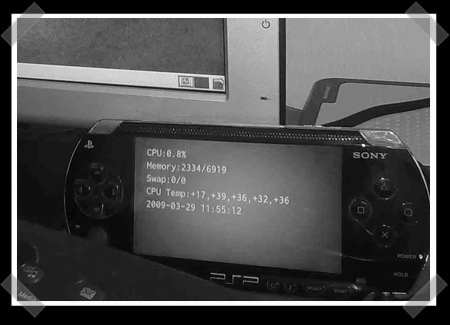
[Avi] sent in his PSP as a status monitor hack(zip). He’s using Lua on the PSP, so you have to install LuaPlayer. The computer side is written in python, so it should be cross platform. Last time we saw a psp as an extra monitor, it had more capabilities, but it was limited to Windows. You’ll find the Lua script as well as the python in the zip file. It’s a nice use for an extra psp.
Parts: Programmable Gain Amplifier (MCP6S26)

Microchip’s MCP6S21/2/6/8 are programmable gain amplifiers that multiply an input voltage by a factor of 1, 2, 4, 5, 8, 10, 16, and 32. The MCP6S22/6/8 also have selectable input channels for working with different signal sources. The multiplication factor and input channel are configured through an SPI interface. This chip is useful for multiplying a small input signal, and selecting among several analog input sources. We demonstrate the six channel MCP6S26 below.
Continue reading “Parts: Programmable Gain Amplifier (MCP6S26)”
Arduino + Wii Nunchuck + Servos
[youtube=http://www.youtube.com/watch?v=phcsDNOglLI]
[Yezzer] has posted a video of a cool little project he’s working on. He has interfaced the Arduino and the Wii Nunchuck to control some servos. He mounted a standard USB webcam on it for good measure. There isn’t a whole lot of information, but he does include a few links to code he modified for the project. The movement is quite natural looking and seems like it would be a cheap way to get some good animatronic controls started. This might actually be a great way to control a robot for the Crabfu challenge, if they ever have another one.
Update: As [dokument] points out in the comments below, it looks like we’ve seen a set up that could be almost identical in the past.
[via the Hack a Day Flickr pool]
ToorCamp Call For Papers/participation

We’ve been watching and waiting intently as ToorCamp comes together. It’s a four day hacker conference that will be held in a Washington state missile silo July 2nd-5th. While we’re excited about this debut event, its success depends entirely on those presenting. The call for papers is currently open and they’ve got a number of formats available: 20 and 50 minute talks and 1 and 2 day workshops. They’re also looking for people to organize campsites and are offering discounts for groups. We’re encouraging you to submit your talk since we’d love to see more hardware talks. You can follow @ToorCamp announcements on Twitter.
Automated Drum

A team of three PhD students constructed this ‘multi-mallet automatic drumming instrument (Madi)‘. Their Expressive Machines Musical Instruments site is dedicated to building instruments like this and they recently showed their work at the first annual Guthman Musical Instrument Competition. A ‘low-stakes X Prize’ for musical instruments. 25 applicants were chosen to show their unique musical instruments for $10K in prizes. We like the team’s Madi because it’s adapting a traditional instrument and then pushing it to the limit. It reminds us of the Crazy J mechatronic guitar from 2005. You can see a video of the Madi playing below.
Vexduino

[Jeremy] picked up a Vexplorer pretty cheap, and wanted to make it better. He decided that Arduino controls would probably be a nice upgrade. He patched into the controller and installed a nice looking plug to interface with the Arduino. He says the software was custom made as he couldn’t find suitable examples on the net. His software is available for download. We covered a picaxe controlled one in January, but it looks like that site is currently down.
The Narcisystem

The Narcisystem is part of an art display where [Eric] strapped himself to as many biometric sensors as he could. The core of the system was a Funnel IO which includes an Arduino, Xbee plug, and LiPo charging circuit. It was collecting data from a heart rate monitor, an EEG, a breathalyzer, compass, and an accelerometer. This data was sent to a laptop and then sent to different displays. You can see the setup functioning in a video after the break. The red flashes are his heart beat, the blue light is the direction he’s facing. What you can’t see is the high power bass thud every time he takes a step. The EEG data was supposed to effect the tempo of the music, but it failed and was dropped, as was the fog machine based on his blood alcohol level. He notes that he wanted to do more, but was lacking the hardware.