2021: As The Hardware World Turns

Well, that didn’t go quite as we expected, did it? Wind the clock back 365 days, and the world seemed to be breathing a collective sigh of relief after making it through 2020 in one piece. Folks started getting their COVID-19 vaccines, and in-person events started tentatively putting new dates on the calendar. After a rough year, it seemed like there was finally some light at the end of the tunnel.

Turns out, it was just a another train. New variants of everyone’s favorite acute respiratory syndrome have kept the pandemic rolling, and in many parts of the world, the last month or so has seen more new cases of the virus than at any point during 2020. This is the part of the Twilight Zone episode were we realize that not only have we not escaped the danger, we didn’t even understand the scope of it to begin with.

Case in point, the chip shortages. We can’t blame it entirely on the pandemic, but it certainly hasn’t helped matters. From video game systems to cars, production has crawled to a standstill as manufacturers fight to get their hands on integrated circuits that were once plentiful. It’s not just a problem for industry either, things have gotten so bad that there’s a good chance most of the people reading this have found themselves unable to get their hands on a part or two these last few months. If you were working on a hobby project, it’s a temporary annoyance. But for those who planned on finally bringing their latest big idea to market, we’ve heard tales of heartbreaking delays and costly redesigns.

It would be easy to look at the last twelve months and see nothing but disappointment, but that’s hardly the attitude you want to have at the beginning of the year. So let’s take the high road, and look back on some of the highlights from 2021 as we turn a hopeful eye towards the future.

Continue reading “2021: As The Hardware World Turns”

New Cars Will Nickel-and-Dime You – It’s Automotive As A Service

Every few years, someone pushing a startup to investors comes up with an acronym or buzzword which rapidly becomes the new hotness in those circles. One of the most pernicious is “as a Service,” which takes regular things and finds a way to charge you a regular fee to use them.

Automotive companies just absolutely loved the sound of this, and the industry is rapidly moving to implement subscription services across the board. Even if there’s hardware in your car for a given feature, you might find you now need to pay a monthly fee to use it. Let’s explore how this came about, and talk about which cars are affected. You might be surprised to find yours already on the list.
Continue reading “New Cars Will Nickel-and-Dime You – It’s Automotive As A Service”

The Label Says HDMI 2.1 But That Doesn’t Mean You’ll Get It

Technology moves quickly these days as consumers continue to demand more data and more pixels. We see regular updates to standards for USB and RAM continually coming down the pipeline as the quest for greater performance goes on.

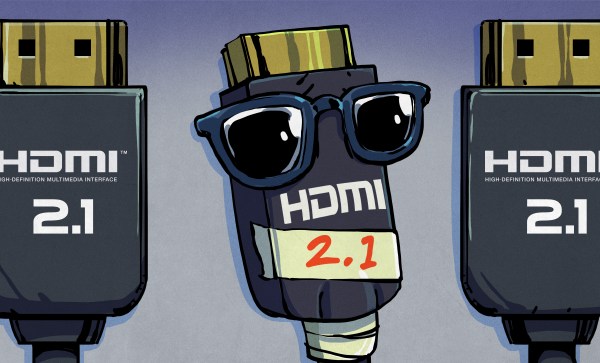
HDMI 2.1 is the latest version of the popular audio-visual interface, and promises a raft of new features and greater performance than preceding versions of the standard. As it turns out, though, buying a new monitor or TV with an HDMI 2.1 logo on the box doesn’t mean you’ll get any of those new features, as discovered by TFT Central.

Continue reading “The Label Says HDMI 2.1 But That Doesn’t Mean You’ll Get It”

Is Cloud Seeding Good, Bad, Or Ugly?

The Chinese Communist Party celebrated its centenary on the 1st of July, 2021. For such a celebration, clear skies and clean air would be ideal. For the capable nation-state, however, one needn’t hope against the whims of the weather. One can simply control it instead!

A recent paper released by Tsinghua University indicated that China had used cloud seeding in order to help create nicer conditions for its 100-year celebration. Weather modification techniques have been the source of some controversy, so let’s explore how they work and precisely what it was that China pulled off.

Continue reading “Is Cloud Seeding Good, Bad, Or Ugly?”

PinePhone Malware Surprises Users, Raises Questions

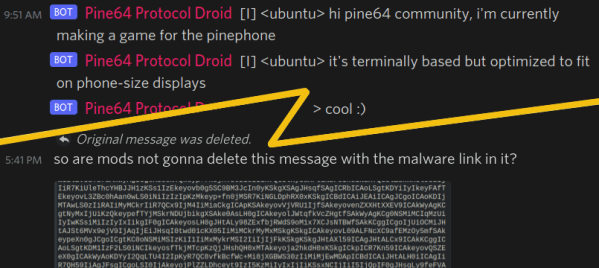
On December 5th, someone by the IRC nickname of [ubuntu] joined the Pine64 Discord’s #pinephone channel through an IRC bridge. In the spirit of December gift-giving traditions, they have presented their fellow PinePhone users with an offering – a “Snake” game. What [ubuntu] supposedly designed had the potential to become a stock, out-of-the-box-installed application with a small but dedicated community of fans, modders and speedrunners.

Unfortunately, that would not be the alternate universe we live in, and all was not well with the package being shared along with a cheerful “hei gaiz I make snake gaem here is link www2-pinephnoe-games-com-tz replace dash with dot kthxbai”  announcement. Shockingly, it was a trojan! Beneath layers of Base64 and Bashfuscator we’d encounter shell code that could be in the “example usage” section of a modern-day thesaurus entry for the word “yeet“.

Continue reading “PinePhone Malware Surprises Users, Raises Questions”

Could India Be The Crucial Battleground For Open Access To Scientific Research?

One of the hottest topics in the world of scientific publishing over the last couple of decades has been the growing pressure to release the fruits of public-funded scientific research from the paywalled clutches of commercial publishers. This week comes news of a new front in this ongoing battle, as a group of Indian researchers have filed an intervention application with the help of the Indian Internet Freedom Foundation in a case that involves the publishers Elsevier, Wiley, and the American Chemical Society who have filed a copyright infringement suit against in the Delhi High Court against the LibGen & Sci-Hub shadow library websites.

The researchers all come from the field of social sciences, and they hope to halt moves to block the websites by demonstrating their importance to research in India in the light of unsustainable pricing for Indian researchers. Furthermore they intend to demonstrate a right of access for researchers and teachers under Indian law, thus undermining the legal standing of the original claim.

We’re not qualified to pass comment on matters of Indian law here at Hackaday, but we feel this will be a case worth watching for anyone worldwide with an interest in open access to research papers. If it can be established that open access shadow libraries can be legal in a country the size of India, then it may bring to an end the somewhat absurd game of legal whack-a-mole that has raged over the last decade between the sites on their untouchable Russian servers and heavy-handed academic publishers who perhaps haven’t moved on from their paper publishing past. It’s time for a fresh start with the way academic publishing works, and maybe this will provide the impetus for that to happen.

For those wondering what the fuss is about, we’ve looked at the issue in the past.

Indian flag image: © Yann Forget / Wikimedia Commons / CC-BY-SA.

Spacing Out: Telescopes, Politics, And Spacecraft Design

Let’s launch into a round-up of stories that are out of this world, as we take a look at what’s happening in the realm of space exploration.

Ten Billion Dollars For A Telescope? Don’t Drop It!

Perhaps the most highly anticipated space mission of the moment is the James Webb Space Telescope, an infra-red telescope that will be placed in an orbit around the Earth-Sun L2 Lagrange point from which it will serve as the successor to the now long-in-the-tooth Hubble telescope. After many years of development the craft has been assembled and shipped to French Guiana for a scheduled Ariane 5 launch on the 22nd of December. We can only imagine what must have gone through the minds of the engineers and technicians working on the telescope when an unplanned release of a clamp band securing it to the launch vehicle adapter sent a vibration throughout the craft. Given the fragility of some of its components this could have jeopardised the mission, however after inspection it was found that no damage had occurred and that space-watchers and astronomers alike can breathe easy.

Continue reading “Spacing Out: Telescopes, Politics, And Spacecraft Design”