A Real Time Data Compression Technique

With more and more embedded systems being connected, sending state information from one machine to another has become more common. However, sending large packets of data around on the network can be bad both for bandwidth consumption and for power usage. Sure, if you are talking between two PCs connected with a gigabit LAN and powered from the wall, just shoot that 100 Kbyte packet across the network 10 times a second. But if you want to be more efficient, you may find this trick useful.

As a thought experiment, I’m going to posit a system that has a database of state information that has 1,000 items in it. It looks like an array of RECORDs:

typedef struct
{
  short topic;
  int data;
} RECORD;

It doesn’t really matter what the topics and the data are. It doesn’t really matter if your state information looks like this at all, really. This is just an example. Given that it is state information, we are going to make an important assumption, though. Most of the data doesn’t change frequently. What most and frequently mean could be debated, of course. But the idea is that if I’m sending data every half second or whatever, that a large amount isn’t going to change between one send and the next.

Continue reading “A Real Time Data Compression Technique”

Hackaday Links Column Banner

Hackaday Links: June 24, 2018

What do you do if you’re laying out a PCB, and you need to jump over a trace, but don’t want to use a via? The usual trick is using a zero Ohm resistor to make a bridge over a PCB trace. Zero Ohm resistors — otherwise known as ‘wire’ — are a handy tool for PCB designers who have backed themselves into a corner and don’t mind putting another reel on the pick and place machine. Here’s a new product from Keystone that is basically wire on a tape and reel. It’s designed to jump traces on a PCB where SMD zero ohm resistors and through-hole jumpers aren’t possible. I suppose you could also use it as a test point. They’re designed for high current applications, but before we get to that, let’s consider how much power is dissipated into a zero ohm resistor.

By the way, as of this writing, Mouser is showing 1,595 for Keystone’s 5100TR PCB jumpers in stock. They come on a reel of 1,000, and a full reel will cost you $280. This is significantly more expensive than any SMD zero ohm resistor, and it means someone bought four hundred of them. The electronic components industry is weird and you will never understand it.

There’s a new product from ODROID, and you want it. The ODROID-GO is a Game Boy and Sega Master System emulator running on an ESP-32, has a fantastic injection molded case, and looks phenomenal.  You can buy it now for $32. Does this sound familiar? Yes, a few months ago, the PocketSprite was released. The PocketSprite is the tiniest Game Boy ever, and a project [Sprite_TM] introduced to the world at the 2016 Hackaday Superconference.

This week, the speaker schedules for two awesome cons were announced. The first is HOPE, at the Hotel Penn on July 20th. Highlights of this year? [Mitch Altman] is talking about DSP, [Chelsea Manning] will be on stage, someone is talking about HAARP (have fun with the conspiracy theorists), and someone is presenting an argument that [Snowden] is an ideological turd. The speaker schedule for DEF CON was also announced. The main takeaway: god bless the CFP board for reigning in all the blockchain talks, the Nintendo Switch was broken wide open this year, but there’s only a talk on the 3DS, and there’s more than enough talks on election hacking, even though that was a success of propaganda instead of balaclava-wearing hackers.

The C.H.I.P. is no more, or at least that’s the rumor we’re running with until we get some official confirmation. When it was introduced, the C.H.I.P. was a Linux system on a chip with complete register documentation. It appears the end of C.H.I.P. is upon us, but have no fear: there’s a community building the PocketC.H.I.P., or the C.H.I.PBeagle. It’s a single board computer based around the OSD3358 from Octavo, the same system found in the PocketBeagle. Source in KiCAD, and people are working on it. Thanks [smerrett79] for the tip.

VCF East XIII: Another Day In Retro Paradise

While the weather alternated between mist and monsoon for most of it, the thirteenth annual Vintage Computer Festival East was still a huge success. People came from all over the country, and indeed the world, to show off computers and equipment that was easily older than many of those in attendance. From 1980’s robots to recreations of the very first machines to ever carry the name “computer” as we understand it today, there were a dizzying array of fascinating exhibits to see for those who made the pilgrimage to the InfoAge Science Center in Wall, New Jersey. The people who own and maintain these technological touchstones were in many cases were just as interesting as the hardware they brought to show off; walking encyclopedias of knowledge about the particular piece of vintage gear that they’ve so lovingly shepherded into the modern day.

Through it all, save for a brief intermission to get chili dogs from the nearest WindMill, Hackaday was there. We got up close and personal with [Brian Stuart]’s impressive ENIAC emulator, listened to some ethereal chiptunes courtesy of [Bill Degnan]’s MITS Altair 8800, saw relics from the days when the “app store” needed stamps from [Allan Bushman]’s impressive colleciton, and got inspired by the [Alexander Pierson]’s somewhat more modern take on the classic kit computers of the 1970’s.

But those were’t the only things on display at the Vintage Computer Festival, not by a long shot. There were over 100 individual exhibits this year at VCF, and that doesn’t even include the workshops, classes, tours, or the daily keynote presentations. To say you get your money’s worth on the ticket is something of an understatement.

It’s fair to say that there’s no real substitute for seeing a show like this in person. But in addition to the aforementioned articles, a rundown (in no particular order) of some of the interesting exhibits and attractions from this year’s VCF is a decent consolation prize. If this piques your interest, we’d invite you to keep an eye out for the next Vintage Computer Festival. We’ll be there.

Continue reading “VCF East XIII: Another Day In Retro Paradise”

Analog Discovery 2 As A Vector Network Analyzer

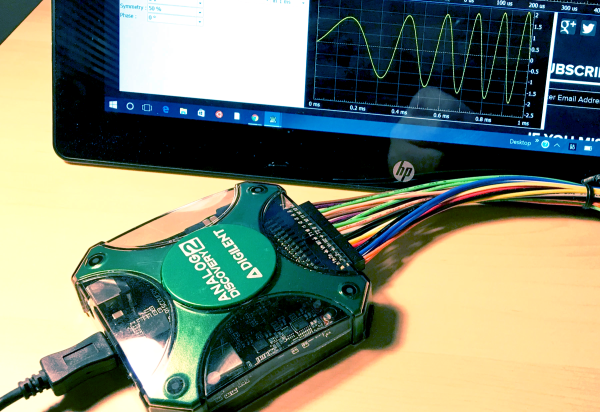
A while back, I posted a review of the Analog Discovery 2, which is one of those USB “do everything” instruments. You might recall I generally liked it, although I wasn’t crazy about the price and the fact that the BNC connectors were an extra item. However, in that same post, I mentioned I’d look at the device’s capabilities as a network analyzer (NA) sometime in the future. The future, as they say, is now.

What’s an NA?

In its simplest form, there’s not much to an NA. You sweep a frequency generator across some range of frequencies. You feed that into some component or network of components and then you measure the power you get out compared to the power you put in. Fancy instruments can do some other measurements, but that’s really the heart of it.

The output is usually in two parts. You see a scope-like graph that has the frequency as the X-axis and some sort of magnitude as the Y-axis. Often the magnitude will be the ratio of the output power to the input power as a decibel. In addition, another scope-like output will show the phase shift through the network (Y-axis) vs frequency (X-axis). The Discovery 2 has these outputs and you can add custom displays, too.

Why do you care? An NA can help you understand tuned circuits, antennas, or anything else that has a frequency response, even an active filter or the feedback network of an oscillator. Could you do the same measurements manually? Of course you could. But taking hundreds of measurements per octave would be tedious and error-prone.

Continue reading “Analog Discovery 2 As A Vector Network Analyzer”

Friday Hack Chat: Ladyada On Creative And Interactive Robotics

Somewhere at the intersection of microcontrollers, open source toolchains, the Maker Movement, and the march of technology, there’s a fuzzy concept that can best be described as robotics or physical computing. Instead of a computer in a box or a dumb microcontroller, these projects interact with the outside world. Whether that’s through the Internet, tapping a bunch of sensors, or just waving the arm of a servo around, there’s a need for a platform that actually does all of this stuff. For this week’s Hack Chat, we’re going to be talking all about creative and interactive robots, and you’re invited.

Our guest for this week’s Hack Chat will be Limor “Ladyada” Fried, the founder of Adafruit, and someone who needs no introduction but we’re going to do it anyway. Adafruit began as a weird side project selling exact reproductions of the Roland TB-303, building cell phone jammers, and making guides to build your own USB power bank before USB power banks were a thing. This has grown into Adafruit, a company with over 100 employees in the heart of New York City, one of the best places for learning and making electronics, and a place that does everything Open Source with zero loans or VC money. By any objective measure, Adafruit has become the most successful business story to come out of the Maker Movement, however nebulously that can be defined.

This week the Hack Chat will be focused on the CRICKIT, the Creative Robotics and Interactive Construction Kit. The CRICKIT is an add-on to Adafruit’s Circuit Playground that allows you to build your own robot with CircuitPython, MakeCode, or just Arduino. There’s support for arts, crafts, sensors, audio, animatronics, physical computing, kinetic sculptures, science experiments, and just about anything else you can think of. Need an example? Here’s Blue Öyster Cult. Here’s that robot that came with the NES. It’s all great fun.

You are, of course, encouraged to add your own questions to the discussion. You can do that by leaving a comment on the Hack Chat Event Page and we’ll put that in the queue for the Hack Chat discussion.join-hack-chat

Our Hack Chats are live community events on the Hackaday.io Hack Chat group messaging. This week is just like any other, and we’ll be gathering ’round our video terminals at noon, Pacific, on Friday, June 22nd.  Here’s a clock counting down the time until the Hack Chat starts.

Click that speech bubble to the right, and you’ll be taken directly to the Hack Chat group on Hackaday.io.

You don’t have to wait until Friday; join whenever you want and you can see what the community is talking about.


What Is Our Martian Quarantine Protocol?

If you somehow haven’t read or watched War of the Worlds, here’s a spoiler alert. The Martians are brought down by the common cold. You can argue if alien biology would be susceptible to human pathogens, but if they were, it wouldn’t be surprising if aliens had little defense against our bugs. The worrisome part of that is the reverse. Could an astronaut or a space probe bring back something that would ravage the Earth with some disease? This is not science fiction, it is both a historically serious question and one we’ll face in the near future. If we send people to Mars are they going to come back with something harmful?

A Bit of News: Methane Gas Fluctuations on Mars

What got me thinking about this was the mounting evidence that there could be life on Mars. Not a little green man with a death ray, but perhaps microbe-like life forms. In a recent press release, NASA revealed that they not only found old organic material in rocks, but they also found that methane gas is present on Mars and the amount varies based on the season with more methane occurring in the summer months. There’s some dispute about possible inorganic reasons for this, but it is at least possible that the variation is due to increased biological activity during the summer.

Continue reading “What Is Our Martian Quarantine Protocol?”

Hackaday Links Column Banner

Hackaday Links: June 17, 2018

Do you like badges? Of course you like badges. It’s conference season, and that means it’s also badge season. Well good news, Tindie now has a ‘badge’ category. Right now, it’s loaded up with creepy Krustys, hypnotoads, and fat Pikas. There’s also an amazing @Spacehuhn chicken from [Dave]. Which reminds me: we need to talk about a thing, Spacehuhn.

On the list of ‘weird emails we get in the tip line’ comes Rat Grease. Rat Grease is the solution to rodents chewing up cabling and wires. From what we can gather, it’s a mineral oil-based gel loaded up with capsaicin; it’s not a poison, and not a glue. Rats are our friends, though, which makes me want to suggest this as a marinade, or at the very least a condiment. The flash point is sufficiently high that you might be able to use this in a fryer.

[Matthias Wandel] is the guy who can build anything with a table saw, including table saws. He posts his stuff online and does YouTube videos. A while back, he was approached by DeWalt to feature their tools in a few videos. He got a few hand tools, a battery-powered table saw, and made some videos. The Internet then went insane and [Matthias] lost money on the entire deal. Part of the reason for this is that his viewers stopped buying plans simply because he featured yellow power tools in his videos. This is dumpster elitism, and possibly the worst aspect of the DIY/engineering/maker community.

Elon Musk is the greatest inventor ever. No scratch that. The greatest person ever. Need more proof? The CEO of Tesla, SpaceX, and our hearts has been given the green light to build a high-speed underground train from Chicago O’Hare to downtown. Here’s the kicker: he’s going to do it for only $1 Billion, or $55 Million per mile, making it the least expensive subway project by an order of magnitude. Yes, Subways usually cost anywhere between $500 to $900 Million per mile. How is he doing it? Luck, skill, and concentrated power of will. Elon is the greatest human ever, and we’re not just saying that to align ourselves with an audience that is easy to manipulate; we’re also saying this because Elon has a foggy idea for a ‘media vetting wiki’.

There are rumors Qualcomm will acquire NXP for $44 Billion. This deal has been years in the making, with reports of an acquisition dating back to 2016. Of course, that time, the deal was set to go through but was apparently put on hold by Chinese regulators. Now it’s the same story again; there were recent rumors of Qualcomm buying NXP, and the story was later changed to rumors. We’re waiting for an actual press release on this one. It’s just another long chapter in the continuing story of, ‘where the hell are all the Motorola app notes and data sheets?’