
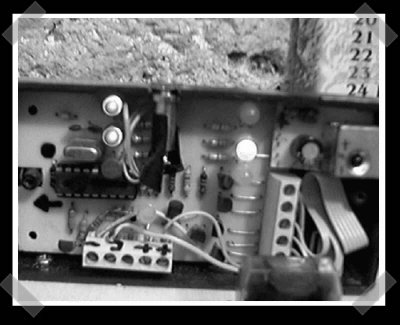
If you’re thinking of building some DIY home automation, this looks like an interesting idea. At the heart is a PIC16F84 that decodes IR signals and controls six outputs – in this case, relays to activate various appliances. The PIC is dirt cheap – if you get a deal on some relays you should be able to build a small local IR HA system for $30… This might be just the thing for my office. It’s cheap enough that it probably wouldn’t walk off.
classic hacks2816 Articles
How-To: Binary Clock Using A Freeduino SB 2.1
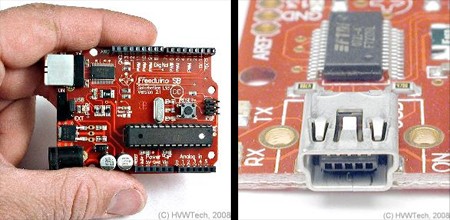
Solarbotics recently released its own version of the Arduino microcontroller development board. They based their board on the Freeduino design. We thought this would be a good opportunity to review the new board as well as present a How-To about building a simple binary clock. Along the way we’ll cover some basics on attaching LEDs and switches to a microcontroller.
Continue reading “How-To: Binary Clock Using A Freeduino SB 2.1”
CRT Blinkenlights
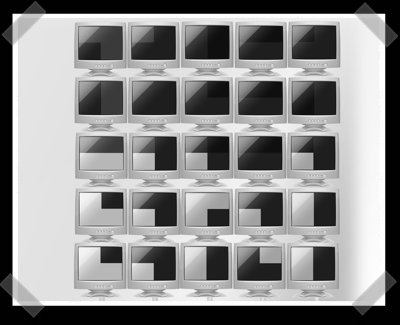
[Julien] sent in his group’s twist on the now classic blinkenlights project. Oddly, the writeup is entirely in jpg form, so I can’t know if he’s finished it yet. One of them promised to send it in during our New uses for old CRT monitors HackIt, so it’s nice to hear something about it. While the classic blinkenlights uses building windows as pixels, this version divides CRT displays into four squares.
Soft Start Your Flashlight For Longer Bulb Life
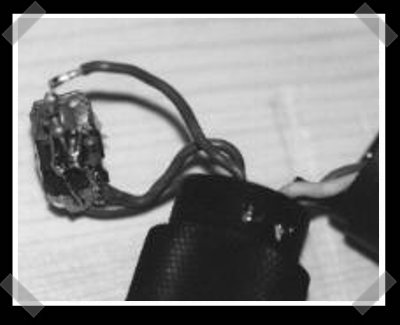
[Reinhard] has a great collection of DIY SCUBA projects. One interesting hack he put together is a soft start circuit to improve the life of the bulb in a flashlight. Despite LEDs getting cheaper, MR16 halogens are dirt cheap and put out some serious lumens.
DIY Slingbox
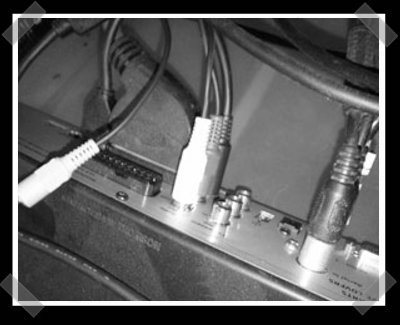
[David] took some interesting steps to put together his own Slingbox-ish setup. He used a Mac mini running Quicktime Broadcaster to capture the stream from a Firewire video camera which his cable/satellite receiver is plugged into. You’ll have to use an OS X machine, but that’s not too difficult these days. Broadcaster is about the simplest way to capture from Firewire and stream. We’re using it in our own office to multicast the signal from a Canadian satellite box.
CNC Milling Gun Parts
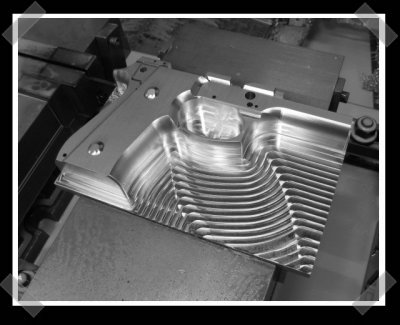
Gun issues aside, [Justin]’s been CNC milling his own gun parts for quite a while. We’ve been a fan of his work simply because of the technical challenge that this sort of milling presents. Even if you’re anti-gun, you should check out the work he’s been turning out. Pictured is one of his early projects: a 92fs Beretta frame in the process of being milled from a solid block of aluminum. Our friend the gun nut is insanely jealous of his AR45 lower project.
DIY Ballistic Glass
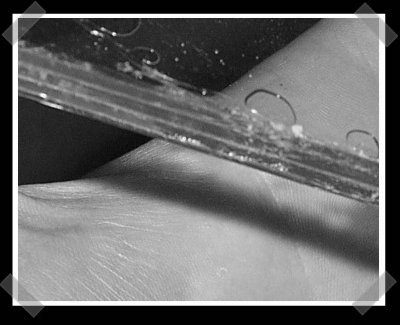
[Glenn] hasn’t put up action shots, but he did write up how he made his own “Bulletproof” glass. The idea is simple: make a composite sandwich of Acrylic and Polycarbonate plastic. Automotive grade uses a combination of glass and Polycarbonate. Great, now we’ve got one more thing on my list of stuff to shoot.









