New Contest: Train All The Things

The old way was to write clever code that could handle every possible outcome. But what if you don’t know exactly what your inputs will look like, or just need a faster route to the final results? The answer is Machine Learning, and we want you to give it a try during the Train All the Things contest!

It’s hard to find a more buzz-worthy term than Artificial Intelligence. Right now, where the rubber hits the road in AI is Machine Learning and it’s never been so easy to get your feet wet in this realm.

From an 8-bit microcontroller to common single-board computers, you can do cool things like object recognition or color classification quite easily. Grab a beefier processor, dedicated ASIC, or lean heavily into the power of the cloud and you can do much more, like facial identification and gesture recognition. But the sky’s the limit. A big part of this contest is that we want everyone to get inspired by what you manage to pull off.

Yes, We Do Want to See Your ML “Hello World” Too!

Wait, wait, come back here. Have we already scared you off? Don’t read AI or ML and assume it’s not for you. We’ve included a category for “Artificial Intelligence Blinky” — your first attempt at doing something cool.

Need something simple to get you excited? How about Machine Learning on an ATtiny85 to sort Skittles candy by color? That uses just one color sensor for a quick and easy way to harvest data that forms a training set. But you could also climb up the ladder just a bit and make yourself a camera-based LEGO sorter or using an IMU in a magic wand to detect which spell you’re casting. Need more scientific inspiration? We’re hoping someday someone will build a training set that classifies microscope shots of micrometeorites. But we’d be equally excited with projects that tackle robot locomotion, natural language, and all the other wild ideas you can come up with.

Our guess is you don’t really need prizes to get excited about this one… most people have been itching for a reason to try out machine learning for quite some time. But we do have $100 Tindie gift certificates for the most interesting entry in each of the four contest categories: ML on the edge, ML on the gateway, AI blinky, and ML in the cloud.

Get started on your entry. The Train All The Things contest is sponsored by Digi-Key and runs until April 7th.


New Contest: Tell Time

Clocks. You love ’em, we certainly love ’em. So you hardly need a reason to take on a new clock build, but it makes it much sweeter when you know there’s a horde of people waiting to fawn over your creation. Hackaday’s Tell Time Contest is a celebration of interesting timepieces. Show off a clever way to mark the passage of time and gain the adoration of your peers, and maybe even score a prize!

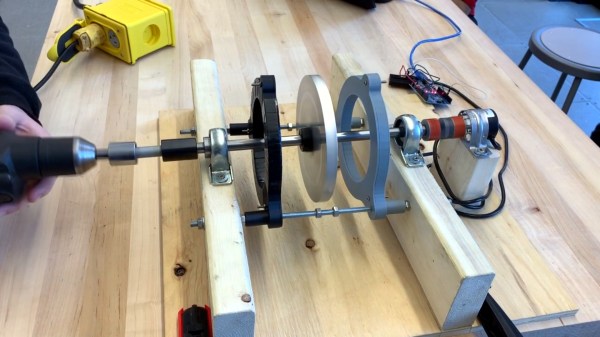
The Rotating Moon Clock is an interesting take on a timepiece

From now until January 24th, you can enter your Hackaday.io project by using the “Submit project to…” menu on the left sidebar of your project page. There is only one main constraint: it needs to somehow represent time. Microseconds or millennia, minutes until the next bus arrival or centuries until Pluto completes its next orbit, we don’t care as long as you find it interesting.

Document your timepiece with pictures, a description, and all of the technical details. Three outstanding entries will each receive a $100 cash prize, based on craftsmanship, function, and creativity.

Tick-tock… don’t delay. Time’s slipping away to have your quirky clock immortalized on Hackaday.

FieldKit Is The Grand Prize Winner Of The 2019 Hackaday Prize

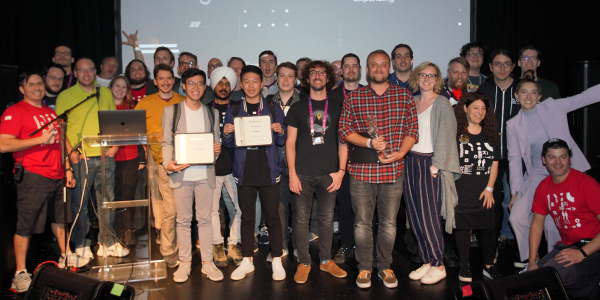
FieldKit, an open-source, modular sensor system for conducting research in harsh environments has just been named the Grand Prize winner of the 2019 Hackaday Prize. The award for claiming the top place and title of “Best Product” in this nine-month global engineering initiative is $125,000. Five other top winners and five honorable mentions were also named during this evening’s Hackaday Prize Ceremony, held during the Hackaday Superconference in Pasadena, California.

This year’s Hackaday Prize focused on product development. From one good idea and a working prototype, entrants were encouraged to iterate on their UX, industrial design, ergonomics, software, and mechanical plans as they worked toward a product that is both manufacturable and meets the needs of the user it has been designed for. Out of twenty finalists, the top eleven are covered below. Over $200,000 in cash prizes have been distributed as part of this year’s initiative where thousands of hardware hackers, makers, and artists compete to build a better future. Continue reading “FieldKit Is The Grand Prize Winner Of The 2019 Hackaday Prize”

The Dyson Awards Definitely Do Not Suck

Named after British inventor James Dyson of cyclonic vacuum cleaner fame, the Dyson Awards are presented annually to current and recent students of engineering, industrial design, and product design, regardless of age. Students from 27 countries work alone or in groups to describe their inventions, which are then judged for their inventiveness, the production feasibility of their design, and the overall strength of the entry itself.

Much like our own Hackaday Prize, the Dyson Awards encourage and highlight innovation in all areas of science and technology. Some ideas help the suffering individual, and others seek to cure the big problems that affect everyone, like the microplastics choking the oceans. The Hackaday spirit is alive and well in these entries and we spotted at least one Hackaday prize alum — [Amitabh]’s Programmable Air. I had fun browsing through everything on offer, and you will too. This is a pretty good source of design inspiration.

Continue reading “The Dyson Awards Definitely Do Not Suck”

Announcing The “Take Flight With Feather” Contest

The Adafruit Feather is the latest platform for microcontroller development, and companies like Particle, Sparkfun, Seeed Studios, and of course Adafruit are producing Feather-compatible devices for development and prototyping. Now it’s your turn! The Take Flight With Feather contest challenges you to design a board to fit in the Feather ecosystem, with the grand prize of having your boards manufactured for you and listed for sale on Digi-Key.

To get started, take a look at the current Feather ecosystem and get acquainted with this list of examples. From there, get to work designing a cool, useful, insane, or practical Feather. But keep in mind that we’re looking for manufacturability. Electron savant Lady Ada will be judging each board on the basis of manufacturability.

What’s a good design? We’re looking for submissions in the following categories:

  • The Weirdest Feather — What’s the most ridiculous expansion board you can come up with?
  • You’ll Cut Yourself On That Edge — We’re surrounded with bleeding-edge tech, what’s the coolest use of new technology?
  • Retro Feather — Old tech lives on, but can you design a Feather to interact with it? Is it even possible to build a vampire Ethernet tap or an old acoustically-coupled modem?
  • Assistive Tech — Build a Feather to help others. Use technology to improve lives.
  • Wireless Feather — Add a new wireless technology to the Feather ecosystem

In addition to the grand prize winner, five other entries (one in each of the 5 categories above) will receive $100 Tindie gift certificates. The contest begins now and runs through December 31st. To get started, start a project on Hackaday.io and use the “Submit Project To” dropdown box on the left sidebar of your project page to enter it in the contest.

Hackaday Prize China Finalists Announced

In the time since the Hackaday Prize was first run it has nurtured an astonishing array of projects from around the world, and brought to the fore some truly exceptional winners that have demonstrated world-changing possibilities. This year it has been extended to a new frontier with the launch of the Hackaday Prize China (Chinese language, here’s a Google Translate link), allowing engineers, makers, and inventors from that country to join the fun. We’re pleased to announce the finalists, from which a winner will be announced in Shenzhen, China on November 23rd. If you’re in Shenzen area, you’re invited to attend the award ceremony!

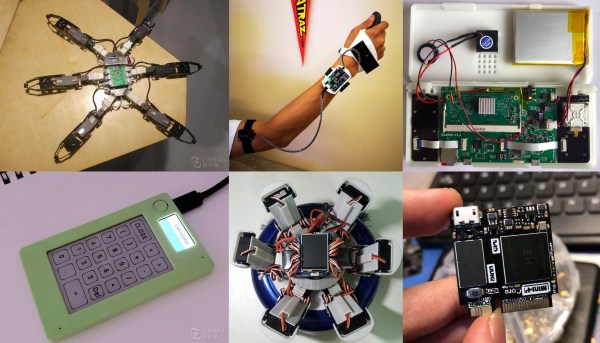
All six of these final project entries have been translated into English to help share information about projects across the language barrier. On the left sidebar of each project page you can find a link back to the original Chinese language project entry. Each presents a fascinating look into what people in our global community can produce when they live at the source of the component supply chain. Among them are a healthy cross-section of projects which we’ll visit in no particular order. Let’s dig in and see what these are all about!

Continue reading “Hackaday Prize China Finalists Announced”

Connected World Contest: Four Top Winners Announced

We love seeing the astonishing array of projects large and small entered into Hackaday contests which push the boundaries of what is possible. Our latest has been the Connected World contest which was announced back in June, and today we’re pleased to bring you its four top winners. As a recap, the brief was to create something that connects wirelessly and shows a blend of creativity and functionality. The final four have a diverse range of applications, and here they are with their respective categories:

Continue reading “Connected World Contest: Four Top Winners Announced”