My son approached me the other day with his best 17-year-old sales pitch: “Dad, I need a bucket of cash!” Given that I was elbow deep in suds doing the dishes he neglected to do the night before, I mentioned that it was a singularly bad time for him to ask for anything.
Never one to be dissuaded, he plunged ahead with the reason for the funding request. He had stumbled upon a series of YouTube videos about paramotoring, and it was love at first sight for him. He waxed eloquent about how cool it would be to strap a big fan to his back and soar with the birds on a nylon parasail wing. It was actually a pretty good pitch, complete with an exposition on the father-son bonding opportunities paramotoring presented. He kind of reminded me of the twelve-year-old version of myself trying to convince my dad to spend $600 on something called a “TRS-80” that I’d surely perish if I didn’t get.
Needless to say, the $2500 he needed for the opportunity to break his neck was not forthcoming. But what happened the next day kind of blew my mind. As I was reviewing my YouTube feed, there among the [Abom79] and [AvE] videos I normally find in my “Recommended” queue was a video about – paramotoring. Now how did that get there?
How do you consume your music, these days? Aside from on the radio, that is. Do you play MP3 or other files on your phone and computer, or perhaps do you stream from an online service? If you’re really at the cutting edge though you’ll do none of those things, because you’ll be playing it on vinyl.
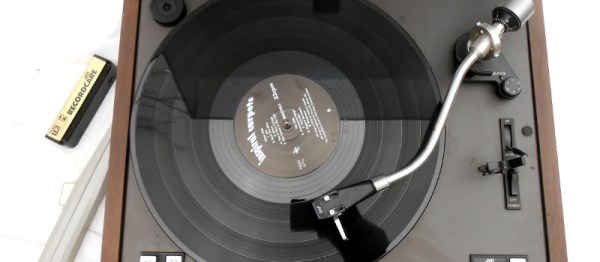
The legendary Technics SL1200 direct-drive turntable, as used by countless DJs. Photo by Dydric CC-BY-SA 2.5A few years ago reporting on a resurgence of sales of vinyl records was something you would never have expected to see, but consumer tastes are unpredictable. Our red-trousered and extravagantly bearded hipster friends have rediscovered the glories of the format, and as a result it’s popping up everywhere. For those of us who are old enough to have genuinely been into the format before it was cool again, the sight of Sergeant Pepper and Led Zeppelin II on 12″ at outrageous prices on a stand at the local supermarket is a source of amusement. It’s good to see your first love back in vogue again, but is it really the £20($25) per album kind of good?
With the turntable having disappeared as an integral part of the typical hi-fi setup the new vinyl enthusiast is faced with a poor choice of equipment. Often the best available without spending serious money at an audiophile store is a USB device with the cheapest possible manufacture, from which the playback will be mediocre at best. We’ve lost the body of collective knowledge about what makes a good turntable to almost thirty years of CDs and MP3s, so perhaps it’s time for a quick primer.
It’s impossible to know when society began to manicure its front lawns. Truth be told — cutting the grass was, and still is a necessity. But keeping the weeds at bay, trimming, edging and so forth is not. Having a nice lawn has become a status symbol of modern suburbia all across the globe. When the aliens arrive, one of the first things they will surely notice is how nice our front lawns are. This feature of our civilization could have only been made possible with the advent of specialized grass-cutting machines.
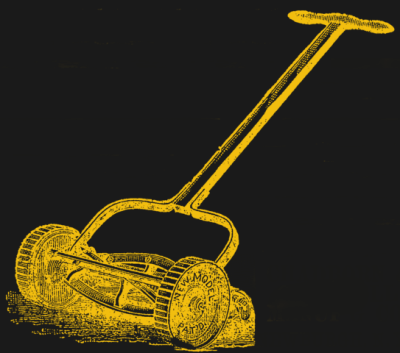
Reel Mower [Public Domain]It could be argued that the very first lawnmowers were live stock. The problem was they were quite high maintenance devices and tended to provide a very uneven cut, which did not bode well for families striving for the nicest front lawn on the dirt road. Coupled with the foul odor of their byproducts, the animals became quite unpopular and were gradually moved out of site into the back yards. Other solutions were sought to maintain the prestigious front yard.
The first mechanical lawnmower was invented in 1830 by a man named Edwin Budding, no doubt in an effort to one-up his neighbor, who still employed a Scythe. Budding’s mower looked much like today’s classic reel mowers, where a rotating cylinder houses the blades and rotates as the mower is pushed forward. Budding was granted a patent for his device by England, much to the dismay of his fellow neighbors — most of whom were forced to buy Budding’s mower due to the fact that everyone else in the neighborhood bought one, even though they weren’t actually needed.
By the early 1930’s, the cold war started by Budding and his neighbor had spread to almost every front yard on earth, with no end in sight. Fast forward to the modern era and the lawn and garden market did 10 billion in sales in 2014 alone. Technological advances have given rise to highly advanced grass-munching machines. For smaller yards, most use push mowers powered by a single cylinder IC engine. Many come with cloth bags to collect the clippings, even though everyone secretly hates using them because they gradually fill and make the mower heavier and therefore more difficult to push. But our neighbors use them, so we have to too. Larger yards require expensive riding mowers, many of which boast hydrostatic transmissions, which owners eagerly brag about at neighborhood get-togethers, even though they haven’t the slightest clue of what it actually is.
Us hackers are no different. We have front lawns just like everyone else. But unlike everyone else (including our neighbors) we have soldering irons. And we know how to use them. I propose we take a shot-across-the-bow and disrupt the neighborhood lawn war the same way Budding did 85 years ago. So break out your favorite microcontroller and let’s get to work!
My phone can now understand me but it’s still an idiot when it comes to understanding what I want. We have both the hardware capacity and the software capacity to solve this right now. What we lack is the social capacity.
We are currently in a dumb state of personal automation. I have Google Now enabled on my phone. Every single month Google Now reminds me of bills coming due that I have already paid. It doesn’t see me pay them, it just sees the email I received and the due date. A creature of habit, I pay my bills on the last day of the month even though that may be weeks early. This is the easiest thing in the world for a computer to learn. But it’s an open loop system and so no learning can happen.
Earlier this month [Cameron Coward] wrote an outstanding pair or articles on AI research that helped shed some light on this problem. The correct term for this level of personal automation is “weak AI”. What I want is Artificial General Intelligence (AGI) on a personal level. But that’s not going to happen, and I am the problem. Here’s why.
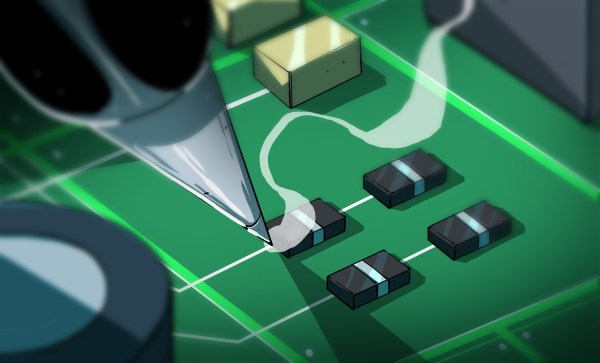
I’ve been soldering for a long time, and I take pride in my abilities. I won’t say that I’m the best solder-slinger around, but I’m pretty good at this essential shop skill — at least for through-hole and “traditional” soldering; I haven’t had much practice at SMD stuff yet. I’m confident that I could make a good, strong, stable joint that’s both electrically and mechanically sound in just about any kind of wire or conductor.
But like some many of us, I learned soldering as a practical skill; put solder and iron together, observe results, repeat the stuff that works and avoid the stuff that doesn’t. Seems like adding a little inside information might help me improve my skills, so I set about learning what’s going on mechanically and chemically inside a solder joint.
3D printers are the single best example of what Open Hardware can be. They’re useful for prototyping, building jigs for other tools, and Lulzbot has proven desktop 3D printers can be used in industrial production. We endorse 3D printing as a viable tool as a matter of course around here, but that doesn’t mean we think every house should have a 3D printer.
Back when Bre was on Colbert and manufacturing was the next thing to be ‘disrupted’, the value proposition of 3D printing was this: everyone would want a 3D printer at home because you could print plastic trinkets. Look, a low-poly Bulbasaur. I made a T-rex skull. The front page of /r/3Dprinting. Needless to say, the average consumer doesn’t need to spend hundreds of dollars to make their own plastic baubles when WalMart and Target exist.
The value proposition of a 3D printer is an open question, but now there is some evidence a 3D printer provides a return on its investment. In a paper published this week, [Joshua Pearce] and an undergraduate at Michigan Tech found a 3D printer pays for itself within six months and can see an almost 1,000% return on investment within five years. Read on as I investigate this dubious claim.
I had a friend who was an engineer for a small TV station. I visited him at work once, and despite the fact that he wouldn’t let me climb the 1,200′ antenna tower, I had a great time. I was working for a video production studio at the time, so there was a fair amount in common about our jobs. One of the regular chores we faced was cleaning the heads on tape machines. He had a 5-gallon pail of cleaning solution under his bench that he told me was Freon, which he swore by for head cleaning and general contact cleaning. He gave me some for my shop in a little jar.
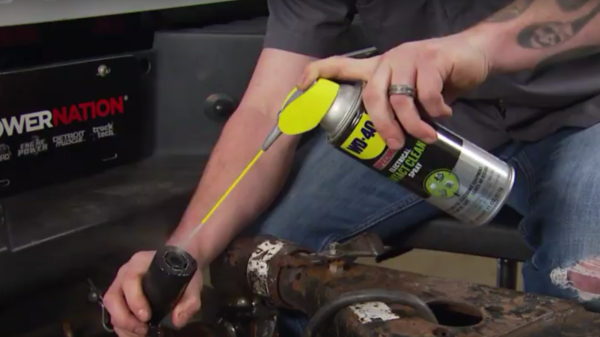
I never knew for sure if that stuff was Freon, but it was the mid-80s, shortly before CFCs were banned, so it might have been. All I know is that I’ve never found its equal for cleaning electronics gear. With that in mind, I thought I’d look at contact cleaners that are in use today, what’s really going on when you clean contacts, and why contacts even need cleaning in the first place.


![The legendary Technics SL1200 direct-drive turntable, as used by countless DJs. Dydric [CC BY-SA 2.5)], via Wikimedia Commons.](https://hackaday.com/wp-content/uploads/2017/02/640px-technics_sl-1200mk2-2.jpg)