Last week we covered the past and current state of artificial intelligence — what modern AI looks like, the differences between weak and strong AI, AGI, and some of the philosophical ideas about what constitutes consciousness. Weak AI is already all around us, in the form of software dedicated to performing specific tasks intelligently. Strong AI is the ultimate goal, and a true strong AI would resemble what most of us have grown familiar with through popular fiction.
Artificial General Intelligence (AGI) is a modern goal many AI researchers are currently devoting their careers to in an effort to bridge that gap. While AGI wouldn’t necessarily possess any kind of consciousness, it would be able to handle any data-related task put before it. Of course, as humans, it’s in our nature to try to forecast the future, and that’s what we’ll be talking about in this article. What are some of our best guesses about what we can expect from AI in the future (near and far)? What possible ethical and practical concerns are there if a conscious AI were to be created? In this speculative future, should an AI have rights, or should it be feared?
The concept of artificial intelligence dates back far before the advent of modern computers — even as far back as Greek mythology. Hephaestus, the Greek god of craftsmen and blacksmiths, was believed to have created automatons to work for him. Another mythological figure, Pygmalion, carved a statue of a beautiful woman from ivory, who he proceeded to fall in love with. Aphrodite then imbued the statue with life as a gift to Pygmalion, who then married the now living woman.
Pygmalion by Jean-Baptiste Regnault, 1786, Musée National du Château et des Trianons
Throughout history, myths and legends of artificial beings that were given intelligence were common. These varied from having simple supernatural origins (such as the Greek myths), to more scientifically-reasoned methods as the idea of alchemy increased in popularity. In fiction, particularly science fiction, artificial intelligence became more and more common beginning in the 19th century.
But, it wasn’t until mathematics, philosophy, and the scientific method advanced enough in the 19th and 20th centuries that artificial intelligence was taken seriously as an actual possibility. It was during this time that mathematicians such as George Boole, Bertrand Russel, and Alfred North Whitehead began presenting theories formalizing logical reasoning. With the development of digital computers in the second half of the 20th century, these concepts were put into practice, and AI research began in earnest.
Over the last 50 years, interest in AI development has waxed and waned with public interest and the successes and failures of the industry. Predictions made by researchers in the field, and by science fiction visionaries, have often fallen short of reality. Generally, this can be chalked up to computing limitations. But, a deeper problem of the understanding of what intelligence actually is has been a source a tremendous debate.
Despite these setbacks, AI research and development has continued. Currently, this research is being conducted by technology corporations who see the economic potential in such advancements, and by academics working at universities around the world. Where does that research currently stand, and what might we expect to see in the future? To answer that, we’ll first need to attempt to define what exactly constitutes artificial intelligence.
When a Hackaday article proclaims that its subject is a book you should read, you might imagine that we would be talking of a seminal text known only by its authors’ names. Horowitz and Hill, perhaps, or maybe Kernigan and Ritchie. The kind of book from which you learn your craft, and to which you continuously return to as a work of reference. Those books that you don’t sell on at the end of your university career.
Ladybird books covered a huge range of topics.
So you might find it a little unexpected then that our subject here is a children’s book. Making A Transistor Radio, by [George Dobbs, G3RJV] is one of the huge series of books published in the UK under the Ladybird imprint that were a staple of British childhoods for a large part of the twentieth century. These slim volumes in a distinctive 7″ by 4.5″ (180 x 115 mm) hard cover format were published on a huge range of subjects, and contained well written and informative text paired with illustrations that often came from the foremost artists of the day. This one was published at the start of the 1970s when Ladybird books were in their heyday, and has the simple objective of taking the reader through the construction of a simple three transistor radio. It’s a book you must read not because it is a seminal work in the vein of Horrowitz and Hill, but because it is the book that will have provided the first introduction to electronics for many people whose path took them from this humble start into taking the subject up as a career. Including me as it happens, I received my copy in about 1979, and never looked back. Continue reading “Books You Should Read: Making A Transistor Radio”→
There are numerous examples of hardware which has latent features waiting to be unlocked by software. Most recently, we saw a Casio calculator which has the same features as its bigger sibling hidden within the firmware, only to be exposed by a buffer overflow bug (or the lead from a pencil if you prefer a hardware hack).
More famously, oscilloscopes have been notorious for having crippled features. The Rigol DS1052E was hugely popular on hacker benches because of it’s very approachable price tag. The model shipped with 50 MHz bandwidth but it was discovered that a simple hack turned it into the DS1102E 100 MHz scope. Tektronix has gotten in on this action as well, shipping modules like I2C, CAN, and LIN analyzation on the scope but requiring a hardware key to unlock (these were discovered to have a horribly insecure unlock method). Similar feature barriers are found on Rigol’s new reigning entry-level scope, the DS1054Z, which ships with protocol analyzation modules (among others) that are enabled only for the first 70 hours of scope operation, requiring an additional payment to unlock them. Most scope manufacturers are in on the game, and of course this is not limited to our tools. WiFi routers are another great example of hardware hosting firmware-unlockable features.
So, the question on my mind which I’d like to ask all of the Hackaday community is this: are unlockable features good for us, the people who use these tools? Let’s take a look at some of the background of these practices and then jump into a discussion in the comments.
If you know me at all, you know I’m a car guy. I’m pretty green as far as hardcore wrenching skills go, but I like to tackle problems with my vehicles myself – I like to learn by doing. What follows is the story of how I learned a few hard lessons when my faithful ride died slowly and painfully in my arms over the final months of 2016.
For context, my beast of a machine was a 1992 Daihatsu Feroza. It’s a 4WD with a 1.6 litre fuel injected four-cylinder engine. It had served me faithfully for over a year and was reading around 295,000 kilometers on the odometer. But I was moving house and needed to pull a trailer with all my possessions on an 800 km journey. I didn’t want to put the stress on the car but I didn’t have a whole lot of choice if I wanted to keep my bed and my prized Ricoh photocopier. I did my best to prepare the car, topping up the oil which had gotten perilously low and fitting new tyres. I’d had a hell of a time over the winter aquaplaning all over the place and wasn’t in the mood for a big ugly crash on the highway. Continue reading “Fixing My 4×4: The Battle Of The Bent Valves”→
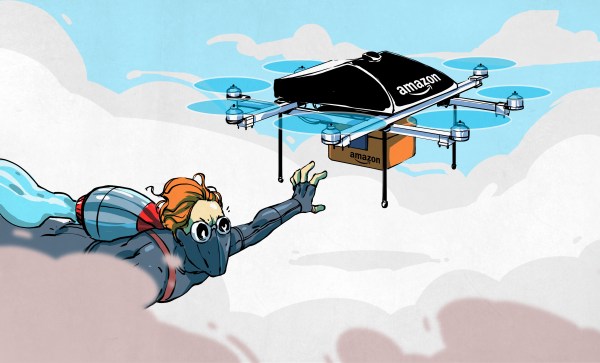
I heard a “Year in Review” program the other day on NPR with a BBC World Service panel discussion of what’s ahead for 2017. One prediction was that UAV delivery of packages would be commonplace this year, and as proof the commentator reported that Amazon had already had a successful test in the UK. But he expressed skepticism that it would ever be possible in the USA, where he said that “the first drone that goes over somebody’s property will be shot down and the goods will be taken.”
He seemed quite sincere about his comment, but we’ll give him the benefit of the doubt that he was only joking to make a point, not actually grotesquely ignorant about the limitations of firearms or being snarky about gun owners in the US. Either way, he brings up a good point: when autonomous parcel delivery is commonplace, who will make sure goods get to the intended recipient?
If you watch enough mainstream TV and movies, you might think that hacking into someone’s account requires a huge monitor, special software, and intricate hand gestures. The reality is way more boring. Because people tend to choose bad passwords, if you have time, you can task a computer with quietly brute-forcing the password. Then again, not everyone has a bad password and many systems will enforce a timeout after failed attempts or require two-factor authentication, so the brute force approach isn’t what it used to be.
Turns out the easiest way to get someone’s password is to ask them for it. Sure, a lot of people will say no, but you’d be surprised how many people will tell you. That number goes up dramatically when you make them think you are with the IT department or their Internet provider. That’s an example of social engineering. You can define that many ways, but in this case it boils down to getting people to give you what you want based on making them believe you are something you aren’t.
Everything Old…
We think of social engineering as something new, but really–like most cybercrime–it is just the movement of old-fashioned crime to the digital world. What got me thinking about this is a service from Amazon called “Mechanical Turk.”
That struck me as odd when I first heard it because for product marketing it is pretty bad unless you are selling turkey jerky or something. If you tell me “Amazon Simple Storage Service” I can probably guess what that might be. But what’s Mechanical Turk?