Airport Runways And Hashtags — How To Become A Social Engineer

Of the $11.7 million companies lose to cyber attacks each year, an estimated 90% begin with a phone call or a chat with support, showing that the human factor is clearly an important facet of security and that security training is seriously lacking in most companies. Between open-source intelligence (OSINT) — the data the leaks out to public sources just waiting to be collected — and social engineering — manipulating people into telling you what you want to know — there’s much about information security that nothing to do with a strong login credentials or VPNs.

There’s great training available if you know where to look. The first time I heard about WISP (Women in Security and Privacy) was last June on Twitter when they announced their first-ever DEFCON Scholarship. As one of 57 lucky participants, I had the chance to attend my first DEFCON and Black Hat, and learn about their organization.

Apart from awarding scholarships to security conferences, WISP also runs regional workshops in lockpicking, security research, cryptography, and other security-related topics. They recently hosted an OSINT and Social Engineering talk in San Francisco, where Rachel Tobac (three-time DEFCON Social Engineering CTF winner and WISP Board Member) spoke about Robert Cialdini’s principles of persuasion and their relevance in social engineering.

Cialdini is a psychologist known for his writings on how persuasion works — one of the core skills of social engineering. It is important to note that while Cialdini’s principles are being applied in the context of social engineering, they are also useful for other means of persuasion, such as bartering for a better price at an open market or convincing a child to finish their vegetables. It is recommended that they are used for legal purposes and that they result in positive consequences for targets. Let’s work through the major points from Tobac’s talk and see if we can learn a little bit about this craft.

Continue reading “Airport Runways And Hashtags — How To Become A Social Engineer”

Rocket Lab Sets Their Sights On Rapid Reusability

Not so very long ago, orbital rockets simply didn’t get reused. After their propellants were expended on the journey to orbit, they petered out and fell back down into the ocean where they were obliterated on impact. Rockets were disposable because, as far as anyone could tell, building another one was cheaper and easier than trying to reuse them. The Space Shuttle had proved that reuse of a spacecraft and its booster was possible, but the promised benefits of reduced cost and higher launch cadence never materialized. If anything, the Space Shuttle was often considered proof that reusability made more sense on paper than it did in the real-world.

Rocket Lab CEO Peter Beck with Electron rocket

But that was before SpaceX started routinely landing and reflying the first stage of their Falcon 9 booster. Nobody outside the company really knows how much money is being saved by reuse, but there’s no denying the turn-around time from landing to reflight is getting progressively shorter. Moreover, by performing up to three flights on the same booster, SpaceX is demonstrating a launch cadence that is simply unmatched in the industry.

So it should come as no surprise to find that other launch providers are feeling the pressure to develop their own reusability programs. The latest to announce their intent to recover and eventually refly their vehicle is Rocket Lab, despite CEO Peter Beck’s admission that he was originally against the idea. He’s certainly changed his tune. With data collected over the last several flights the company now believes they have a reusability plan that’s compatible with the unique limitations of their diminutive Electron launch vehicle.

According to Beck, the goal isn’t necessarily to save money. During his presentation at the Small Satellite Conference in Utah, he explained that what they’re really going after is an increase in flight frequency. Right now they can build and fly an Electron every month, and while they eventually hope to produce a rocket a week, even a single reuse per core would have a huge impact on their annual launch capability:

If we can get these systems up on orbit quickly and reliably and frequently, we can innovate a lot more and create a lot more opportunities. So launch frequency is really the main driver for why Electron is going reusable. In time, hopefully we can obviously reduce prices as well. But the fundamental reason we’re doing this is launch frequency. Even if I can get the stage back once, I’ve effectively doubled my production ratio.

But, there’s a catch. Electron is too small to support the addition of landing legs and doesn’t have the excess propellants to use its engines during descent. Put simply, the tiny rocket is incapable of landing itself. So Rocket Lab believes the only way to recover the Electron is by snatching it out of the air before it gets to the ground.

Continue reading “Rocket Lab Sets Their Sights On Rapid Reusability”

Circuit VR: Advanced Falstad Logic With Geniac

I find that if I’m trying to make a point with a student or a colleague about a circuit, sometimes the Falstad online simulator is worth a few thousand words. You can draw the circuit, play with the values, and even see the current flow in an intuitive way as well as make traditional measurements. The simulator not only handles analog but also digital circuits. At first glance, though, the digital functions appear limited, but if you dig deeper, there is a custom logic block that can really help. I dug into this — and into how switches work in the simulator — the other day in response to a Hackaday post. If you use Falstad, read on!

Continue reading “Circuit VR: Advanced Falstad Logic With Geniac”

Echos Of The Cold War: Nuclear-Powered Missiles Have Been Tried Before

On August 8th, an experimental nuclear device exploded at a military test facility in Nyonoksa, Russia. Thirty kilometers away, radiation levels in the city of Severodvinsk reportedly peaked at twenty times normal levels for the span of a few hours. Rumors began circulating about the severity of the event, and conflicting reports regarding forced evacuations of residents from nearby villages had some media outlets drawing comparisons with the Soviet Union’s handling of the Chernobyl disaster.

Today, there remain more questions than answers surrounding what happened at the Nyonoksa facility. It’s still unclear how many people were killed or injured in the explosion, or what the next steps are for the Russian government in terms of environmental cleanup at the coastal site. The exceptionally vague explanation given by state nuclear agency Rosatom saying that the explosion “occurred during the period of work related to the engineering and technical support of isotopic power sources in a liquid propulsion system”, has done little to assuage concerns.

The consensus of global intelligence agencies is that the test was likely part of Russia’s program to develop the 9M730 Burevestnik nuclear-powered cruise missile. Better known by its NATO designation SSC-X-9 Skyfall, the missile is said to offer virtually unlimited flight range and endurance. In theory the missile could remain airborne indefinitely, ready to divert to its intended target at a moment’s notice. An effectively unlimited range also means it could take whatever unpredictable or circuitous route necessary to best avoid the air defenses of the target nation. All while traveling at near-hypersonic speeds that make interception exceptionally difficult.

Such incredible claims might sound like saber rattling, or perhaps even something out of science fiction. But in reality, the basic technology for a nuclear-powered missile was developed and successfully tested nearly sixty years ago. Let’s take a look at this relic of the Cold War, and find out how Russia may be working to resolve some of the issues that lead to it being abandoned. Continue reading “Echos Of The Cold War: Nuclear-Powered Missiles Have Been Tried Before”

Apollo’s PLSS And The Science Of Keeping Humans Alive In Space

Ever since humans came up with the bright idea to explore parts of the Earth which were significantly less hospitable to human life than the plains of Africa where humankind evolved, there’s been a constant pressure to better protect ourselves against the elements to keep our bodies comfortable. Those first tests of a new frontier required little more than a warm set of clothes. Over the course of millennia, challenging those frontiers became more and more difficult. In the modern age we set our sights on altitude and space, where a warm set of clothes won’t do much to protect you.

With the launch of Sputnik in 1957 and the heating up of the space race between the US and USSR, many firsts had to be accomplished with minimal time for testing and refinement. From developing 1945’s then state-of-the-art V-2 sounding rockets into something capable of launching people to the moon and beyond, to finding out what would be required to keep people alive in Earth orbit and on the Moon. Let’s take a look at what was required to make this technological marvel happen, and develop the Portable Life Support System — an essential component of those space suits that kept astronauts so comfortable they were able to crack jokes while standing on the surface of the Moon.

Continue reading “Apollo’s PLSS And The Science Of Keeping Humans Alive In Space”

Safety Systems For Stopping An Uncontrolled Drone Crash

We spend a lot of time here at Hackaday talking about drone incidents and today we’re looking into the hazard of operating in areas where people are present. Accidents happen, and a whether it’s a catastrophic failure or just a dead battery pack, the chance of a multi-rotor aircraft crashing down onto people below is a real and persistent hazard. For amateur fliers, operating over crowds of people is simply banned, but there are cases where professionally-piloted dones are flying near crowds of people and other safety measures need to be considered.

We saw a skier narrowly missed by a falling camera drone in 2015, and a couple weeks back there was news of a postal drone trial in Switzerland being halted after a parachute system failed. When a multirotor somehow fails while in flight it represents a multi-kilogram flying weapon widow-maker equipped with spinning blades, how does it make it to the ground in as safe a manner as possible? Does it fall in uncontrolled flight, or does it activate a failsafe technology and retain some form of control as it descends?

Continue reading “Safety Systems For Stopping An Uncontrolled Drone Crash”

India Launched A Moon Orbiter, Lander, And Rover All In One Shot With Chandrayaan-2

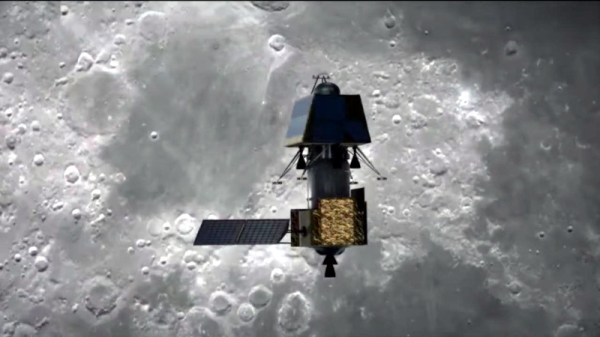
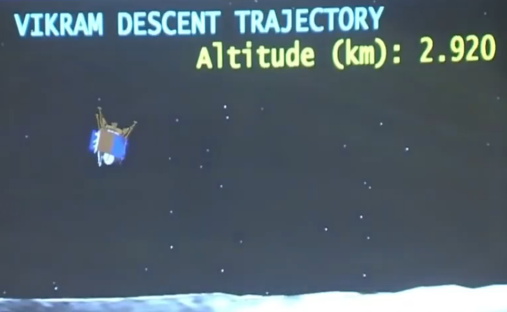
On July 22nd, India launched an ambitious mission to simultaneously deliver an orbiter, lander, and rover to the Moon. Launched from the Satish Dhawan Space Centre on a domestically-built GSLV Mk III rocket, Chandrayaan-2 is expected to enter lunar orbit on August 20th. If everything goes well, the mission’s lander module will touch down on September 7th.

Attempting a multifaceted mission of this nature is a bold move, but the Indian Space Research Organisation (ISRO) does have the benefit of experience. The Chandrayaan-1 mission, launched in 2008, spent nearly a year operating in lunar orbit. That mission also included the so-called Moon Impact Probe (MIP), which deliberately crashed into the surface near the Shackleton crater. The MIP wasn’t designed to survive the impact, but it still secured India a position on the short list of countries that have placed an object on the lunar surface.

If the lander component of Chandrayaan-2, named Vikram after Indian space pioneer Vikram Sarabhai, can safely touch down on the lunar surface it will be a historic accomplishment for the ISRO. To date, the only countries to perform a controlled landing on the Moon are the Soviet Union, the United States, and China. Earlier in the year, it seemed Israel would secure its position as the fourth country to perform the feat with their Beresheet spacecraft, but a last second fault caused the craft to crash into the surface. The loss of Beresheet, while unfortunate, has given India an unexpected chance to take the coveted fourth position despite Israel’s head start.

We have a few months before the big event, but so far, everything has gone according to plan for Chandrayaan-2. As we await word that the spacecraft has successfully entered orbit around the Moon, let’s take a closer look at how this ambitious mission is supposed to work.

Continue reading “India Launched A Moon Orbiter, Lander, And Rover All In One Shot With Chandrayaan-2”