Jerri Nielsen: Surviving The Last Place On Earth

There may be no place on Earth less visited by humans than the South Pole. Despite a permanent research base with buildings clustered about the pole and active scientific programs, comparatively few people have made the arduous journey there. From October to February, up to 200 people may be stationed at the Amundsen-Scott South Pole Station for the Antarctic summer, and tourists checking an item off their bucket lists come and go. But by March, when the sun dips below the horizon for the next six months, almost everyone has cleared out, except for a couple of dozen “winter-overs” who settle in to maintain the station, carry on research, and survive the worst weather Mother Nature brews up anywhere on the planet.

To be a winter-over means accepting the fact that whatever happens, once that last plane leaves, you’re on your own for eight months. Such isolation and self-reliance require special people, and Dr. Jerri Nielsen was one who took the challenge. But as she and the other winter-overs watched the last plane leave the Pole in 1998 and prepared for the ritual first-night screening of John Carpenter’s The Thing, she had no way of knowing what she would have to do to survive the cancer that was even then growing inside her.

Continue reading “Jerri Nielsen: Surviving The Last Place On Earth”

Prepping For Power Outages

When the mains power goes, we are abruptly brought face-to-face with how many of the devices and services we take for granted rely upon it. Telephones for instance, where once they were attached to the wall by a cable, now they are a cordless device with a mains-powered base station. Your cellphone can fill that gap, but a modern smartphone with a battery life of under a day is hardly a reliable long-term solution. Meanwhile modern heating systems may still burn gas or fuel oil, but rely on an electric pump for circulation. Your kitchen is full of electrically-powered white goods, your food is preserved by an electric refrigerator, even your gas cooker if you have one will probably expect a mains supply.

When the power goes out we might say that we instantaneously travel back a couple of centuries, but the reality is that our ancestors in 1817 wouldn’t have been in the same mess we are, they had appropriate solutions to surviving a wickedly cold winter when electricity was still something of a gleam in [Michael Faraday]’s eye. In short, they were prepared in a way most of us are not. That’s a shame, so let’s take a closer look sensible modern preparedness.

Continue reading “Prepping For Power Outages”

3D Printing The Final Frontier

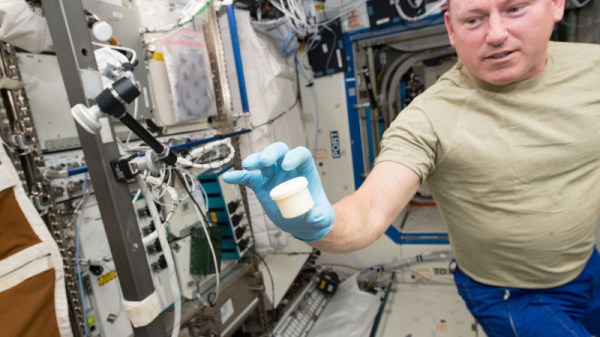
While down here there’s room for debate about the suitability of 3D printing for anything more serious than rapid prototyping, few would say the same once you’ve slipped the surly bonds of Earth. With 3D printing, astronauts would have the ability to produce objects and tools on-demand from a supply of inert raw building materials. Instead of trying to pack every conceivable spare part for a mission to Mars, replacements (assuming a little forward thinking on the part of the spacecraft designers) can be made to order out of the stock of raw plastic or metal kept on-board. The implications of such technology for deep space travel or off-world settlement simply cannot be overstated.

In the more immediate future, 3D printing can be used to rapidly develop and deploy unmanned spacecraft. Tiny satellites (referred to as CubeSats) could be printed, assembled, and deployed by astronauts already in orbit. Innovations such as these could allow science missions to be planned and executed in months instead of years, and at a vastly reduced cost.

Continue reading “3D Printing The Final Frontier”

Thermistors And 3D Printing

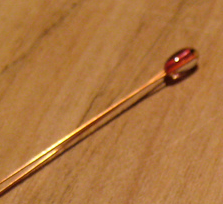
I always find it interesting that 3D printers — at least the kind most of us have — are mostly open-loop devices. You tell the head to move four millimeters in the X direction and you assume that the stepper motors will make it so. Because of the mechanics, you can calculate that four millimeters is so many steps and direct the motor to take them. If something prevents that amount of travel you get a failed print. But there is one part of the printer that is part of a closed loop. It is very tiny, very important, but you don’t hear a whole lot about it. The thermistor.

The hot end and the heated bed will both have a temperature sensor that the firmware uses to keep temperatures at least in the ballpark. Depending on the controller it might just do on-and-off “bang-bang” control or it might do something as sophisticated as PID control. But either way, you set the desired temperature and the controller uses feedback from the thermistor to try to keep it there.

If you print with high-temperature materials you might have a thermocouple in your hot end, but most machines use a thermistor. These are usually good to about 300 °C. What got me thinking about this was the installation of an E3D V6 clone hot end into my oldest printer which had a five-year-old hot end in it. I had accumulated a variety of clone parts and had no idea what kind of thermistor was in the heat block I was using.

Continue reading “Thermistors And 3D Printing”

Hardware Heroes: Isambard Kingdom Brunel

There are some notable figures in history that you know of for just one single thing. They may have achieved much in their lifetimes or they may have only been famous for Andy Warhol’s fifteen minutes, but through the lens of time we only know them for that single achievement. Then on the other hand there are those historic figures for whom there is such a choice of their achievements that have stood the test of time, that it is difficult to characterize them by a single one.

[Isambard Kingdom Brunel], in front of the launching chains for the Great Eastern. [Public domain]
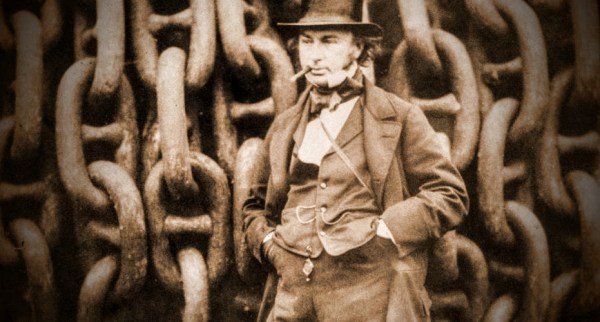
Isambard Kingdom Brunel, in front of the launching chains for the Great Eastern. [Public domain]
Such is the case of Isambard Kingdom Brunel, the subject of today’s Hardware Heroes piece. Do we remember him for his involvement in the first successful tunnel to pass beneath a river, as a builder of some of the most impressive bridges on the 19th century, the innovator in all aspects of rail engineering, the man behind the first screw-driven ocean-going iron ship, or do we remember him as all of those and more?

It is possible that if you are not British, or in particular you are not from the West of England, this is the first you’ve heard of Brunel. In which case he is best described as a towering figure of many aspects of engineering over the middle years of the 19th century. His influence extended from civil engineering through the then-emerging rail industry, to shipbuilding and more, and his legacy lives on today in that many of his works are still with us.

Engineering: The Family Trade

Brunel’s father, Marc Brunel, was an engineer and refugee from the French Revolution who found success in providing the British Navy with a mass-production system for wooden pulley blocks as used in the rigging of sailing ships. He enters this story for his grand project, the world’s first tunnel to be dug under a navigable river, beneath London’s River Thames from Rotherhithe to Wapping, and for his patented tunneling shield which made it possible to be dug.

Continue reading “Hardware Heroes: Isambard Kingdom Brunel”

Using Gmail With OAUTH2 In Linux And On An ESP8266

One of the tasks I dread is configuring a web server to send email correctly via Gmail. The simplest way of sending emails is SMTP, and there are a number of scripts out there that provide a simple method to send mail that way with a minimum of configuration. There’s even PHP mail(), although it’s less than reliable.

Out of the box, Gmail requires OAUTH2 for authentication and to share user data, which has the major advantage of not requiring that you store your username and password in the application that requires access to your account. While they have an ‘allow less secure apps’ option that allows SMTP access for legacy products like Microsoft Outlook, it just doesn’t seem like the right way forward. Google documents how to interact with their API with OAUTH2, so why not just use that instead of putting my username and password in plaintext in a bunch of prototypes and test scripts?

Those are the thoughts that run through my head every time this comes up for a project, and each time I’ve somehow forgotten the steps to do it, also forgotten to write it down, and end up wasting quite a bit of time due to my own foolishness. As penance, I’ve decided to document the process and share it with all of you, and then also make it work on an ESP8266 board running the Arduino development environment.

Continue reading “Using Gmail With OAUTH2 In Linux And On An ESP8266”

Truly Terrible Dimensioned Drawings

I’m in the planning stages of a side project for Hackaday right now. It’s nothing too impressive, but this is a project that will involve a lot of electromechanical parts. This project is going to need a lot of panel mount 1/8″ jacks and sockets, vertical mount DIN 5 connectors, pots, switches, and other carefully crafted bits of metal. Mouser and Digikey are great for nearly every other type of electrical component, but when it comes to these sorts of electromechanical components, your best move is usually to look at AliExpress or DealExtreme, finding something close to what you need, and buying a few hundred. Is this the best move for a manufacturable product? No, but we’re only building a few hundred of these things.

I have been browsing my usual Internet haunts in the search for the right bits of stamped brass and injection molded plastic for this project, and have come to a remarkable conclusion. Engineers, apparently, have no idea how to dimension drawings. Drafting has been a core competency for engineers from the dawn of time until AutoCAD was invented, and now we’re finally reaping the reward: It’s now rare to find a usable dimensioned drawing on the Internet.

This post is going to be half rant, half explanation of what is wrong with a few of the dimensioned drawings I’ve found recently. Consider this an example of what not to do.  There is no reason for the state of engineering drawing to be this bad.

Continue reading “Truly Terrible Dimensioned Drawings”