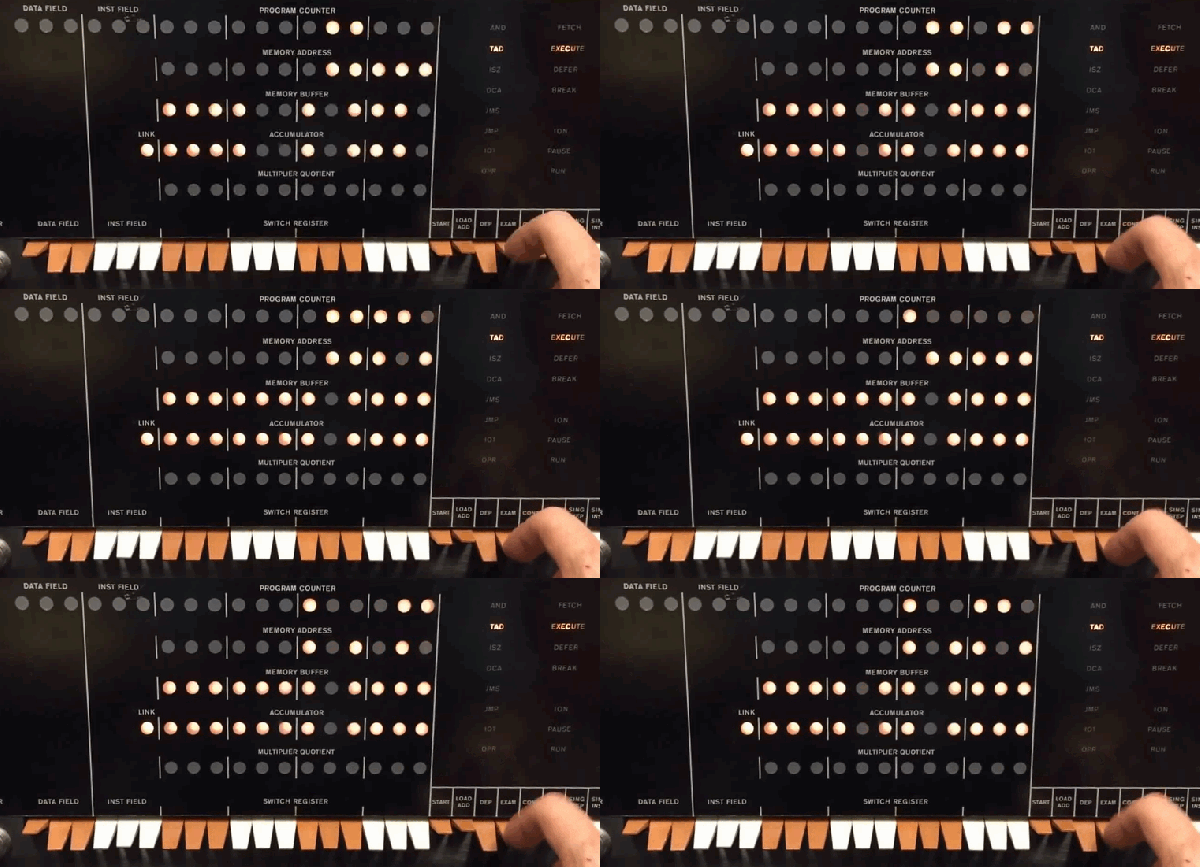
Getting Started With Blinking Lights On Old Iron

If you ever go to a computer history museum, you’ll be struck by how bland most modern computers look. Prior to 1980 computers had lights and switches, and sometimes dials and meters. Some had switchboard-like wiring panels and some even had oscilloscope-like displays. There’s something about a machine with all those switches and lights and displays that gets your hacker juices flowing. Have you ever wanted to get started in retrocomputing? Is it difficult? Do you need a lot of money? That depends on what your goals are.

There are at least three ways you can go about participating in retrocomputing: You can pony up the money to buy actual antique computers, you can build or buy old computers recreated with anywhere from zero to one hundred percent of period-authentic components, or you can experiment with emulators that run on a modern computer. As a hybrid of the second and third option there are also emulations in FPGAs.

You can see that the first option can be very expensive and you will probably have to develop a lot of repair and restoration skills. Watching [Mattis Lind] twiddle the bits on an actual PDP-8 in the clip above is great, but you’ll need to work up to it. The two techniques which get you going without the original hardware don’t have to break the bank or even cost anything presuming you already have a PC.

Although some sneer at emulation, for some machines it is almost the only way to go. You couldn’t buy the original EDSAC, for example. It is also a good way to get started without a lot of expense or risk. But regardless of how you do it, there’s one thing in common: you have to know how to operate the thing.

Continue reading “Getting Started With Blinking Lights On Old Iron”

CNC Mill Out Of A Building Set

I have some aluminum building-set parts on hand and just got a second rotary tool, so I thought I’d try my hand at making a light-duty CNC mill—maybe carve up some cheap pine or make circuit boards. This post explores some of the early decisions I’m facing as I begin the project.

Of primary importance is the basic format of the mill’s chassis. Gantry configuration or put everything in a box of girders? How will the axes move–belts or racks? How will the Z-axis work, the assembly that lowers the tool onto the material? Finally, once the chassis is complete, or perhaps beforehand, I’ll need to figure out how I intend to control the thing.

Continue reading “CNC Mill Out Of A Building Set”

The Sensors Automating Your Commute

In a bout of frustration I recently realized that the roads have all updated — most people have no idea how — and this sometimes hurts the flow of traffic. This realization happened when an unfortunate person stopped in a left turn lane well before the stop line. The vehicle didn’t trigger the sensor, so cycle after cycle went by and the traffic system never gave the left turn lane a green light, thinking the lane was unoccupied. Had the driver known about this the world would have been a better place. The first step in intelligent automation is sensing, and there are a variety of methods used to sense traffic’s flow.

Continue reading “The Sensors Automating Your Commute”

Eclipse Megamovie: Thousands Of Cameras For Citizen Science

On August 21, 2017, the Moon will cast its shadow across the entire breadth of the United States for the first time in almost a century. It is estimated that 12 million people live within the path in which the sun will be blotted out, and many millions more are expected to pour into the area to experience the wonders of totality.

We’d really love it if you would tell us where you’ll be during the eclipse by creating your own event page, but that’s not what this article’s about. With millions gathered in a narrow swath from Oregon to South Carolina, and with the eclipse falling on a Monday so that the prior two weekend days will be filled with campouts at prime viewing locations, I expect that Eclipse 2017 will be one big coast-to-coast party. This is an event that will attract people of all stripes, from those with no interest in astronomy that have only the faintest idea of what’s actually happening celestially, to those so steeped in the science that they’ll be calling out the exact beginning of totality and when to expect Baily’s Beads to appear.

I suspect our readership leans closer to the latter than the former, and some may want to add to the eclipse experience by participating in a little citizen science. Here’s how you can get involved.

Continue reading “Eclipse Megamovie: Thousands Of Cameras For Citizen Science”

Know Thy LED

The invention of the LED is one of the most important discoveries of our times. They are everywhere, from our flashlights to household lighting and television sets. We don’t need to tell you that a project with more blinkies is better than a project with fewer blinkies. But an LED is not simply an LED; the sheer variety of LEDs is amazing, and so in this write-up, we’ll take a closer look at how to choose the right LED for your next masterpiece. Continue reading “Know Thy LED”

Intro To The North American Traffic Signal

Traffic lights are so ubiquitous that we hardly give them a second thought, except to curse their existence when they impede us on our daily drive. But no matter how much it seems like traffic lights have the ability to read our minds and tell when we’re running late, they’re really not much more than a set of lights and a programmable controller. Simple in practice, but as usual, the devil is in the details, and for a system that needs to work as close to 100% of the time as possible, the details are important. Let’s explore the inner workings of traffic signals.

Electromechanical Timing

The traffic lights and crosswalk signals at an intersection are only the public user interface, of course. The interesting stuff is going on in the control box. There’s at least one at every intersection, usually a plain metal cabinet set back from the road, sometimes camouflaged with public bills or graffiti. But inside are the guts of what makes an intersection work and keeps vehicle and foot traffic moving smoothly and safely.

Unsurprisingly, most traffic signal controls started out as purely electromechanical devices. Cabinets were chock full of synchronous motors turning timing wheels with cams to cycle the intersection’s lights through the proper sequence. One old time controller that was common up until recently was made by Econolite, and the insides are a paragon of sturdy design.

Continue reading “Intro To The North American Traffic Signal”

Hackaday UK Unconference Art

Hackaday UK Unconference Needs You

Hackaday’s first ever conference in the United Kingdom will take place on September 16th. Get your free ticket right now for the Hackaday UK Unconference!

An Unconference is the best way to put your finger on the pulse of what is happening in the hardware world right now. Everyone who attends should be ready to stand and deliver a seven-minute talk on something that excites them right now — this mean you. The easiest thing to do is grab your latest hack off the shelf and talk about that.

Talks may be about a prototype, project, or product currently in progress at your home, work, or university. It could also be an idea, concept, or skill that you’re now exploring. The point is to channel your excitement and pass it on to others in a friendly presentation environment where everyone will cheer as your story unfolds.

Hackaday doesn’t often have the opportunity to organize live events in Europe which is why we’re so happy to partner with DesignSpark, the exclusive sponsor of the Hackaday UK Unconference. DesignSpark is the innovation arm of RS Components and will have some staff on hand at the Unconference. They share our excitement in bringing together the Hackaday community throughout the UK. It is with their support that we are able to book an incredible venue and offer admission at no cost to all attendees. Hackaday events fill to capacity quickly, so get your ticket now before they are gone.

We have already asked a few of our friends in the area if they will be there. Seb Lee-Delisle who wowed us in Belgrade with his laser projection wizardry plans to be there. James Larsson is part of the crew that started the Flashing Light Prize and will be on hand. Phoenix Perry is always on the cutting edge of where people and technology meet and we can’t wait to hear her talk. Mike Harrison of Mike’s Electric Stuff will be around and likely teasing some secret Hackaday hardware he’s spearheading. James Bruton of XRobots (and a Hackaday Prize Judge) is coming, as is Saar Drimer who you may know as the person behind the beautiful hardware art of Boldport. Several Hackaday editors will be there; Elliot Williams, Jenny List, and I will all be on hand. All that’s missing is you.

We’ll flood into the Culture Space at Canada Water on the east side of London starting at 13:00. Tea, coffee, and snacks will be served throughout the afternoon and we’ll provide dinner as well. Anyone who is still standing when we close the doors at 21:00 is invited to join us at the pub afterward (we’ll get the first round).

As always, Hackaday’s success is based on the community of hackers, designers, and engineers that make it up. Please share the link to tickets on your social media and pester your friends to attend. Most importantly, don’t shy away from this speaking opportunity. We want to hear your story and this is the place to tell it. See you in London in just a few short weeks!

UPDATE: Wow, that didn’t take long. The tickets are claimed, but make sure you get on the waitlist. A lot can change in the next five week’s and we’ll be pestering all ticket holders to be there or give their seat up for someone on the waitlist.