Norman Borlaug Saves A Billion

Everyone loves a hero. Save someone from a burning building, and you’ll get your fifteen minutes of fame. That’s why I’m always surprised that more people don’t know Norman Borlaug, who would have celebrated his 104th birthday on Sunday. He won the Nobel prize in 1970 and there’s good reason to think that his hacking efforts saved about a billion people from starving to death. A billion people. That’s not just a hero, that’s a superhero.

To understand why that claim is made, you have to go back to the 1970s. The population was growing and was approaching an unprecedented four billion people. Common wisdom was that the Earth couldn’t sustain that many people. Concerns about pollution were rampant and there were many influential thinkers who felt that we would not be able to grow enough food to feed everyone.

Paul Ehrlich, in particular, was a Stanford University biologist who wrote a book “The Population Bomb.” His forecast of hundreds of millions starving to death in the 1970s and 1980s, including 65 million Americans, were taken very seriously. He also predicted doom for India and that England would not exist by the year 2000.

Here we are 40 or 50 years later and while there are hungry people all over the world, there isn’t a global famine of the proportions many people thought was imminent. What happened? People are pretty good problem solvers and Norman Borlaug — along with others — created what’s known as the Green Revolution.

Continue reading “Norman Borlaug Saves A Billion”

Ever Wonder How The Bots On Robot Wars Were Built?

Building a robot that can do anything well is a tough challenge. Building one that can stand up to another robot trying to violently put it out of commission is an even harder task. But it makes for some entertaining television! It is this combination that thrust a few creative robot building teams into the world of Robot Wars.

SMIDSY in the pits for series 5 of the UK Robot Wars TV show. From left to right: [Andy Pugh], [Robin Bennett], and [Mik Reed]. RIP [Mik].
SMIDSY, short for the insubstantial excuse heard by many a motorcyclist “Sorry Mate, I Didn’t See You”, is a robot that competed in several seasons of the British incarnation of the Robot Wars TV show. It wasn’t the most successful of machines because its weapons were slightly weedy compared to some of the competition, but it was one of the more robust and reliable platforms on the circuit at the time thanks to its combination of simple uncomplicated construction and extremely good design. I had the pleasure of being on the team that built and competed with SMIDSY and carry from it some of the more found memories from that decade.

A few weeks ago I learned that a friend from that period in my life had died following an illness. I hadn’t seen [Mik] for a few years as our lives had drifted apart, but if we were to turn back the clock nearly a couple of decades you would find us and about twenty other fellow members of the Ixion British motorcyclist’s mailing list hard at work building a Robot Wars robot.

The hard work and determination make this a great story. But even more so it’s fun to look back on the state of the art of the time and see some clever workarounds in a time when robot building was just starting to be approachable by the average engineer.

Continue reading “Ever Wonder How The Bots On Robot Wars Were Built?”

An Introduction To Storm Detector Modules

Lightning storm detectors have been around for a surprisingly long time. The early designs consisted of a pair of metal bells and a pendulum. When there was a charge applied, for example by connecting one bell to the ground and the other to a lightning rod, the bells would ring when a lightning storm was close by. In the mid 18th century, these devices were only practical for demonstration and research purposes, but very likely represent the earliest devices that convert electrostatic charge to mechanical force. A bit over a hundred years later, the first lightning detector was considered by some as the first radio receiver as well.

As soon as I found out about storm detector chips, I knew I would have to get one working. For about $25, I ordered an AMS AS3935 module from China. This chip has been featured before in a number of excellent projects such as Twittering lightning detectors, and networks of Sub-Saharan weather stations. While there’s an Arduino library for interfacing with this IC, I’m going to be connecting it up to an ESP8266 running the NodeMCU firware, which means digging into the datasheet and writing some SPI code. If any of the above tickles your fancy, read on! Continue reading “An Introduction To Storm Detector Modules”

Hackaday guide to Lathes

Buying Machine Tools: Foreign Or Domestic, New Or Used?

The last time we discussed machine tools, we talked about how to choose the size of the new metalworking lathe that your wallet is itching to pour itself into. The next big decision to make is “new or used?” If you’re in North America, this question has a lot of overlap with the classic question “Import or American?”. The answer boils down to what your needs are, and what you want to get out of this machine.

If you are new to machining, and want to learn the skills, I recommend starting with an Asian import machine. If you’re careful which one you select, you’ll end up with a very reasonably priced lathe that can do precise work right out of the crate. If your interest is in learning how these tools work, and in doing a restoration project, an old American machine is a great choice. Let’s look at these two routes in more detail.

Continue reading “Buying Machine Tools: Foreign Or Domestic, New Or Used?”

Uber Has An Autonomous Fatality

You have doubtlessly heard the news. A robotic Uber car in Arizona struck and killed [Elaine Herzberg] as she crossed the street. Details are sketchy, but preliminary reports indicate that the accident was unavoidable as the woman crossed the street suddenly from the shadows at night.

If and when more technical details emerge, we’ll cover them. But you can bet this is going to spark a lot of conversation about autonomous vehicles. Given that Hackaday readers are at the top of the technical ladder, it is likely that your thoughts on the matter will influence your friends, coworkers, and even your politicians. So what do you think?

Continue reading “Uber Has An Autonomous Fatality”

Inventing The Digital Watch Again And Again And…

In the 1950s, artwork of what the future would look like included flying cars and streamlined buildings reaching for the sky. In the 60s we were heading for the Moon. When digital watches came along in the 70s, it seemed like a natural step away from rotating mechanical hands to space age, electrically written digits in futuristic script.

But little did we know that digital watches had existed before and that our interest in digital watches would fade only to be reborn in the age of smartphones.

Mechanical Digital Watches

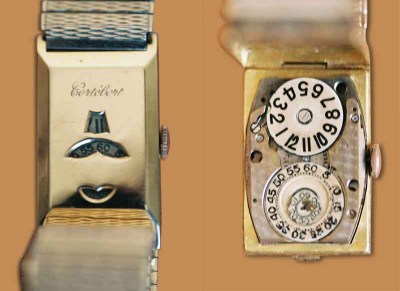
Cortébert jump-hour wristwatch by Wallstonekraft CC-BY-SA 3.0
Cortébert jump-hour wristwatch.
Image by Wallstonekraft CC-BY-SA 3.0

In 1883, Austrian inventor Josef Pallweber patented his idea for a jumping hour mechanism. At precisely the change of the hour, a dial containing the digits from 1 to 12 rapidly rotates to display the next hour. It does so suddenly and without any bounce, hence the term “jump hour”. He licensed the mechanism to a number of watchmakers who used it in their pocket watches. In the 1920s it appeared in wristwatches as well. The minute was indicated either by a regular minute hand or a dial with digits on it visible through a window as shown here in a wristwatch by Swiss watchmaker, Cortébert.

The jump hour became popular worldwide but was manufactured only for a short period of time due to the complexity of its production. It’s still manufactured today but for very expensive watches, sometimes with a limited edition run.

The modern digital watch, however, started from an unlikely source, the classic movie 2001: A Space Odyssey.

Continue reading “Inventing The Digital Watch Again And Again And…”

A Taste Of Who’s Speaking At Hackaday Belgrade

We’re busy confirming speakers at the Hackaday Belgrade conference, taking place in Belgrade Serbia on 26 May. Now’s the time to grab a ticket and be part of something special. Here’s a teaser.

Asier Marzo // Build Principles of an Acoustic Levitator
Applications of acoustic levitation in mid-air chemistry, spectroscopy, and tissue engineering.

Vanessa Julia Carpenter // Designing for Meaningfulness in Smart Products
Creating new smart products which focus on value over function, self development, critical reflection, and behaviour change to enable meaningful experiences.

Marcel van Kervinck // Building a TTL Microcomputer without a Microprocessor
Building a small 8-bit homebrew computer out of a few dozen 1970s TTL chips, an oscillator, some RAM, and an EPROM.

Hackaday Belgrade is the hardware community you love gathered together for one exquisite weekend. Get to town Friday for a meetup at the pub, then spend a marathon Saturday enjoying the best talks, badge hacking, workshop, and live music. What we’ve just listed are of course all just the events… the real value of Hackaday Belgrade is the culture and the people that make up this community. Don’t miss it!

More Excitement to Come

Join the Hackaday Belgrade project page to get in on the live chat where we drop early info as it comes along. Also keep your eye on Hackaday, we’ll announce more speakers as we receive final confirmation. Right now we’re reviewing workshop proposals and expect to send out acceptances later this week.

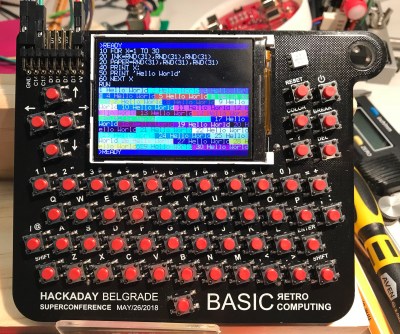
Of course there’s a lot more to get really excited about. For instance, Voja Antonic and Jaromi Sukuba are hard at work on the hardware badge for the conference. It’s alive, and that’s an awful lot of switches!

Brush up on your BASIC language skills and dig that PICkit out of your tool bag. We can’t wait to see the hacks that come together with this one. If you have suggestions for features we should roll into the stock firmware, leave a comment on the badge project page!