Tote Boards: The Impressive Engineering Of Horse Gambling

Horse racing has been around since the time of the ancient Greeks. Often called the sport of kings, it was an early platform for making friendly wagers. Over time, private bets among friends gave way to bookmaking, and the odds of winning skewed in favor of a new concept called the “house”.

During the late 1860s, an entrepreneur in Paris named Joseph Oller invented a new form of betting he called pari-mutuel. In this method, bettors wager among themselves instead of against the house. Bets are pooled together and the winnings divided among the bettors. Pari-mutuel betting creates more organic odds than ones given by a profit-driven bookmaker.

Oller’s method caught on quite well. It brought fairness and transparency to betting, which made it even more attractive. It takes a lot of quick calculations to show real-time bet totals and changing odds, and human adding machines presented a bottleneck. In the early 1900s, a man named George Julius would change pari-mutuel technology forever by making an automatic vote-counting machine in his garage.

Continue reading “Tote Boards: The Impressive Engineering Of Horse Gambling”

Check Out Who’s Speaking At The Hackaday SuperConference

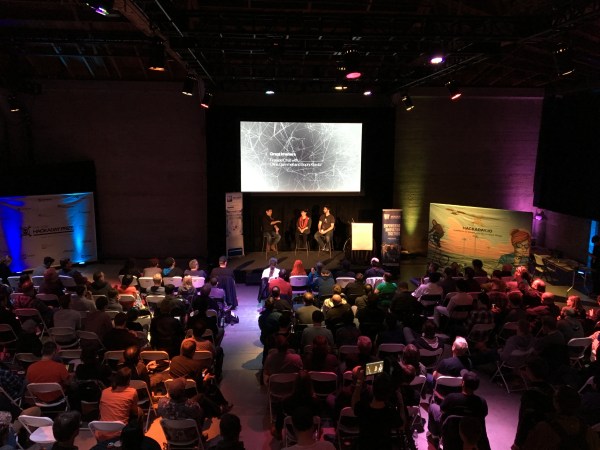
The Hackaday SuperConference is just eleven short days from now! We’ve put together a conference that is all about hardware creation with a side of science and art. Join hundreds of amazing people along with Hackaday crew for a weekend of talks, workshops, and socializing.

Below you will find the full slate of talks, and last week we revealed the lineup of hands-on workshops. We’ve expanded a few of the more popular workshops. If you previously tried to get a ticket and found they were sold out, please check again. We know many of you are working on impressive projects in your workshops, so bring them and sign up for a lightning talk at registration.

This is a gathering of people who make the hardware world go round, and that includes you. Apply now to attend the 2015 Hackaday SuperConference.


2015 Hackaday SuperConference Talks:

Shanni R. Prutchi

Construction of an Entangled Photon Source for Experimenting with Quantum Technologies

Minas Liarokapis

OpenBionics: Revolutionizing Prosthetics with Open-Source Dissemination

Fran Blanche

Fun and Relevance of Antiquated Technology

Danielle Applestone

Founding a hardware startup: what I wish I’d known!

Luke Iseman

Starting a Hardware Startup

Grant Imahara

Recapping Mythbusters and his Engineering Career follow by a Fireside Chat

Noah Feehan

Making in Public

Jeroen Domburg

Implementing the Tamagotchi Singularity

Sarah Petkus

NoodleFeet: Building a Robot as Art

Alvaro Prieto

Lessons in Making Laser Shooting Robots

Zach Fredin

You Can Take Your Hardware Idea Through Pilot-Scale Production With Minimal Prior Experience And Not Very Much Money, So You Should Do It NOW!!

Kate Reed

The Creative Process In Action

Oscar Vermeulen

PiDP-8: Experiences developing an electronics kit

Reinier van der Lee

The Vinduino Project

Radu Motisan

Global environmental surveillance network

David Prutchi

Construction of Imaging Polarimetric Cameras for Humanitarian Demining

Rory Aronson

Why great documentation is vital to open-source projects

Jonathan Beri

I like to move it, move it: a pragmatic guide to making your world move with motors!

Neil Movva

Adding (wearable) Haptic Feedback to Your Project

Dustin Freeman

The Practical Experience of Designing a Theatre Experience around iBeacons

Kay Igwe

Brain Gaming

The Evolution Of Oscillations

The laptop I’m using, found for 50 bucks in the junk bins of Akihabara has a CPU that runs at 2.53GHz. Two billion five hundred and thirty million times every second electrons systematically briefly pulse. To the human mind this is unimaginable, yet two hundred years ago humanity had no knowledge of electrical oscillations at all.

There were clear natural sources of oscillation of course, the sun perhaps the clearest of all. The Pythagoreans first proposed that the earth’s rotation caused the suns daily cycle. Their system was more esoteric and complex than the truth as we now know it and included a postulated Counter-Earth, lying unseen behind a central fire. Regardless of the errors their theory contained, a central link was made between rotation and oscillation.

And rotational motion was exploited in early electrical oscillators. Both alternators, similar to those in use today, and more esoteric devices like the interrupter. Developed by Charles Page in 1838, the interrupter used rocking or rotational motion to dip a wire into a mercury bath periodically breaking a circuit to produce a simple oscillation.

As we progressed toward industrial electrical generators, alternating current became common. But higher and higher frequencies were also required for radio transmitters. The first transmitters had used spark gaps. These simple transmitters used a DC supply to charge a capacitor until it reached the breakdown voltage of the gap between two pieces of wire. The electricity then ionized the air molecules in the gap. Thus allowing current to flow, quickly discharging the capacitor. The capacitor charged again, allowing the process to repeat.

Alexanderson_Alternator
An Alexanderson Alternator

As you can see and hear in the video above spark gaps produce a noisy, far from sinusoidal output. So for more efficient oscillations, engineers again resorted to rotation.

The Alexanderson alternator uses a wheel on which hundreds of slots are cut. This wheel is placed between two coils. One coil, powered by a direct current, produces a magnetic field inducing a current in the second. The slotted disc, periodically cutting this field, produces an alternating current. Alexanderson alternators were used to generate frequencies of 15 to 30 KHz, mostly for naval applications. Amazingly one Alexanderson alternator remained in service until 1996, and is still kept in working condition.

A similar principal was used in the Hammond organ. You may not know the name, but you’ll recognize the sound of this early electronic instrument:

The Hammond organ used a series of tone wheels and pickups. The pickups consist of a coil and magnet. In order to produce a tone the pickup is pushed toward a rotating wheel which has bumps on its surface. These are similar to the slots of the Alexanderson Alternator, and effectively modulate the field between the magnet and the coil to produce a tone.

Amplifying the Oscillation

lc
The operation of a tank circuit (from wikipedia)

So far we have purely relied on electromechanical techniques, however amplification is key to all modern oscillators, for which of course you require active devices. The simplest of these uses an inductor and capacitor to form a tank circuit. In a tank circuit energy sloshes back and forth between an inductor and capacitor. Without amplification, losses will cause the oscillation to quickly die out. However by introducing amplification (such as in the Colpitts oscillator) the process can be kept going indefinitely.

Oscillator stability is important in many applications such as radio transmission. Better oscillators allow transmissions to be packed more closely on the spectrum without fear that they might drift and overlap. So the quest for better, more stable oscillators continued. Thus the crystal oscillator was discovered, and productionized. This was a monumental effort.

Producing Crystal Oscillators

The video below shows a typical process used in the 1940s for the production of crystal oscillators:

https://www.youtube.com/watch?v=b–FKHCFjOM

Natural quartz crystals mined in Brazil were shipped to the US, and processed. I counted a total of 13 non-trivial machining/etching steps and 16 measurement steps (including rigorous quality control). Many of these quite advanced, such as the alignment of the crystal under an X-Ray using a technique similar to X-Ray crystalography.

These days our crystal oscillator production process is more advanced. Since the 1970s crystal oscillators have been fabricated in a photolithographic process. In order to further stabilize the crystal additional techniques such as temperature compensation (TCXO) or operating the crystal at a temperature controlled by the use of a heating element (OCXO) have been employed. For most applications this has proved accurate enough… Not accurate enough however for the timenuts.

Timenuts Use Atoms

wristwatch
Typical timenut wearing atomic wristwatch

For timenuts there is no “accurate enough”. These hackers strive to create the most accurate timing systems they can, which all of course rely on the most accurate oscillator they can devise.

Many timenuts rely on atomic clocks to make their measurements. Atomic clocks are an order of magnitude more precise than even the best temperature controlled crystal oscillators.

Bill Hammack has a great video describing the operation of a cesium beam oscillator. The fundamental process is shown in the image below. The crux is that cesium gas exists in two energy states, which can be separated under a magnetic field. The low energy atoms are exposed to a radiation source, the wavelength of which is determined by a crystal oscillator. Only a wavelength of exactly 9,192,631,770Hz will convert the low energy cesium atoms to the high energy form. The high energy atoms are directed toward a detector, the output of which is used to discipline the crystal oscillator, such that if the frequency of the oscillator drifts and the cesium atoms are no longer directed toward the detector its output is nudged toward the correct value. Thus a basic physical constant is used to calibrate the atomic clock.

atomicclock
The basic operating principle of a cesium atomic clock

While cesium standards are the most accurate oscillators known, Rubidium oscillators (another “atomic” clock) also provide an accurate and relatively cheap option for many timenuts. The price of these oscillators has been driven down due to volume production for the telecoms industry (they are key to GSM and other mobile radio systems) and they are now readily available on eBay.

With accurate time pieces in hand timenuts have performed a number of interesting experiments. To my mind the most interesting of these is measuring time differences due to relativistic effects. As is the case with one timenut who took his family and a car full of atomic clocks up Mt. Rainier for the weekend. When he returned he was able to measure a 20 nanosecond difference between the clocks he took on the trip and those he left at home. This time dilation effect was almost exactly as predicted by the theory of relativity. An impressive result and an amazing family outing!

It’s amazing to think that when Einstein proposed the theory of special relatively in 1905, even primitive crystal oscillators would not have been available. Spark gap, and Alexanderson alternators would still have been in everyday use. I doubt he could imagine that one day the fruits of his theory would be confirmed by one man, on a road trip with his kids as a weekend hobby project. Hackers of the world, rejoice.

The Eloquence Of The Barcode

Beep. You hear it every time you buy a product in a retail store. The checkout person slides your purchase over a scanner embedded in their checkout stand, or shoots it with a handheld scanner. The familiar series of bars and spaces on the label is digitized, decoded to digits, and then used as a query to a database of every product that particular store sells. It happens so often that we take it for granted. Modern barcodes have been around for 41 years now. The first product purchased with a barcode was a 10 pack of Juicy Fruit gum, scanned on June 26, 1974 at Marsh supermarket in Troy, Ohio. The code scanned that day was UPC-A, the same barcode used today on just about every retail product you can buy.

The history of the barcode is not as cut and dry as one would think. More than one group has been credited with inventing the technology. How does one encode data on a machine, store it on a physical media, then read it at some later date? Punch cards and paper tape have been doing that for centuries. The problem was storing that data without cutting holes in the carrier. The overall issue was common enough that efforts were launched in several different industries.

Continue reading “The Eloquence Of The Barcode”

Making The Case For Nuclear Aircraft

At any given moment, several of the US Navy’s Nimitz class aircraft carriers are sailing the world’s oceans. Weighing in at 90 thousand tons, these massive vessels need a lot of power to get moving. One would think this power requires a lot of fuel which would limit their range, but this is not the case. Their range is virtually unlimited, and they only need refueling every 25 years. What kind of technology allows for this? The answer is miniaturized nuclear power plants. Nimitz class carriers have two of them, and they are pretty much identical to the much larger power plants that make electricity. If we can make them small enough for ships, can we make them small enough for other things, like airplanes?

Continue reading “Making The Case For Nuclear Aircraft”

The Key To Modular Smartphones

Cellphone startup Fairphone is now taking pre-orders for their modular smartphone, which is expected to start shipping in December of this year. Although I’m much more familiar with Google’s project Ara, this is the first modular concept to make it to market. It does lead me to a few questions though: is this actually a modular smartphone, and how widely will modular concepts be adopted?

Continue reading “The Key To Modular Smartphones”

Hackaday.io Just Passed 100,000 Members

Today, Hackaday.io passed 100,000 registered users. It seems like yesterday that I wrote a post about passing 10k but that was last year already! Much has happened in that year, and there is much more to come. Thank you to everyone that makes Hackaday.io great by interacting with each other, posting about what is going on in basements, garages, hackerspaces, and workplaces, and finding new and interesting ways of making the site your very own. Your involvement has made Hackaday.io the greatest open source hardware resource in the world.

We don’t call it project hosting. The seed idea did start as project hosting for the hardware hacker, but Hackaday.io has long since outgrown that pair of shoes. It’s become a self-sustaining reaction that grows ever bigger and more awesome as everyone gets involved and decides how and what they want to do.

hackchatOne of the major additions to Hackaday.io this year was group messaging. This spawned an explosion of new communities within Hackaday.io starting with the Hacker Channel. Anyone may request to be a team member and will then gain access to the group messaging; there are now well over 500 members. We’ve scheduled many somewhat-formal events on the channel over the last few months that invited people to show off what they’re building and ask for feedback. That evolved into topic-based sessions on things like FPGA design and what you need to know about manufacturing. Many of these were co-hosted by Hackaday Staff and community members.

This bizarre text is part of the itanimulli profile

A curious event on the site was the appearance of the user itanimulli who join and registered the vanity URL: /conspiracy. This is an enigma. The user is a puzzler and has posted a number of images and other challenges that appear to include hidden data. How do you solve something like this? Get all of your friends involved, of course! Thomas Wilson started a project to solve the itanimulli puzzle and posted about it on the stack to invite teammates to the challenge.

Hackaday.io has spilled over into the real world too. Do you ever look at the valuable odds and ends in your workshop that you know someone will use, but you never will? The Travelling Hacker Box is the answer to that conundrum. It’s the “take a penny, leave a penny” of the hacker world. Get on the project and get in line to receive the box. When it hits your workshop, take out something cool but then we want to see you build something with it! Replace what you took with something of your own and send it to the next person. International shipping has not been solved yet for this particular box, but nothing is stopping you from starting an EU version.

The support we’ve seen from the hardware community for Hackaday.io is one of the reasons we’ve set out to do something new. In just a few weeks the first ever Hackaday SuperConference will be held. Two days of talks and workshops let us meet in person the users we’ve grown close to through the site. I hope to see you there. But if not just ping me on Hackaday.io!

Or course 100k isn’t the only interesting number. We’ve got more juicy statistics in the image below.

Continue reading “Hackaday.io Just Passed 100,000 Members”