Since our last article covering the Arduino v. Arduino case, we’ve received a couple of tips, done some more digging, and learned a lot more about what’s going on. We thought it was time to share the story with you as it develops.
The Players
In short, there are two companies calling themselves “Arduino” at the moment. One, Arduino LLC was founded by [Massimo Banzi], [David Cuartielles], [David Mellis], [Tom Igoe] and [Gianluca Martino] in 2009, runs the website arduino.cc, and has been directing and releasing the code that makes it all work. Most of these folks had been working together on what would become the Arduino project since as early as 2005.
The other “Arduino” used to be called Smart Projects and was the manufacturing arm of the project founded and run by [Gianluca Martino]. Smart Projects changed their name to Arduino SRL in November 2014. (A “Società a responsabilità limitata” is one form of Italian limited-liability company.) They have been a major producer of Arduino boards from the very beginning and recently registered the domain arduino.org.
Around the time of the name change [Martino] sold his shares to a Swiss firm Gheo SA and [Federico Musto] was appointed CEO. Gheo SA is owned and directed by [Musto], who also runs a design consultancy based in the US and Taiwan called dog hunter, LLC.
dog hunter and [Musto] helped develop the Arduino Yun, a mashup of an Arduino with an OpenWRT-compatible WiFi router. dog hunter also runs the Linino.org website to support the Linux distribution that’s running on the router part of the Yun.
In short, on one side is Arduino LLC, run by the original Arduino Five and hosting arduino.cc. On the other is now called Arduino SRL, run by a former co-developer [Federico Musto] who bought out the largest producer of Arduino boards and opened up arduino.org.
The Caption CERN Contest has been rolling along since the first week of February. We’re in our 6th week now, and the users over at Hackaday.io have given us some great captions!
Guy #1 “Pay close attention: If anything goes wrong, press this BIG RED BUTTON. Then count to ten.”
Guy #2″ What does it do?”
Guy #1 “Absolutely nothing… it just gives you something to do while you’re dying a horrible, painful death.” – [Lorin Briand]
“We’ve miniaturized the mainframe – only 21,480 tubes!.” – [Tim]
“Watch my finger…now, you are getting very sleepy…fund this project…sleeeeepy…” – [Erik Ratcliffe]
The winner this week is [johnowhitaker] with the following caption:
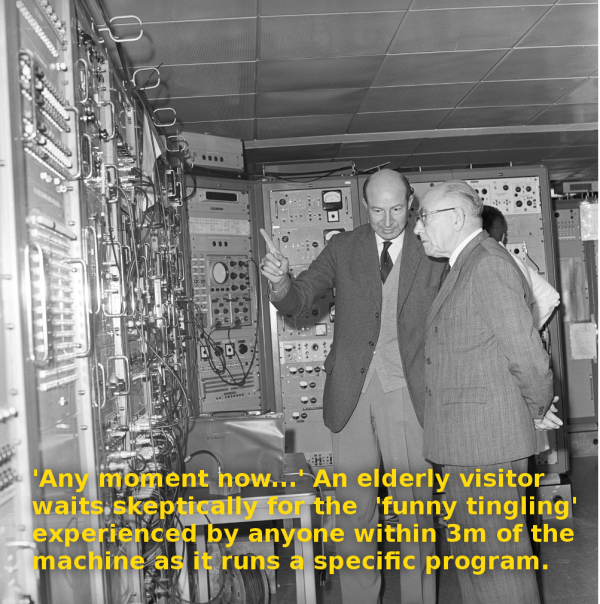
‘Any moment now…’ An elderly visitor waits skeptically for the ‘funny tingling’ experienced by anyone within 3m of the machine as it runs a specific program.
Week 6 just started! Caption the image for your chance to win a T-shirt of your own!
CERN scientists and engineers often find themselves in interesting positions. However, we’re not sure if this CERN staffer ever expected to be quite where he is now!
The only hard information we have to go on is the album this title of the image: “SEPARATEURS ELECTRO STATICS MONTAGE DES ELECTRODES”. Our French isn’t as good as our C++ or x86 assembly, but that sounds like electrostatic separators. Which separators, on which beamline, and in what decade? Your guess is as good as our’s, or CERN’s for that matter.
Add your humorous caption as a comment to this project log. Make sure you’re commenting on the project log, not on the project itself. As always, if you actually have information about the image or the people in it, let the folks at CERN know on the original image discussion page.
If you really want to see what’s happening at CERN, enter The Hackaday Prize! You could win a trip to Geneva, Switzerland to visit CERN yourself (not to mention a trip to space)!
Last year we challenged you to build the next generation of connected devices. Six months later, the best teams and projects from around the world battled for the greatest prize of all: the respect of their peers and a trip to space. This year, we’re issuing a call to hackers, engineers, makers and startups from all over the world, to focus their creative efforts on nothing less than solving serious issues facing humanity.
Fix the World
We’ll all be facing a lot of problems in the next few decades, whether they’re from rising costs and consumption of oil, droughts, access to food, demographic shifts in populations, or increasing health care costs. These problems need to be dealt with, and there’s no better time than right now to start working on solutions.
What do we want from you? We want you to identify the greatest problems faced by humanity in the next few years and come up with a solution. This can be anything from better, lower-cost solar power components, inexpensive ultrasound machines, better ways to store drugs, more advanced ways of measuring farm production, or cheaper, more sustainable smartphones to bridge the digital divide. The world is full of problems, but if there’s one thing hackers have taught us, it’s that there are more than enough people willing to find solutions.
Prizes
If worldwide notoriety isn’t enough personal incentive, Hackaday is back with a huge slate of prizes for those devices that best exemplify solutions to problems that matter.
The Grand Prize is a trip to space on a carrier of your choice or $196,883 (a Monster Group number). Other top prizes include a 90-Watt laser cutter, a builder kit (pcb mill, 3d printer, cnc router, bench lathe), a tour of CERN in Geneva, and a tour of Shenzhen in China.
New this year is the Best Product award. Go the extra mile and show a production-ready device (in addition to supplying three beta test units for judging) and you can score $100,000! The entry is of course still eligible to compete for the Grand prize and other top prizes.
We’re able to pull this off once again thanks to the vision of Supplyframe who managed to unite giants of the electronics industry as sponsors of the 2015 Hackaday Prize. Atmel, Freescale, Microchip, Mouser, and Texas Instruments have all signed on in supporting this mission.
Individuals, Colleges, Hackerspaces, and Startups
If you just don’t want to go-it alone, get your team excited. After all, it was a team that won the Grand Prize last year. SatNOGS transformed the cash-option of $196,418 into a jumpstart for a foundation to carry the project forward. Get the boss on board by touting the notoriety your company will get from showing off their engineering prowess. Or help build your resume by herding your college buddies into some brainstorming session. And the Best Product prize is perfect for Startups who want to show off their builds.
Judges
Joining the Judging Panels this year are Akiba (Freaklabs), Pete Dokter (Sparkfun), Heather Knight (Marilyn MonRobot), Ben Krasnow (GoogleX & host of Applied Science on YouTube), Lenore Edman & Windell Oskay (Evil Mad Scientist Labs), and Micah Scott (Scanlime).
Our returning judges are Limor “Ladyada” Fried (Adafruit), Jack Ganssle (Ganssle Group, & The Embedded Muse), Dave Jones (EEVBlog), Ian Lesnet (Dangerous Prototypes), and Elecia White (Logical Elegance).
You can read all of the judge bios and find social media and webpage links for them on our Judges page. We are indebted to these industry experts for sharing their time and talent to make the Hackaday Prize possible.
Tell Everyone
We don’t ask often: please tell everyone you know about the 2015 Hackaday Prize! Social media share icons are just above the image at the top of this post. Submit this page or the prize page (http://hackaday.io/prize) to all your favorite sites. No hacker should get through this day without hearing about #HackadayPrize and we can’t reach total media saturation without your help. Thanks in advance!
GET STARTED NOW
Don’t wait, put up an idea right now and tag it with “2015HackadayPrize”. We’re sending out swag for early ideas that help get the ball rolling. And as you flesh out your plans you could score prizes to help build the prototype like PCBs, 3D prints, laser cutting, etc. Make it to the finals and you’ll be looking at the five top prizes we mentioned earlier. A simple idea can change the world.
Today we’ll take a journey into less noisy noise, and leave behind the comfortable digital world that we’ve been living in. The payoff? Smoother sounds, because today we start our trip into analog.
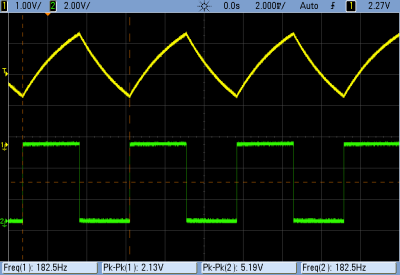
If you remember back to our first session when I was explaining how the basic oscillator loads and unloads a capacitor, triggering the output high or low when it crosses two different thresholds. At the time, we pointed out that there was a triangle waveform being generated, but that you’d have a hard time amplifying it without buffering. Today we buffer, and get that triangle wave out to our amplifiers.
But as long as we’re amplifying, we might as well overdrive the amps and head off to the land of distortion. We’ll do just that and build up a triangle-wave oscillator that can morph into a square wave, passing through a rounded-over kinda square wave along the way. The triangle sounds nice and mellow, and the square wave sounds bright and noisy. (You should be used to them by now…) And we get everything in between.
And while we’re at it, we might as well turn the triangle wave into a sawtooth for that nice buzzy-bass sound. Then we can turn the fat sawtooth into a much brighter sounding pulse wave, a near cousin of the square wave above.
What’s making all this work for us? Some dead-boring amplification with negative feedback, and the (mis-)use of a logic chip to get it. After the break I’ll introduce our Chip of the Day: the 4069UB.
If you somehow missed them, here are the first three installments of Logic Noise:
Each year the giant South by Southwest (SXSW) festival descends on Austin, Texas. It attracts droves of music lovers, among them an ocean of our kind of tech geeks. This year the crowd will trend evermore in that direction since Hackaday has decided to be there too!
In addition to scouring the crowd for awesome tech, we have a booth and are hosting an organized Hackaday meetup on Friday 3/13 at 11:00am. It’s free to all so put it on your calendar now! Several of our Hackaday crew will be there, we’re bringing cool hardware, and of course we’ll have some swag in tow the most hardcore of hackers.
This is one chance to talk about our passion: hardware development. We’ll be discussing the concept of focused and sustained efforts at building hardware as individuals, small teams, and a growing community. We know this is possible… we saw a lot of it with The Hackaday Prize and had a great look at one type of distributed development process through Developed on Hackaday which followed the Mooltipass project. Of course it’s not a lecture so bring your own ideas while we all chew the fat of what the future needs to look like.
As we mentioned, we have a booth at SXSW Create. Entry is again free to all and runs 11am-6pm for three days — find us in one of the four corner stalls. There we will be exhibiting the hardware from SatNOGS, ChipWhisperer, PortableSDR, Open Science Tricorder, and RamanPi. Don’t know what’s notable about these projects? They all won big for sharing the details of their future tech designs.
So, find us there! Give a shout on Twitter if you wonder what’s going on (we’re always looking for a good impromptu beer meetup or taco crawl). @hackaday, @hackadayio, @hackadayprize
In the last video I demonstrated a Universal Active Filter that I could adjust with a dual-gang potentiometer, here I replace the potentiometer with a processor controlled solid-state potentiometer. For those that are too young to remember, we used to say “solid-state” to differentiate between that and something that used vacuum tubes… mostly we meant you could drop it without it breakage.
Using SPI to set Cutoff of Low Pass Filter
UAF42 Filter with Dual Ganged Pots
The most common way to control the everyday peripheral chips available is through use of one of the common Serial Protocols such as I2C and SPI. In the before-time back when we had only 8 bits and were lucky if 7 of them worked, we used to have to memory map a peripheral or Input/Output (I/O) controller which means we had to take many control and data lines from the microprocessor such as Data, Address, Read/Write, system clocks and several other signals just to write to a couple of control registers buried in a chip.
Nowadays there is a proliferation of microcontrollers that tend to have built-in serial interface capability it is pretty straightforward to control a full range of peripheral functions; digital and analog alike. Rather than map each peripheral using said data and address lines,which is a very parallel approach, the controller communicates with peripherals serially using but a handful of signal lines such as serial data and clock. A major task of old system design, mapping of I/O and peripherals, is no longer needed.
Logic Noise is all about using logic circuits to make sounds. Preferably sound that will be enjoyable to hear and useful for making music. This week, we’ll be scratching the surface of one of my favorite chips to use and abuse for, well, nearly anything: the 4051 8-way analog switch. As the name suggests, you can hook up eight inputs and select one from among them to be connected up to the output. (Alternatively, you can send a single input to one of eight destinations, but we won’t be doing that here.)
Why is this cool? Well, imagine that you wanted to make our oscillator play eight notes. If you worked through our first installment, you built an abrasive-sounding but versatile oscillator. I had you tapping manually on eight different resistors or turning a potentiometer to eight different positions. This week, we’ll be letting the 4051 take over some of the controls, leaving us to do the more advanced knob twiddling.


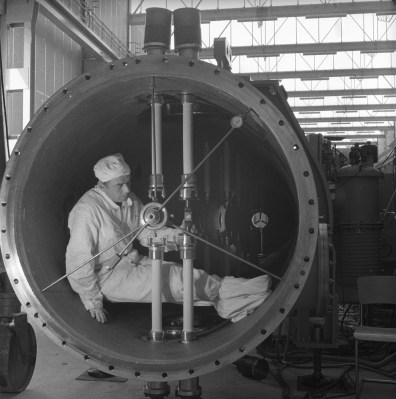 CERN scientists and engineers often find themselves in interesting positions. However, we’re not sure if this CERN staffer ever expected to be quite where he is now!