Hacking Education; Project-Based Learning Trumps The Ivory Tower

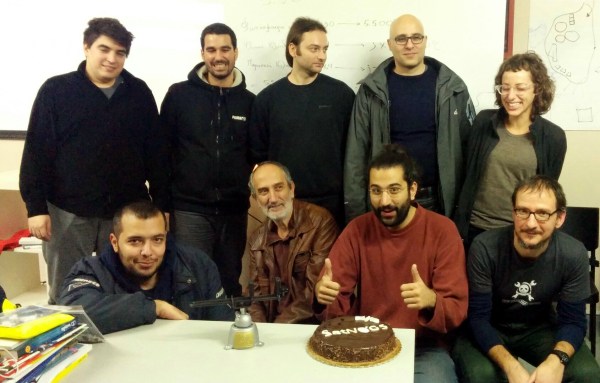
Project-based learning, hackathons, and final projects for college courses are fulfilling a demand for hands-on technical learning that had previously fallen by the wayside during the internet/multi-media computer euphoria of the late 90’s. By getting back to building actual hardware yourself, Hackers are influencing the direction of education. In this post we will review some of this progress and seek your input for where we go next.

Continue reading “Hacking Education; Project-Based Learning Trumps The Ivory Tower”

[Sophi Kravitz] Joins The Hackaday Crew

Please join us in welcoming [Sophi Kravitz] to the Hackaday crew. She is coming on board to crank on the 2015 Hackaday Prize. You may remember a post from a few weeks ago when we were in search of a person with a skill set that could only be described as mythical. [Sophi] jumped at the chance and it is immediately clear that she belongs here.

[Sophi] walks the walk, and talks the talk. She’s an EE and has worked with art installations, built props and FX for movies, and tackled jobs that some might consider ‘more serious’ engineering challenges. Her passion for electronics has led her to evangelize education on the subject by working with student programs, and she recently served as a Hacker in Residence with Sparkfun. Her love of the hardware community already has her promoting hacking by immersing herself in Hackerspace culture and organizing events like the Bring a Hack meetup at Maker Faire New York.

We have big plans for the 2015 Hackaday Prize which will be announced soon. In the meantime, anyone attending the International Consumer Electronics Show (CES) next week can meet up with [Sophi] and find out about the plans we’ve made so far. She will be at CES to represent Hackaday along with [Mike Szczys] and [Sarah Petkus]. We’re planning an impromptu meetup for anyone interested. Reply to this Tweet to tell us you’ll be there and we’ll make sure to get you the details when we have them. And of course, if you want to get your hands on some Hackaday stickers track us down during the conference. Check out our CES Twitter list to make more connections.

Trinket EDC Contest Entry: Shorty

Sometimes finding a short-circuit is easy, especially after the magic smoke has escaped. Finding a short on a newly etched or milled board though, can be a maddening task. Many of us have been there – wrestling with multimeter probes under a magnifier trying to find the offending bit of copper that is the source of all our problems. [Jaromir] designed Shorty to make this task a little bit easier.

Shorty is a short-circuit finder – but it’s not exactly like the one you would find on a typical multimeter.  [Jaromir] used MCP6041 Op-Amp to detect resistances down to the order of tens of milliohms. Determining an exact resistance measurement at these levels would require a heck of a lot of calibration. When looking for a short though, [Jaromir] is only concerned with the relative value – is he getting closer to or further away from the short. He determines this by sound. The Op-Amp output is sent to the Pro Trinket’s ADC input. The trinket drives a speaker with lower or higher tones based upon the ADC voltage. Much like the childhood game of “hot and cold”, Shorty will direct you right to your short!

There’s still time to enter the Trinket Everyday Carry Contest. The main contest runs until January 2, but we’re having random drawings every week! Don’t forget to write a project log before the next drawing at 9pm EST on Tuesday, December 30th. You and all of the other entrants have a chance to win a Teensy 3.1 from The Hackaday Store!

Trinket EDC Contest Entry: Can I Borrow A Feeling?

We got a case of the Mondays just reading about [Sascha]’s work environment. Get this: every morning, first thing, the whole team gets together to check in and share how they’re all feeling. And they can’t even be candid about it—there’s actually an approved list of feeling descriptors, both good and bad. It’s an admittedly big list that includes, interestingly enough, both ‘tortured’ and ’embarrassed’. Yeah. We think something like group t’ai chi on the roof each morning sounds a lot more relaxing. Since [Sascha] is between a rock and a hard place on this one, it was time to let chance take over. He raised his HaD-imprinted Trinket skyward and Can I Borrow a Feeling? was born.

The gist is simple: [Sascha] abstracts his disposition out to either ‘good’ or ‘bad’ and pushes the corresponding button. The Trinket accesses an array and returns a randomly selected feeling to the LCD. Since the official list of feelings is about 300 words long, [Sascha] has to push the data into PROGMEM. He used good old Excel to split the list in twain, and her formulas came in very handy for centering the result on the LCD. Once [Sascha] knew how it would all fit together, he designed a cool enclosure in CorelDRAW and turned on the laser cutter. See the Spreadsheet of Acceptable Words for yourself on GitHub, and pick up the code and enclosure file while you’re there.

There’s still time to enter the Trinket Everyday Carry Contest.  The main contest runs until January 2, but we’re having random drawings every week! Don’t forget to write a project log before the next drawing at 9pm EST on Tuesday, December 30th. You and all of the other entrants have a chance to win a Teensy 3.1 from The Hackaday Store!

TRINKET EDC CONTEST ENTRY: Lazydoro

[Vasilis] has entered Lazydoro in the Trinket Everyday Carry Contest.  Lazydoro is designed to get him up off his backside, and walking around. Recent medical research has determined that sitting too long is a bad thing. In fact,  Dr. David Agus has been quoted by Nike as saying that sitting for several hours is as bad as smoking (wayback machine link). While we’re not exactly up on the latest medical trends, we can definitely see that getting up and walking around a bit never hurt anyone. Lazydoro will alert [Vasilis] once every 20 minutes or so to get up and stretch his legs a bit.

[Vasilis] plans to pair a Pro Trinket with an accelerometer module, specifically an ADXL377 from Analog Devices. The accelerometer will allow Lazydoro to determine if [Vasilis] has moved around. If 20 or 30 minutes go by without major movement, Lazydoro will nudge him to get up and take a walk.

Since shipping to Greece takes awhile, [Vasilis] is developing with an Arduino Uno and a ADXL345 while he waits for his parts to arrive. He’s hacked this into a wrist mounted device for testing. One thing  [Vasilis]  hasn’t figured out yet is how to alert the user to move around. A small vibrating motor would probably work – but we’d suggest electric shocks. A good zap always puts the spring in our step!

There is still plenty of time to enter the Trinket Everyday Carry Contest.  The main contest runs until January 2, but we’re having random drawings every week! Don’t forget to write a project log before the next drawing at 9pm EDT on Tuesday, December 23. You and all of the other entrants have a chance to win a Cordwood Puzzle from The Hackaday Store!

Towards The Perfect Coin Flip: The NIST Randomness Beacon

Since early evening on September 5th, 2013 the US National Institute of Standards and Technology (NIST) has been publishing a 512-bit, full-entropy random number every minute of every day. What’s more, each number is cryptographically signed so that you can easily verify that it was generated by the NIST. A date stamp is included in the process, so that you can tell when the random values were created. And finally, all of the values are linked to the previous value in a chain so that you can detect if any of the past numbers in the series have been altered after the next number is published. This is quite an extensive list of features for a list of random values, and we’ll get into the rationale, methods, and uses behind this scheme in the next section, so stick around.

Continue reading “Towards The Perfect Coin Flip: The NIST Randomness Beacon”

Hackaday Video: Wire Wrap 101 with Bil Herd

Wire Wrap 101

You might notice that many of my writings start with “Back in the day”. Not wanting to disappoint I will say that back in the day we used to use wire wrap technology when we needed a somewhat solid, somewhat reliably assembly. Given a readable schematic a good tech could return a working or near-working unit in a day or two depending on the completeness and accuracy of the schematic.

wire-wrap2

Properly done a wire wrap assembly is capable of fairly high speed and acceptable noise when the alternative option of creating a custom PCB would take too long or not allow enough experimentation.  Wire wrap is also used in several types of production, from telco to NASA, but I am all about the engineer’s point of view on this.

My first wire wrap tool and wire wrap wire came from Radio Shack in the mid 1970’s.  I still have the wire, because frankly its kind of cheap wire and I use it when it’s the only thing I can reach quickly when I need to make a jumper on a PCB. The tool is still around also, given the fact that I can’t find it at the moment the one shown here is my new wire wrap tool which is good for low quantity wrapping, unwrapping and stripping.

ww-tool2The skinny little wrap tool is okay for hobbyist as the wraps are fine with a little practice.  But I do recommend investing in high-quality wire.  A common wire available is Kynar® coated, a fluorinated vinyl that performs well as an insulator.

Before I go too much further, here’s the video walkthrough of wire wrap, its uses, and several demonstration. But make sure you also join me after the break where I cover the rest of the information you need to start on the road to wire wrap master.

Continue reading “Wire Wrap 101”