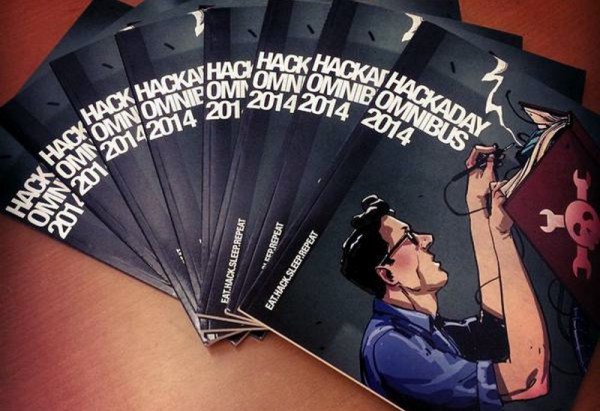
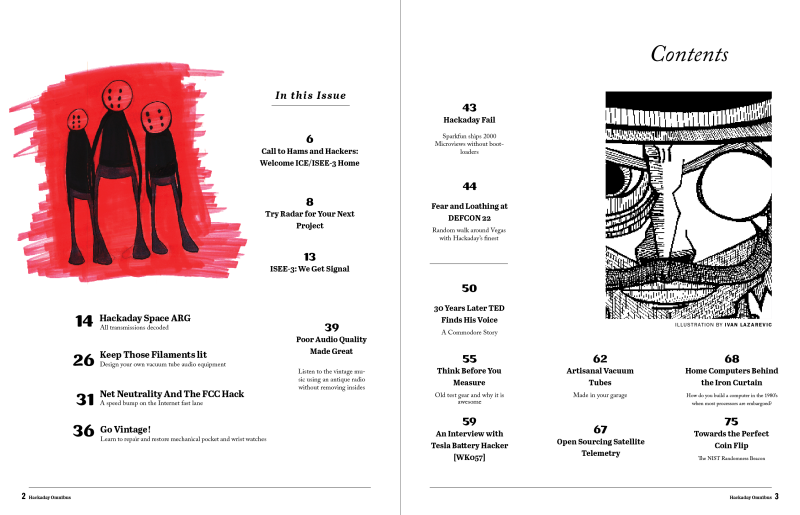
Here’s your chance to grab a tangible piece of Hackaday. This morning we are starting pre-orders for the Hackaday Omnibus 2014. This is our first-ever print edition. It collects some of the best original content published on Hackaday in 2014.
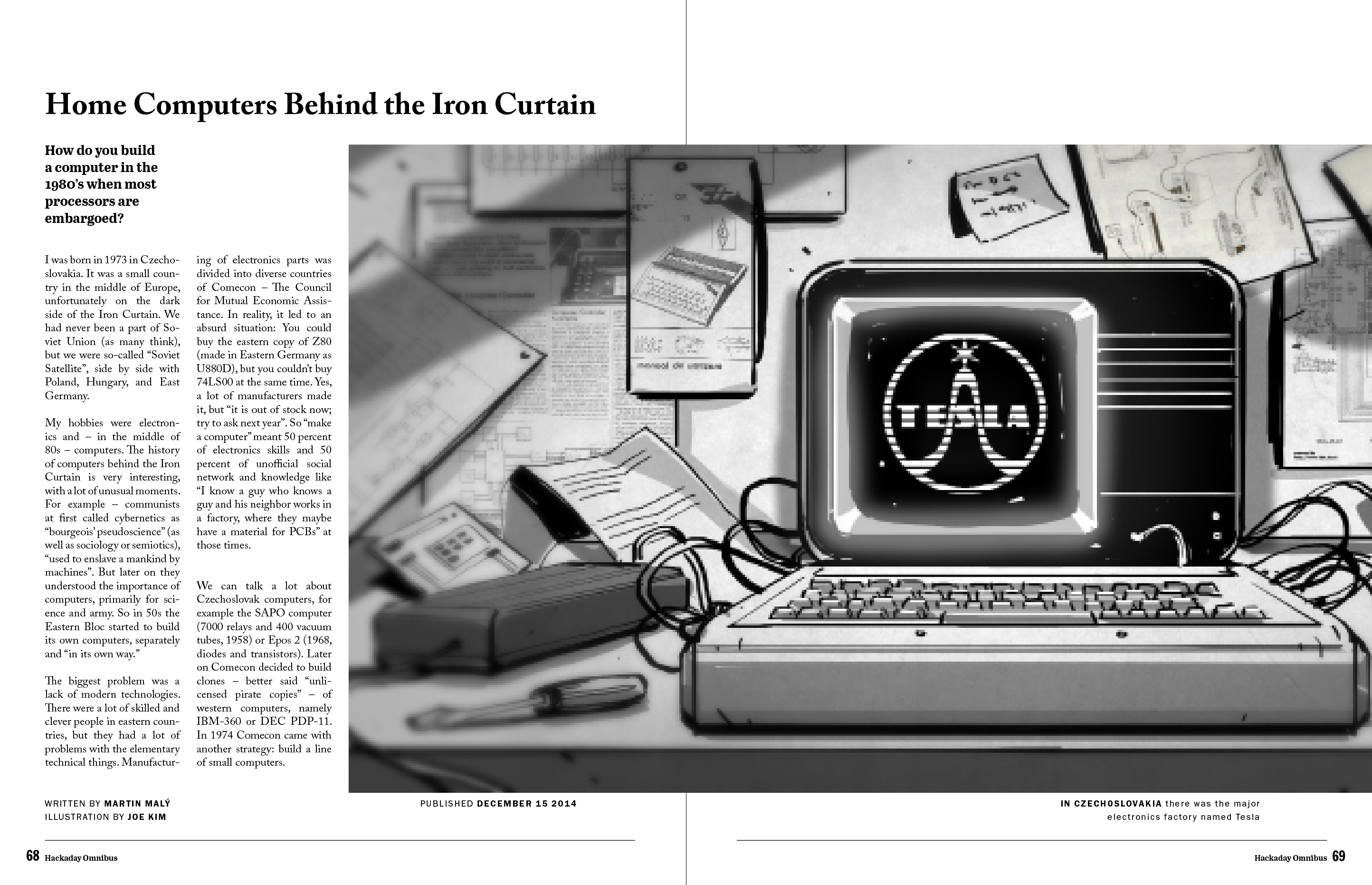
We’re proud of what the Hackaday crew accomplished last year. From stories of old and new to articles that encouraged you to stretch your hacking universe, we are thrilled with the original content articles we saw published last year. To go along with this top-tier content, we added amazing art and illustrations from [Joe Kim]. The product is something that demands commemoration in print and thus the Omnibus was born.
This full-color, 80 page, perfect binding volume is just what your coffee table has been crying out for. Of course it will look spectacular covered in solder and clipped resistor leads on the bench. And if your company is serious about hardware you need to send that message with a copy of the Omnibus in the reception area (or comically in the commode).
We are pricing the Hackaday Omnibus 2014 at $15 but we will sweeten the deal if you get in on the preorder. Use this coupon code to get $5 off: OMNIBUS2014. The coupon will work for the first 500 copies pre-ordered with an estimated shipping date of 2/9/15.
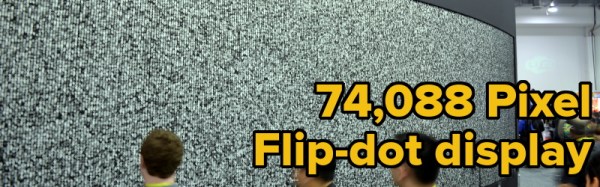
Flip-dot displays are grand, especially this one which boasts 74,088 pixels! I once heard the hardware compared to e-ink. That’s actually a pretty good description since both use a pixel that is white on one side and black on the other, depend on a coil to change state, and only use electricity when flipping those bits.
What’s remarkable about this is the size of the installation. It occupied a huge curving wall on the ooVoo booth at 2015 CES. We wanted to hear more about the hardware so we reached out to them they didn’t disappoint. The ooVoo crew made time for a conference call which included [Pat Murray] who coordinated the build effort. That’s right, they built this thing — we had assumed it was a rental. [Matt Farrell] recounts that during conception, the team had asked themselves how an HD video chat for mobile company can show off display technology when juxtaposed with cutting edge 4k and 8k displays? We think the flip-dot was a perfect tack — I know I spent more time looking at this than at televisions.
Join us after the break for the skinny on how it was built, including pictures of the back side of the installation and video clips that you have to hear to believe.
Today I am experimenting with a single chip Universal Active Filter, in this case I made a small PCB for the UAF-42 from Texas Instruments. I chose this part in particular as it facilitates setting the filter frequency by changing just a pair of resistors and the somewhat critical values that are contained on the chip have been laser trimmed for accuracy. This type of active filter includes Operational Amplifiers to supply gain and it supports various configurations including simultaneous operating modes such as Band Pass, Low Pass and High Pass make it “Universal”.
UAF421 Universal Active Filter
UAF421 Universal Active Filter using a dual ganged potentiometer.
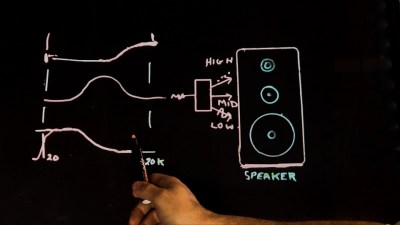
Filter Basics
Speaker Crossover Example
Looking at the block diagram you can see where I have inserted a dual-ganged potentiometer to change both resistors simultaneously which should allow a straight forward adjustment for our purposes here.
Looking into the components of a simple RC filter which can easily implement a simple Low Pass or High Pass filter, we see that the math is fairly straight forward and swapping the components with each other is all that is needed to change the type of filter. Continue reading “Universal Active Filters: Part 1”→
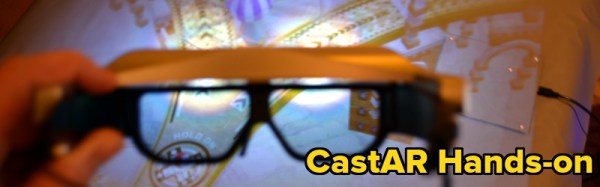
At long last I had the opportunity to try out the CastAR, a glasses-based Augmented Reality system developed by Technical Illusions. The hardware has been in the works now for a couple of years, but every time we have come across a demo we were thwarted by the long lines that accompany them. This time I was really lucky. [Jeri] gave us a private demo in a suite at the Palazzo during CES 2015. Reflecting on the experience, CastAR is exactly the type of Virtual Reality hardware I’ve been longing for.
This year’s CES has dredged up some memories. I had assumed that as one becomes old they are supposed to become used to memories of a young vigorous person that shared their body and memories leaving little else except some scars and some old stale socks lying around plus 2 or 3 pictures to prove it was in fact not a series of hallucinations. Turns out you don’t get used to it, you just endure.
30 Years ago was our CES: Commodore had the reputation of showing something new every CES and this was a time when a Home Computer meant a Consumer Computer. I have written before about how we endeavored to make sure other’s failures didn’t become ours and we did in fact make it, just in time, to the ’85 CES with what became our flagship computer, at least for the next 4 days.
To the Very Last Minute
1985 Commodore CES Booth
Commodore 1985 CES Booth: an “elegant” grey and yellow battleship parting the CES seas. (Marketings’ idea)
Putting 85 CES together. Pics courtesy of [Terry Ryan]
When I say made it just in time I am counting people hand carrying the last ten or so homebrewed and MOS cooked 80 column chips either the night before or that very morning. The C128 computers where waiting lined up and open in the room seen below; cases agape much like a row of baby birds waiting on whatever engorgement MOS had come up with for us as the seconds counted down.
And then finally we stood on the second floor of our booth (yes they built a 2 story structure for us in a couple of hours the night before) surveying the now working computers; C128’s and the never released LCD machine, when the last “issue” before the doors opened arrived; a Marketing person (panting) telling us of “yet another C128 failure” though she couldn’t actually point to any previous computers that had failed. We wouldn’t let her continue with her complaint until she retracted the previous general statement of failure, more on principle than actual meanness.
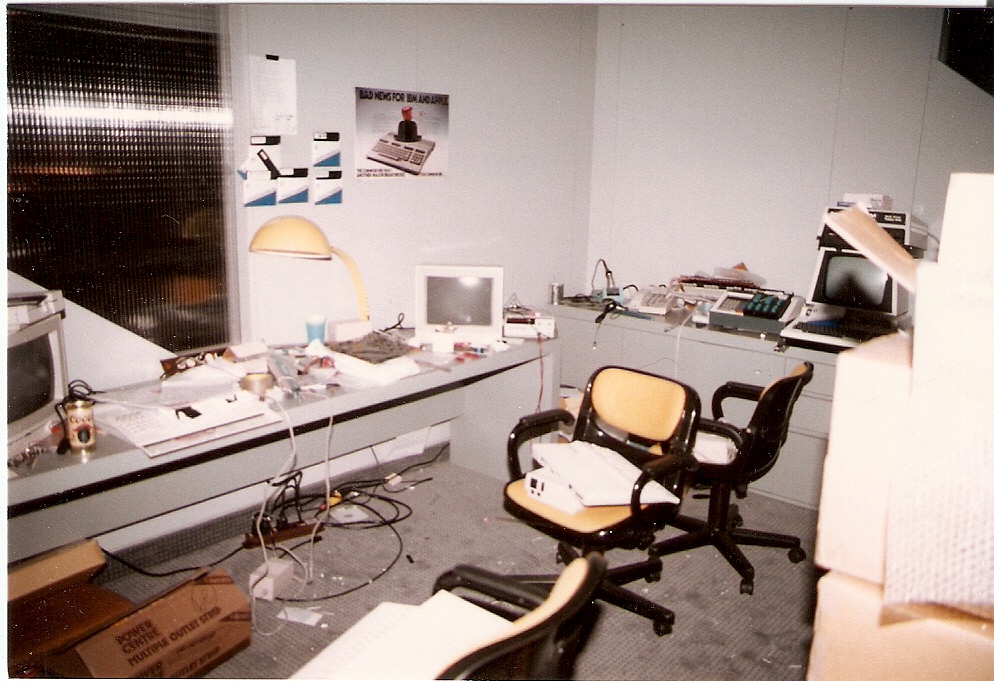
The “Prep” room now empty, every CES C128 computer came through here. Note the EPROM burner and disks taped to the wall along with a residual Coors beer can
As with most highly technical in-the-field fixes this one was something to remember. My last act of “the ’85 CES show” became the simple motion of walking up to the “failed” computer station and pressing the key changing the C128 back to 40 column mode, especially important since it only had a 40 column monitor attached to it.
End of Line
Then something happened: We were done. I felt sub-processes actually end that had been consuming both CPU and I/O for months, I was suddenly unencumbered by the next “must fix”. I didn’t have a next task to pop from the stack… the phrase “End of Line” came to mind.
I was 24, in Las Vegas and had just delivered one of the major products for the best computer company in the world to the only show that mattered to us. I started walking towards the door with the uncommonly bright Las Vegas sun streaming through the windows. There were lines of people around the block waiting to enter, but the exit was completely unobstructed.
I buried myself in Las Vegas in a way that only youth, testosterone, and adrenaline can enable.
Making the Rounds
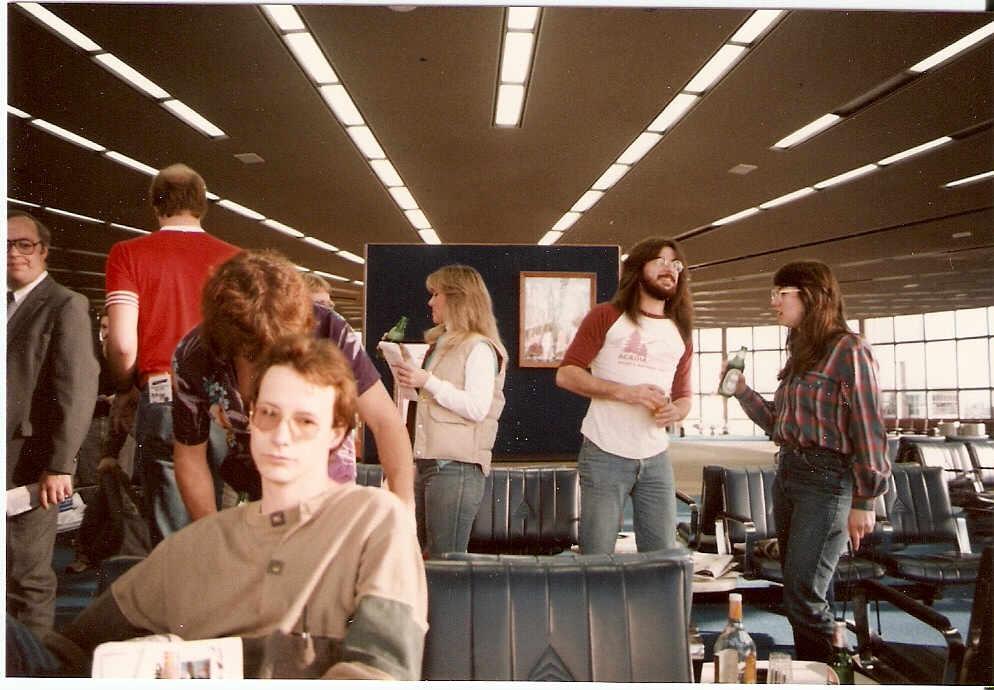
Thats me with the long hair and the girl (Judy Braddick, a somewhat brilliant Game Programmer). Note the bottle of Tequila and empty beer bottle sitting on the table in the Las Vegas airport. Greg Berlin is on the left standing two feet taller than normal humans. (Hedley Davis of Xbox fame in the foreground). It was a good CES.
I won’t report here much of what all was done over the next days as I understand that for some things the statute of limitations never truly runs out, but inspired by [Mike’s] reporting of visiting the suites of the companies I will relate one small tale here: I had grabbed my best friend and fellow hardware designer who was the father of the 1581 disk drive, also successfully released on this day, and headed out. With the 6’8” [Greg Berlin] (grandson of the designer of the Curtis Wright P-40 Warhawk) in tow we started hitting the floors of the local hotels looking for the suites of the “important” companies that never managed to personally invite us. We had a secret weapon that opened doors as if bribed; not in Greg’s towering presence but in the simple phrase: “we’re from Commodore”.
Doors fully opened that had previously opened only 12-14 inches only to stop on the shoe of the doorman, and 5.25” floppies were stuffed in our pockets like the $20 bills of a VIP trying to impress his date. The suite that comes to mind was that of Electronic Arts (EA). With backslaps and copies of this year’s (and a few of last year’s) C64 game floppies shoved in our pockets we were welcomed like old friends; appointments were made and more than a couple of chugging contests were held. They lost or at least didn’t better us as we were young and full of testosterone.
As we made ready to leave the good folk of EA, after making sure that we would swing by their booth the next day (we did), they asked if there was anything they could get for us. This may sound like a strange or gratuitous question but I had already spied the case of Michelob (a beer from the early days of 1 micron silicon) and was pointing to it before the question was fully uttered. EA grabbed the case with no hesitation as I turned to face the door so he could set the case of teardrop shaped bottles on my shoulder for me.
Back out into Las Vegas we went with Electronic Art’s beer on my shoulder… It was a good CES.
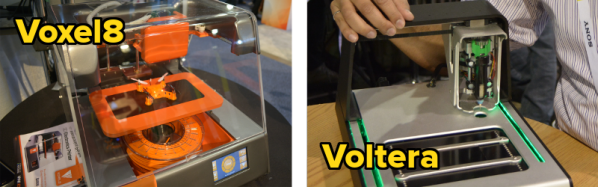
There are two printers being shown off at the 2015 Consumer Electronics shows which really spark our interest. They are the Voltera and the Voxel8. Each is taking on the challenge of printing circuits. They use similar techniques but approach the problem in very different ways.
Voxel8
[Michael Bell] poses with the Voxel8
Quad on the print bed of the Voxel8
3D printed quadcopter — conductive traces and all
The Voxel8 marries the idea of a 3D printer with a silver conductive ink dispenser. You start by modeling your entire design, hardware and electronics, all in one. The printer will then begin the 3D print, pausing when necessary for you to add electronics and mechanicals. With the parts — and their pins — in place it lays out the conductive ink to connect the components and then continues with the 3D printing to finish the object.
Voltera
[Alroy Almeida] poses with the Voltera
PCB demo, colored traces are for insulation between layers
PCB with components populated
The Voltera is a PCB printer that uses silver conductive ink. It prints the ink onto a substrate. Pads made of the ink are used to solder the components in place after the printing is finished. The trick added to this design is the ability to print two layers, both on the same side of the board. There is a second ink material which is an insulator. It is laid over the first conductive layer before the second is printed, allowing traces to cross over each other.
Congratulations to the Voltera team who won $50k from the 2015 Hardware Battlefield at CES.
Our Thoughts
We didn’t see enough to shake our skepticism about the viability of silver conductive ink to take the place of copper on prototype boards. But if anyone is going to make the case that it is plausible these two offerings will.
One interesting thing about the Voxel8 is the ability to specify point-to-point wiring as a “part”. If you do so, the machine will pause while you solder the wires in place before it encapsulates them with the rest of the print. Of course if you’re going to do this manually it shouldn’t really matter which printer you use for it.
What do think about the future of conductive ink for prototyping? Lets us know in the comments.
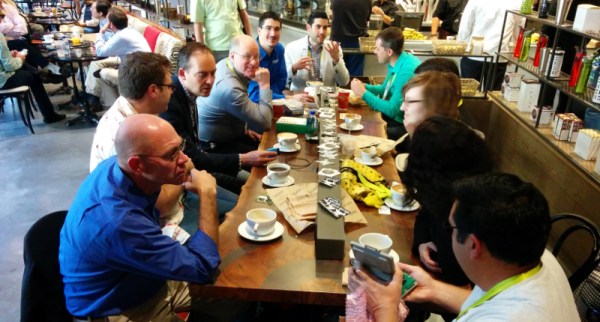
Hackaday started off Thursday of the Consumer Electronics Show with an impromptu breakfast meetup. This turns out to be a wonderful thing as it lets you ease into a 16 hour day of standing, walking, talking, and getting lost trying to find your way from conference hall to conference hall. We had a great turnout and many brought their hacks and demos to show off. A big thanks to the Sambalatte staff who are awesome people and top tier baristas.
CastAR
Before leaving for CES I was talking to [Ben Krasnow] about what we should try to see and he suggested looking for private showings that are given in the suites of the hotels at the conference. Turns out our friends at Technical Illusions are doing just that. [Jeri] and [Rick] were showing off CastAR in a suite during the week and were nice enough to make room in their booked schedule for a private Demo.
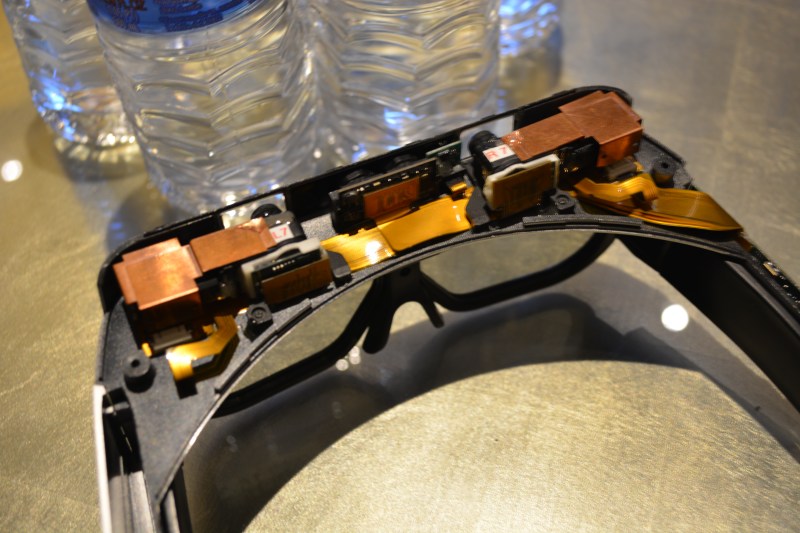
What you see above are the guts of the version they are currently shipping as part of their Kickstarter fulfillment. I also got a look at a rev2 prototype and will write a follow-up post with more information on the whole experience when I have more time.
Eureka, Startups!
There is a loop of aisles in the Sands that has startup booths and most of the interesting things I saw on Wednesday and Thursday are there. Here we have a jamming gripper robot arm. It’s designed for things like moving oddly shaped goods on a manufacturing line. Empire Robotics hit a homerun with their demo for the booth, a take on beer-bong: robot versus human. The scoreboard showed the robot winning an order of magnitude more than the humans.
[Todd] was at was at the Tinkerines booth showing off 3D printers aimed to augmented the STEM curriculum. We couldn’t help but notice his TIE fighter right and inquired about it. He modeled the design himself, send it off to be cast in silver, and inlaid the stone when the ring came back from the casting service. Sweet!
LVBots
[Sarah Petkus] clued me in and gave me a ride to the Pololu CES open house. The night coincided with the LVBots meetup which they support by providing space for the meetings. There were lots of cool robots being shown off. What you see here was just the pre-meeting warmup of line-followers and sumo robots. I shot some video of the show-and-tell which we’ll post once we’ve had a chance to edit the content.
Closing out CES
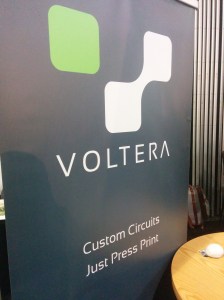
Today is the last day of the conference. I stopped by the Voltera PCB printer booth yesterday but they were nowhere to be found. Turns out they were being handed a $50k check by TechCrunch for winning the Battleground. I suppose we’ll give them a pass for not being at the table during that!
I’ll be headed over this afternoon to catch up with them. I’m also hoping to get a look at the Voxel8 printer. If you have any other “can’t-miss” suggestions let me know in the comments and I’ll try to add them to my CES dance card.







![[Michael Bell] poses with the Voxel8](https://i0.wp.com/hackaday.com/wp-content/uploads/2015/01/dsc_0405.jpg?w=530&h=353&ssl=1 "DSC_0405")


![[Alroy Almeida] poses with the Voltera](https://i0.wp.com/hackaday.com/wp-content/uploads/2015/01/dsc_0432.jpg?w=524&h=350&ssl=1 "DSC_0432")




 Today is the last day of the conference. I stopped by the








