Retro Gadgets: Nintendo R.O.B Wanted To Be Your Friend

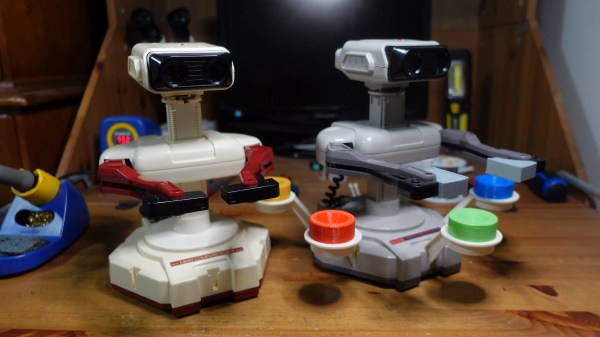
Too busy playing video games to have a social life? No worries. In 1985, Nintendo introduced R.O.B. — otherwise known as the Robotic Operating Buddy. It was made to play Nintendo with you. In Japan, apparently, it was the Family Computer Robot. We suppose ROB isn’t a very Japanese name. The robot was in response to the video game market crash of 1983 and was meant to keep the new Nintendo Entertainment System (NES) from being classified as a video game, which would have been a death sentence at the time of its release.

Since you might not have heard of R.O.B., you can probably guess it didn’t work out very well. In fact, the whole thing tanked in two years and resulted in only two games.

Continue reading “Retro Gadgets: Nintendo R.O.B Wanted To Be Your Friend”

Drilling Glass With Femtosecond Lasers Just Got Even Better

Glass! It’s a finicky thing. Strong as hell, yet chip it and glance at it the wrong way, and you’re left with a bunch of sharp rubbish. It’s at once adored for its clarity and smoothness, and decried for how temperamental it can be in the case of shock, whether mechanical, thermal, or otherwise.

If you’ve ever tried to drill glass, you’ll know it’s a tough errand. To do so without cracking it is about as likely as winning the lottery on Mars. Even lasers aren’t great at it. However, a research team from France has developed a new technique that uses femtosecond lasers to drill microscopic holes in glass with a minimum of tapering and no cracking! Brilliant, no?
Continue reading “Drilling Glass With Femtosecond Lasers Just Got Even Better”

MXenes Make Faraday Cages You Can Turn On And Off

Shielding is crucial for all manner of electronic devices. Whether you want to keep power supply noise out of an audio amplifier, or protect ICBMs against an electromagnetic pulse from a nuclear attack, the basic physics behind shielding remains the same. A Faraday cage or shield will do the trick.

At times, though, it would be desirable to shield and unshield a device at will. A new class of materials known as MXenes may be able to offer just that functionality, with microscopically thin films serving as shields that can be switched on and off at will.

Continue reading “MXenes Make Faraday Cages You Can Turn On And Off”

How To Build Jenny’s Budget Mixing Desk

Jenny did an Ask Hackaday article earlier this month, all about the quest for a cheap computer-based audio mixer. The first attempt didn’t go so well, with a problem that many of us are familiar with: Linux applications really doesn’t like using multiple audio devices at the same time. Jenny ran into this issue, and didn’t come across a way to merge the soundcards in a single application.

I’ve fought this problem for a while, probably 10 years now. My first collision with this was an attempt to record a piano with three mics, using a couple different USB pre-amps. And of course, just like Jenny, I was quickly frustrated by the problem that my recording software would only see one interface at a time. The easy solution is to buy an interface with more channels. The Tascam US-4x4HR is a great four channel input/output audio interface, and the Behringer U-PHORIA line goes all the way up to eight mic pre-amps, expandable to 16 with a second DAC that can send audio over ADAT. But those are semi-pro interfaces, with price tags to match.

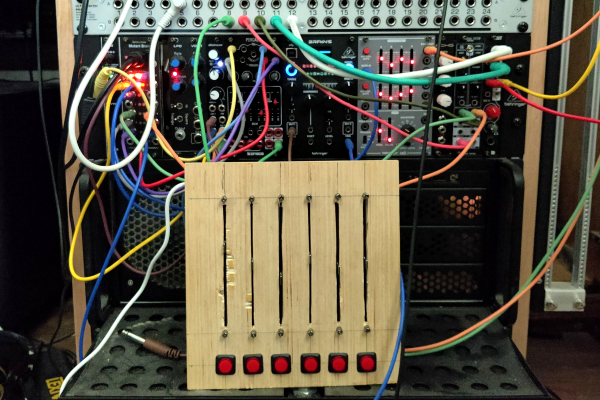
But what about Jenny’s idea, of cobbling multiple super cheap interfaces together? Well yes, that’s possible too. I’ll show you how, but first, let’s talk about how we’re going to control this software mixer monster. Yes, you can just use a mouse or keyboard, but the challenge was to build a mixing desk, and to me, that means physical faders and mute buttons. Now, there are pre-built solutions, with the Behringer X-touch being a popular solution. But again, we’re way above the price-point Jenny set for this problem. So, let’s do what we do best here at Hackaday, and build our own. Continue reading “How To Build Jenny’s Budget Mixing Desk”

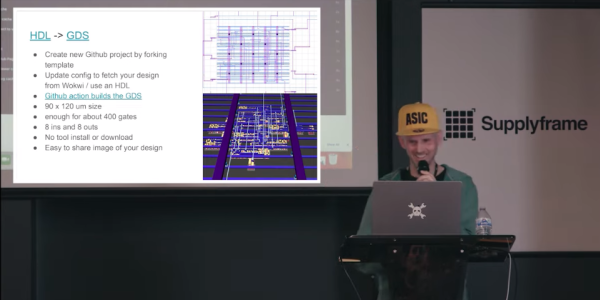
Matt Venn speaking at Supercon 2022

Supercon 2022: Matt Venn’s Tiny Tapeout Brings Chip Design To The Masses

Not that long ago, rolling your own printed circuit boards was difficult, time-consuming and expensive. But thanks to an army of cheap, online manufacturing services as well as high-quality free design software, any hobbyist can now make boards to rival those made by pros. A similar shift might be underway when it comes to chip design: affordable manufacturing options and a set of free software tools are slowly bringing custom chips into the realm of hackers and hobbyists. One of those working hard to democratize chip design is Matt Venn, who’s been telling us all about his current big project, called Tiny Tapeout, in his talk at Remoticon 2022.

Matt’s quest to bring IC design to the masses started in 2020, when the first open-source compatible Process Design Kit (PDK) was released to the public. A PDK is a collection of files, normally only available under strict non-disclosure agreements, that describe all the features of a specific chip manufacturing process and enable you to make a design. With this free PDK in hand and a rag-tag collection of free software tools, Matt set out to design his first chip, a VGA clock, which he taped out (released to manufacturing) in July 2020. Continue reading “Supercon 2022: Matt Venn’s Tiny Tapeout Brings Chip Design To The Masses”

All About USB-C: Talking Low-Level PD

In this USB-C series, we’ve covered quite a bit of USB-C – things that are well known, things that should beĀ  better known, and a couple things that just appeared online for the first time. We’ve covered almost everything in some depth except USB Power Delivery. I’ve described the process a bit in the “Power” article, but that was mostly about how to use PD by simply buying the right solution. However, that’s not enough for a hacker. Let’s see if we can make our own PD trigger board. Continue reading “All About USB-C: Talking Low-Level PD”

Methane Pyrolysis: Producing Green Hydrogen Without Carbon Emissions

Generally, when we talk about the production of hydrogen, the discussion is about either electrolysis of water into oxygen and hydrogen, or steam methane reforming (SMR). Although electrolysis is often mentioned – as it can create hydrogen using nothing but water and electricity – SMR is by far the most common source of hydrogen. Much of this is due to the low cost and high efficiency of SMR, but a major disadvantage of SMR is that large amounts of carbon dioxide are released, which offsets some of the benefits of using hydrogen as a fuel in the first place.

Although capturing this CO2 can be considered as a potential solution here, methane pyrolysis is a newer method that promises to offer the same benefits as SMR while also producing hydrogen and carbon, rather than CO2. With the many uses for hydrogen in industrial applications and other fields, such as the manufacturing of fertilizer, a direct replacement for SMR that produces green hydrogen would seem almost too good to be true.

What precisely is this methane pyrolysis, and what can be expect from it the coming years?

Continue reading “Methane Pyrolysis: Producing Green Hydrogen Without Carbon Emissions”