Paper Airplane Machine Gun V2.0

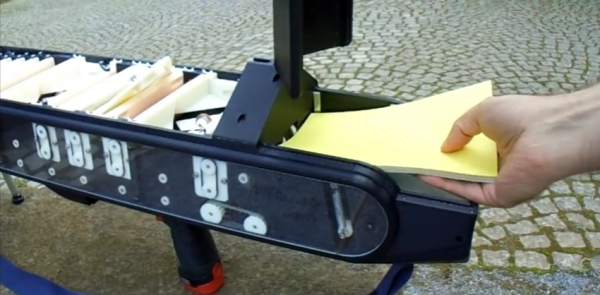
A little over two years ago we posted an amazing contraption that holds a stack of paper sheets, folds them into paper planes, and launches them. There’s now a newer version — the PFM A5 v2.0. It is over a meter long, weighs about 10 kilograms, and features a mind-boggling number of gears and moving parts. Video is embedded below.

In one end travels one sheet of paper after the next. At each stage in the process the paper is folded (symmetrically) and creased by a vertical wheel to make up the keel of the finished plane before launching out the other end. Amazing, and not a jam or “PC Load Letter” error message in sight!

This, of course, has a purpose… junk ads from the sky!

Continue reading “Paper Airplane Machine Gun V2.0”

The 3D Printers Of CES

CES is over, and now we can take a step back, distance ourselves from the trade show booths, and figure out where 3D printing will be going over the next year.

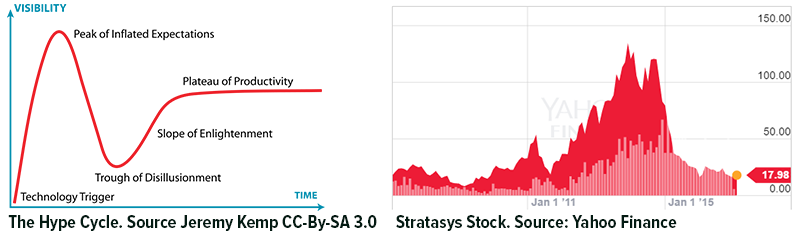
The Hype Cycle is a great way to explain trends in fads and technological advances. VR and autonomous cars are very early on the Hype Cycle right now. Smartphones are on the plateau of productivity. 3D printing is head-down in the trough of disillusionment.

For this year’s CES, 3D printing is not even a product category. In fact, the official documentation I found at Prusa’s booth listed their company in the ‘Assistive Technologies’ category. These are dark days for the public perception of 3D printing. The source of this perception can be brilliantly presented in a pair of graphs:

hype-cycle

The perception of 3D printing has been tied inexorably to Makerbot. Makerbot presented the only 3D printer on The Colbert Report. Only Makerbot had their 3D printing storefronts featured on CNN. It’s been like this for half a decade, and hopefully things will get better.

This doesn’t mean 3D printing isn’t improving. In fact, it’s the best it’s ever been. CES had the most innovative printers I’ve seen in years. I caught a glimpse of this year’s top-selling printer (and it launches in April). Resin machines are going to be very popular soon. What did CES have to offer? Check it out below.

Continue reading “The 3D Printers Of CES”

First flight

Why The Wright Brothers Succeeded

The types of steps and missteps the Wright brothers took in developing the first practical airplane should be familiar to hackers. They started with a simple kite design and painstakingly added only a few features at a time, testing each, and discarding some. The airfoil data they had was wrong and they had to make their own wind tunnel to produce their own data. Unable to find motor manufacturers willing to do a one-off to their specifications, they had to make their own.

Sound familiar? Here’s a trip through the Wright brothers development of the first practical airplane.

Continue reading “Why The Wright Brothers Succeeded”

IoT-ify All Things: LG Has Gone Overboard

If you been following Hackaday lately, you’ve surely noticed an increased number of articles about IoT-ifying stuff. It’s a cool project to take something old (or new) and improve its connectivity, usually via WiFi, making it part of the Internet of Things. Several easy to use modules, in particular the ESP8266, are making a huge contribution to this trend. It’s satisfactory to see our homes with an ESP8266 in every light switch and outlet or to control our old stereo with our iPhone. It gives us a warm fuzzy feeling. And that’s completely fine for one’s personal projects.

But what happens when this becomes mainstream? When literally all our appliances are ‘connected’ in the near future? The implications might be a lot harder to predict than expected. The near future, it seems, starts now.

This year, at CES, LG Electronics (LG) has introduced Smart InstaView™, a refrigerator that’s powered by webOS smart platform and integrated with Amazon’s Alexa Voice Service.

… with webOS, consumers can also explore a host of WiFi-enabled features directly on the refrigerator, creating a streamlined and powerful food management system all housed directly on the front of the fridge door. Amazon’s Alexa Voice Service gives users access to an intelligent personal assistant that, in addition to searching recipes, can play music, place Prime-eligible orders from Amazon.com…

This is ‘just’ a fridge. There are other WiFi-enabled appliances by now, so what?  Apparently, during the LG press conference last Wednesday, the company marketing VP David VanderWaal said that from 2017 on, all of LG’s home appliances will feature “advanced Wi-Fi connectivity”.

Notice the word advanced, we wonder what that means? Will ‘advanced’ mean complicated? Mesh? Secure? Intelligent? Will our toaster finally break the Internet and ruin it for everyone by the end of the year? Will the other big players in the home appliances market jump in the WiFi wagon? We bet the answer is yes.

Here be dragons.

[via Ars Technica]

Did A Russian Physicist Invent Radio?

It is said that “success has many fathers, but failure is an orphan.” Given the world-changing success of radio in the late 19th and early 20th centuries, it’s no wonder that so many scientists, physicists, and engineers have been credited with its invention. The fact that electromagnetic radiation is a natural phenomenon that no one can reasonably claim to have invented sometimes seems lost in the shuffle to claim the prize.

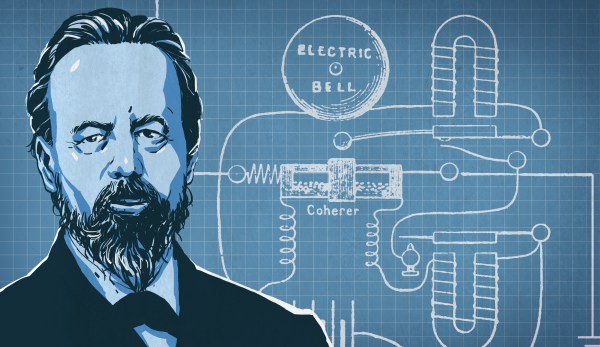
But it was exactly through the study of natural phenomena that one of the earliest pioneers in radio research came to have a reasonable claim to at least be the inventor of the radio receiver, well before anyone had learned how to reliably produce electromagnetic waves. This is the story of how a Russian physicist harnessed the power of lightning and became one of the many fathers of radio.

Continue reading “Did A Russian Physicist Invent Radio?”

Light Dimmer Shows How To Steal Power From AC Line

We see a lot of traffic on the tips line with projects that cover old ground but do so in an instructive way, giving us insight into the basics of electronics. Sure, commercial versions of this IR-controlled light dimmer have been available for decades. But seeing how one works might just help you design your Next Big Thing.

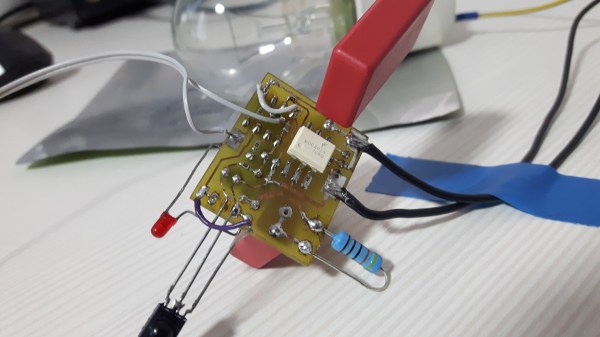
Like many electronic controls, the previous version of this hack required a connection to a neutral in addition to the hot. This version of the circuit relies on passing a small current through the light bulb the dimmer controls to avoid that extra connection. This design limits application to resistive loads like incandescent bulbs. But it’s still a cool circuit, and [Muris] goes into great detail explaining how it works.

We think the neatest bit is the power supply that actually shorts itself out to turn on the load. A PIC controls a triac connected across the supply by monitoring power line zero-crossing. The PIC controls dimming by delaying the time the triac fires, which trims the peaks off of the AC waveform. The PIC is powered by a large capacitor while the triac is conducting, preventing it from resetting until the circuit can start stealing power again. Pretty clever stuff, and a nice PCB design to boot.

Given the pace of technological and cultural change, it might be that [Muris]’ dimmer is already largely obsolete since it won’t work with CFLs or LEDs. But we can see other applications for non-switched mode transformerless power supplies. And then again, we reported on [Muris]’s original dimmer back in 2009, so the basic design has staying power.