Clearly The Best Way To Organize SMD Parts

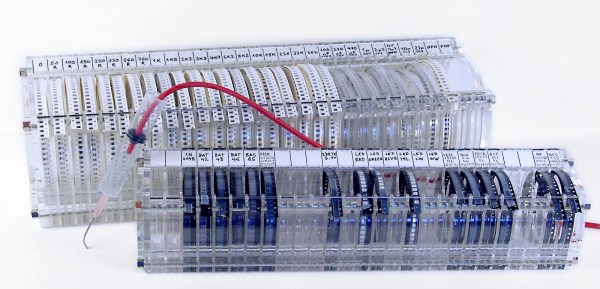
Have some plexiglas (acrylic) leftovers lying around? Well, they could be put to good use in making this SMD organizer. It comes in handy if you deal with a lot of SMD components in your work. No longer will you waste your time trying to find a 15K 1206 resistor, or that BAS85 diode… or any other component you can think of soldering on the PCB. The basic idea is fairly straightforword, which helped keep this short.
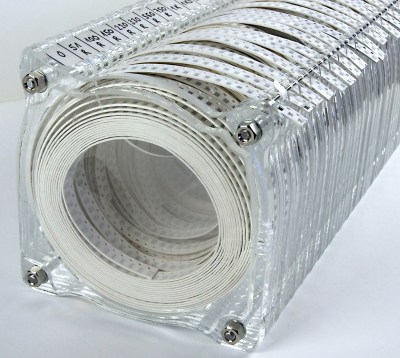
2SMD resistors are packed in thick paper tapes that don’t bend easily, and thus need larger containers than other components, which are packed mainly in flexible PE tapes. The first version of this organizer was built with a 96mm diameter space for resistors and 63mm diameter for other components, but it seems that there is no need for such large compartments. If I were to make it again, I would probably scale everything down to about 80% of it’s current size.

The best way to join all plexiglass parts is to use four M4 threaded rods. There is also a 1.5mm steel rod which holds SMD tape ends in place and helps to un-stick the transparent tape which covers the components. At the top of the organizer there is a notch for paper, used for components labels. Most SMD components are packed in 8mm wide tapes, making the optimal compartment width 10mm. It is not easy to cut the 10mm thick acrylic and get a neat edge – instead, you could use more layers of thin sheets to make the spacers. Using 5mm acrylic you can combine more layers for any width of tape, which contains wider components, like SMD integrated circuits. The only thing that you have to be careful about, is to keep the distance between the thin steel rod and acrylic, which is marked as “2-4mm” on the drawing. It is good if this space is just a few tenths of a millimeter wider than the thickness of SMD tapes.
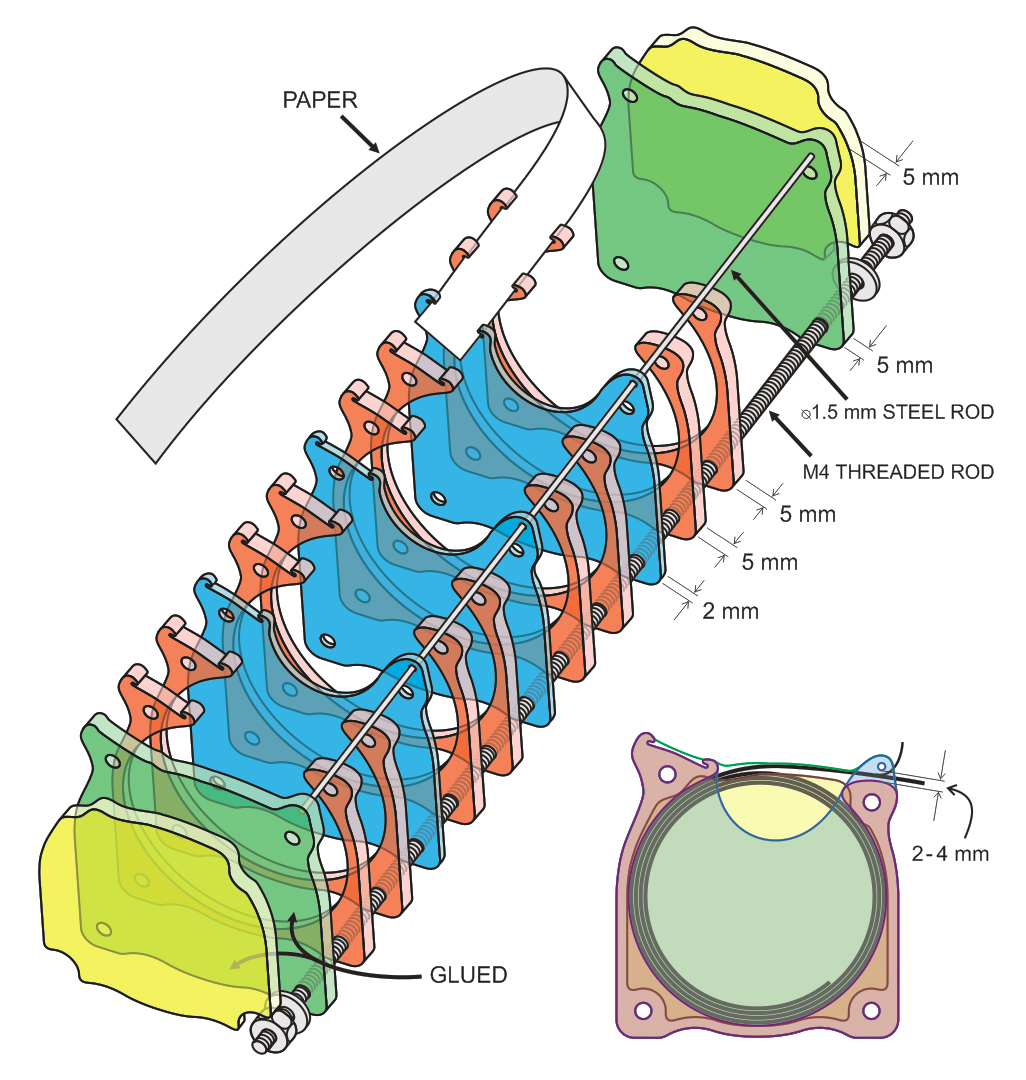
smd_orthoThe CorelDraw file that can be used for laser cutting the acrylic parts, is available for download. If you scale the profiles, don’t forget to readjust the hole diameters and some other dimensions which have to remain intact. If you have 5mm acrylic pieces, you should probably use two layers of acrylic for every tape (red parts on the drawing). The barrier layers would be made of thin acrylic — for instance 2mm (the blue parts). Edge layers (green) are once again 5mm thick, and there are also the end pieces (yellow), glued to the previous borders and used to “round up” the whole construction and to protect your hands from the threaded rods and nuts.

While you’re building this for your bench, make a vacuum picking tool for SMDs out of a dispensing syringe with a thick needle. It’s a common trick for hackers to use an aquarium air pump, just turn the compressor unit by 180°, so that it creates vacuum instead of blowing the air outside. This process is described by R&TPreppers in the video below.

Continue reading “Clearly The Best Way To Organize SMD Parts” →
China’s Fusion Reactor Hits Milestone

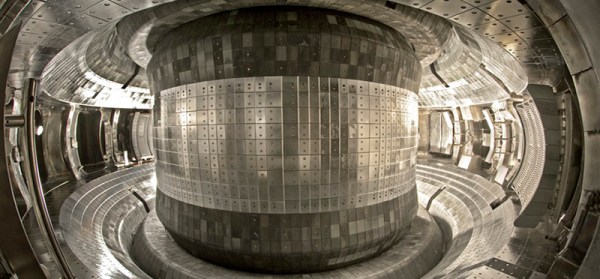
An experimental fusion reactor built by the Chinese Academy of Science has hit a major milestone. The Experimental Advanced Superconducting Tokamak (EAST) has maintained a plasma pulse for a record 102 seconds at a temperature of 50 million degrees – three times hotter than the core of the sun.

The EAST is a tokamak, or a torus that uses superconducting magnets to compress plasma into a thin ribbon where atoms will fuse and energy will be created. For the last fifty years, most research has been dedicated to the study of tokamaks in producing fusion power, but recently several projects have challenged this idea. The Wendelstein 7-X  stellarator at the Max Planck Institute for Plasma Physics recently saw first plasma and if results go as expected, the stellarator will be the design used in fusion power plants. Tokamaks have shortcomings; they can only be ‘pulsed’, not used continuously, and we haven’t been building tokamaks large enough to produce a net gain in power, anyway.

Other tokamaks currently in development include ITER in France. Theoretically, ITER is large enough to attain a net gain in power at 12.4 meters in diameter. EAST is much smaller, with a diameter of just 3.7 meters. It is impossible for EAST to ever produce a net gain in power, but innovations in the design that include superconducting toroidal and poloidal magnets will surely provide insight into unsolved questions in fusion reactor design.

Dumping U8Plus Smartwatch ROM Via Vibration Motor

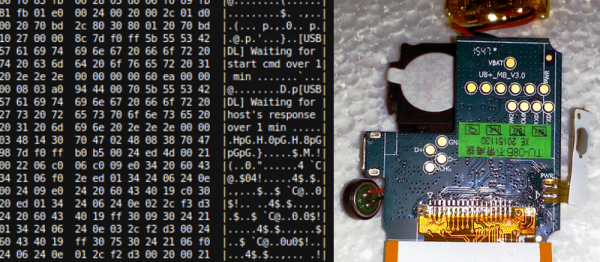
[Lee] continues with his exploration of the U8Plus (a cheap smartwatch). He hasn’t got it all cracked, yet, but he did manage to get a dump of the device’s ROM using an unusual method. At first, [Lee] thought that the JTAG interface (or, at least, the pins presumed to be the JTAG interface) would be a good way to explore the device. However, none of the people experimenting with the device have managed to get it to work.

Instead, [Lee] went through the serial bootloader and dumped the flash memory. He found out, though, that the bootloader refused to read the ROM area. It would, however, load and run a program. Unfortunately, no one has found how to access the UART device directly, but they have found how to drive the vibration motor.

[Lee] took off the vibration motor and used it as an output port for a simple program to dump the ROM. An Arduino picked up the data at a low baud rate and produced an output file. This should allow more understanding of how to drive the watch hardware.

We covered the initial teardown of this watch earlier this year. Of course, if you don’t want to reverse engineer a smartwatch, you could always build your own.

Particle Electron – The Solution To Cellular Things

Just over a year ago, Particle (formerly Spark), makers of the very popular Core and Particle Photon WiFi development kits, released the first juicy tidbits for a very interesting piece of hardware. It was the Electron, a cheap, all-in-one cellular development kit with an even more interesting data plan. Particle would offer their own cellular service, allowing their tiny board to send or receive 1 Megabyte for $3.00 a month, without any contracts.

Thousands of people found this an interesting proposition and the Electron crowdfunding campaign took off like a rocket. Now, after a year of development and manufacturing, these tiny cellular boards are finally shipping out to backers and today the Electron officially launches.

Particle was kind enough to provide Hackaday with an Electron kit for a review. The short version of this review is the Electron is a great development platform, but Particle pulled off a small revolution in cellular communications and the Internet of Things

Continue reading “Particle Electron – The Solution To Cellular Things” →

Error Detection And Correction: Reed-Solomon, Convolution And Trellis Diagrams

Transferring data without error when there is a lot of background noise is a challenge. Dr. Claude E. Shannon in 1948 provided guidance with his theory addressing the capacity of a communications channel in the presence of noise. His work quickly spread beyond communications into other fields. Even other aspects of computer use were impacted. An example is the transfer of data from a storage medium, like a hard drive or CD-ROM. These media and their sensors are not 100% reliable so errors occur. Just as Shannon’s work defines communication channel capacity it defines the transfer rate from a media surface to the read head.

Shannon told us how much could be passed through a channel but didn’t say how. Since 1948 a lot of research effort went into accurately detecting errors and correcting them. Error correction codes (ECC) add extra bits to messages, but their cost pays off in their ability to work around errors. For instance, without ECC the two Voyager spacecraft, now leaving our solar system, would be unable to phone home with the information they’ve gathered because noise would overwhelm their signals. Typically in hardware, like memory, error correction is referred to as ECC. In communications, the term forward error correction (FEC) is used.

Robust communication, or data transfer, is a combination of fancy software and tricky signal processing. I’m going to focus on the software side in this article. You may find some of these techniques useful in communicating data among your devices. While I’ll be using the term communications keep in mind this is applicable to transferring data in general.

Continue reading “Error Detection And Correction: Reed-Solomon, Convolution And Trellis Diagrams” →

Experiments With A Bowden Extruder Filament Force Sensor

We were excited to learn that someone had started working with force sensors on filament extruders, especially after we posted about a recent development in filament thickness sensors.

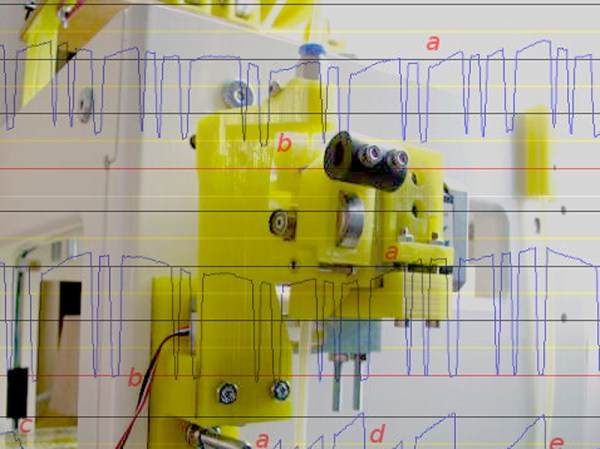
[airtripper] primarily uses a Bowden extruder, and wanted to be a little more scientific in his 3D printing efforts. So he purchased a force sensor off eBay and modified his extruder design to fit it. Once installed he could see exactly how different temperatures, retraction rates, speed, etc. resulted in different forces on the extruder. He used this information to tune his printer just a bit better.

More interesting, [airtripper] used his new sensor to validate the powers of various extruder gears. These are the gears that actually transfer the driving force of the stepper to the filament itself. He tested some of the common drive gears, and proved that the Mk8 gear slipped the least and provided the most constant force. We love to see this kind of science in the 3D printing community — let’s see if someone can replicate his findings.


Learn Resin Casting Techniques: Duplicating Plastic Parts

Resin casting lets you produce parts that would be otherwise impossible to make without a full CNC and injection molding set-up. It costs about as much as a 3d printer, 300 to 600 US dollars, to get a good set-up going. This is for raw material, resin, dye, pressure chamber, and an optional vacuum degassing set-up. A good resin casting set-up will let you produce parts which are stronger than injection molding, and with phenomenal accuracy, temperature resistance, and strength. I will be covering various techniques from the simple to advanced for using resin casting from a hacker’s perspective.

Continue reading “Learn Resin Casting Techniques: Duplicating Plastic Parts” →