Machine Inside Of A Chip: How Sprite_TM Built The FPGA Game Boy Badge

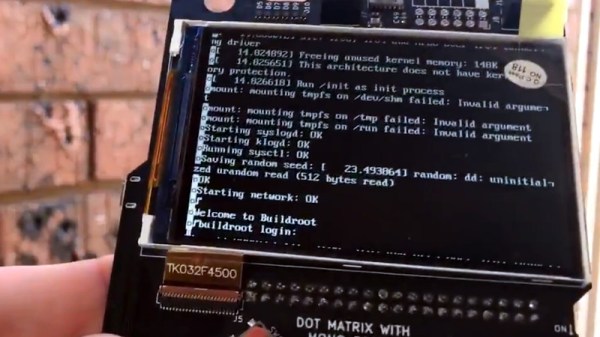
Kids of the 1990’s would call you a liar if you told them that within thirty years you’d go to a conference and be handed a Super Nintendo Entertainment System to wear around your neck. But that’s what happened with the badge Jeroen Domburg, aka [Sprite_TM], designed for the 2019 Hackaday Superconference. It’s built in the Game Boy form factor, complete with a cartridge slot, beautiful screen, and the familiar button layout. But there’s so much more here, like the HDMI port on the bottom and the ability to completely reconfigure the device by dropping a binary file onto it over USB.

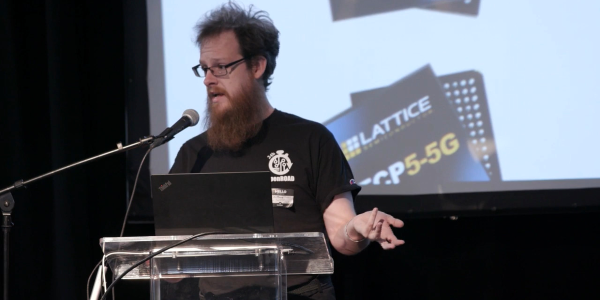
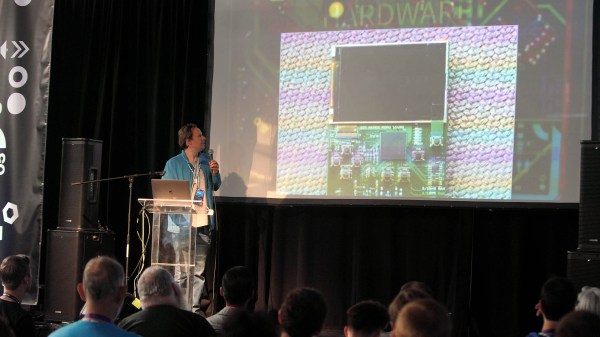
Of course what makes this possible is the FPGA at the heart of the design. The story of how the badge was developed is shared in great detail during Sprite’s Supercon talk. The timeline, the hardware choices, and the oopses along the way make for a great story. But what you really don’t want to miss is how he built the machine inside of the FPGA — the collection of Verilog code known as “gateware” that brings together the System-on-a-Chip (SoC). From his delight at being able to spawn more processor cores by changing a single variable, to the fascinating SNES-inspired graphics subsystem, the inside story shared below is even more interesting than the physical device itself.

Continue reading “Machine Inside Of A Chip: How Sprite_TM Built The FPGA Game Boy Badge”

Supercon Keynote: Megan Wachs Breaks Down RISC-V

The 2019 Hackaday Superconference kicked off with a marvelous, and marvelously geeky, keynote talk on the subject of RISC-V by Dr. Megan Wachs. She is VP of Engineering at SiFive, a company that makes RISC-V processors in silicon, but the talk is a much more general introduction to the RISC-V open instruction-set architecture (ISA) and why you’d care. The short answer to the latter is the same reason you care about any other open standard: it promotes interoperability, reusable toolchains, and will result in us all having access to better and faster CPUs.

The video is embedded below, and it’s absolutely worth a watch. Unfortunately, The video is missing the first few minutes, you can follow along through her slides (PDF) and read through our brief recap below of what fell down the video hole.

Continue reading “Supercon Keynote: Megan Wachs Breaks Down RISC-V”

New Part Day: LED Driver Is FPGA Dev Board In Disguise

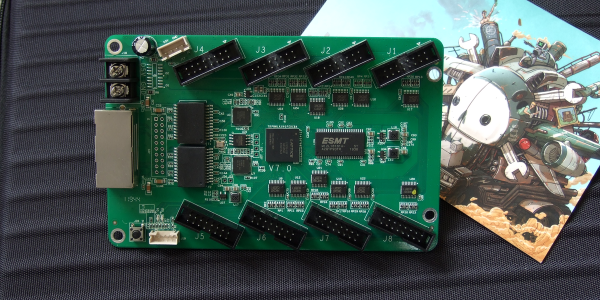
Our new part of the day is the ColorLight 5A-75B, a board that’s meant to drive eight of those ubiquitous high-density color LED panels over gigabit Ethernet. If you were building a commercial LED wall, you’d screw a bunch of the LED panels together, daisy-chain a bunch of these boards to drive them, supply power, and you’d be done. Because of that high-volume application, these boards are inexpensive, around $15 each, and available as quickly as you can get stuff shipped from China.

But we’re not here to talk commercial applications. Managing fast Ethernet and pushing so many pixels in real time is a task best handled by an FPGA, and [Tom Verbeure] noticed that these things were essentially amazing FPGA development boards and started hacking on them. [q3k] put it up on GitHub, and you can follow along with the chubby75 reverse engineering project to dig into their secrets.

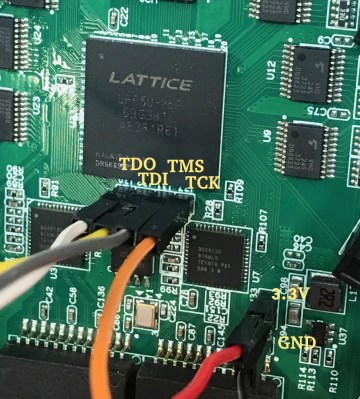
While the first generations of these boards used the old-standby Spartan 6, things got interesting for fans of open FPGA tools when newer versions were found using the Lattice ECP5-25 chips, the little brother of the stonking big chip [Sprite_TM] used on the 2019 Hackaday Supercon badge. If you want to grab one you’re looking for ColorLight boards marked with revision 6 or 7 as of this writing.

What does this mean? For the price of a gourmet hamburger, you get an FPGA that’s big enough to run a RISC-V softcore, two 166 MHz, 2 MB SDRAMS, flash for the FPGA bitstream, a bazillion digital outputs on 5 V level shifters, and two gigabit Ethernet ports. The JTAG port is broken out in 0.1″ headers, and it works with OpenOCD, which is ridiculously convenient. How’s that for a well-stocked budget FPGA dev board that’s served by a completely open toolchain? Continue reading “New Part Day: LED Driver Is FPGA Dev Board In Disguise”

COSMAC ELF Lives Again, In FPGA

Looking around at the personal computing markets in modern times, there seem to be a lot of choices in the market. In reality, though, almost everything runs on hardware from a very small group of companies, and software is often available across platforms. This wasn’t the case in the personal computing boom of the 70s and 80s, where different computers were wildly different in hardware and even architecture. The Cosmac ELF was one of the more interesting specimens from this era, and this one has been meticulously reproduced on an FPGA.

The original hardware was based on an RCA 1802 microprocessor and had a rudimentary (by today’s standards) set of switches and buttons as the computer’s inputs. It was low cost, even for the time, but was one of the first single-board computers available. This recreation is coded in SpinalHDL and the simplicity of the original hardware makes it relatively easy to understand. The FPGA is cycle-accurate to the original hardware, too, which makes it nearly perfect even without any of the original hardware.

The project’s creator, [Winston] aka [wel97459], found that SpinalHDL made this project fun to work on (and released his code on his GitHub page), and was able to get the code down to just 1500 lines to recreate the original hardware. It’s very impressive, and also an accessible read for anyone interested in some of the more unique computers offered during the early computer renaissance in the 70s.

FPGA 6800 Uses Python Toolbox

Usually, when you think of designing — or recreating — a CPU on an FPGA, you assume you’ll have to use Verilog or VHDL. There are other options, as well, but those are the biggest two players in FPGA configuration. [Robert Baruch] has a multipart series where he uses nMigen — a Python toolbox — to recreate a 6800 CPU like the one used in many vintage video games and pinball machines.

Unlike some tools that try to convert software written in some language to an FPGA configuration, nMigen uses Python as a scripting language to create code in FHDL. This is similar in concept to VHDL or Verilog, but gives up the event-driven paradigm, opting instead to allow designers to explicitly call out synchronous and combinatorial logic.

Continue reading “FPGA 6800 Uses Python Toolbox”

.NET To FPGA With Hastlayer

There are lots of ways to use FPGAs. One way is to convert compute-bound software into hardware. This can increase speed and — in some cases — reduce power consumption. Typically, you’ll do this by writing in a subset of C, but Hastlayer can convert .NET assemblies into FPGA configurations with some limitations.

The Hungarian company behind Hastlayer claims they’ll eventually have to charge money for something but for now, the tool is free and they are promising to always have some free option. The interesting thing is that the .NET assemblies are essentially object code so you aren’t compiling source but rather an intermediate language that you can generate with many different language tools.

Continue reading “.NET To FPGA With Hastlayer”

Yosys Fronts For Xilinx ISE

We always marvel at how open-source tools can often outstrip their commercial counterparts. Yosys, the open-source tool for Verilog synthesis, is a good example. Although the Xilinx ISE design suite is something close to abandonware, a lot of people still use it because it supports older FPGAs the newer tools don’t. Its Verilog parser is somewhat slow to catch up to new standards, and according to a recent GitHub update, Yosys can now provide files for ISE that target Spartan 6, Virtex 7, and Series 7 FPGAs. In addition, there is some support for Spartan 3, Virtex 2, 4, and 5, although those are not ready yet.

According to the post, you’ll want to use the synth_xilinx command along with the -ise option and a -family option that matches your target (that is, xc6s for Spartan 6).  On the output side, you’ll write an EDIF file using the write_edif command.

Continue reading “Yosys Fronts For Xilinx ISE”