Electronic Catan Game Board Is Modular

Plenty of gamers around these parts require an expensive PC to play games, often spending thousands of dollars for a gaming machine. Believe it or not, though, there are entire classes of games that don’t require any electronics at all, but that doesn’t mean that they don’t benefit from the addition of some neat gadgets. This Settlers of Catan game uses custom LCD tiles with a built-in custom mesh network.

The tiles for the game board themselves are hexagonal and snap together using magnetic pogo pins in order to form a board of any size or shape. The pogo pins also allow communication for a pseudo-mesh network to operate with each tile’s built-in PCB to allow the game board to know exactly which tiles are placed where and to display the correct image on each one. Each tile contains it own RP2040 microcontroller, keeping the overall cost of each tile to a minimum.

For those regularly hosting game night, a project like this could really change the traditionally analog game’s dynamic for the better. It was mostly a project that [Colin Iuliano] built just for fun, and if he ever builds a second one he does plan on some improvements, but we’d say that it looks like a success already. For other Catan-based electronic design inspiration, take a look at this complete and non-modular electronic game board.

One Coder Is Porting Portal To The Nintendo 64

When Portal came out in 2007, developers Valve chose not to release the groundbreaking title on an obsolete Nintendo console long out of production. Nobody cared at the time, of course, but [James Lambert] is here to right that wrong. Yes, he’s porting Portal to the N64.

The port, or “demake,” as [James] calls it, has been under construction for some time. The project has posed some challenges: Portal was developed for PCs that were vastly more powerful than the Nintendo 64 of 1996. Thus, initial concerns were that the console wouldn’t be able to handle the physics of the game or render the recursive portal graphics.

However, hard work has paid off. [James] has chipped away, bit by bit, making improvements to his engine all the while. The latest work has the portals rendering nicely, and the companion cube works just the way you’d expect. There’s also a visible portal gun, and the engine can even render 15 recursive layers when looking through mirrored portals. Sixteen was too much.

Of course, there’s still lots to do. There’s no player model yet, and basic animations and sound are lacking. However, the core concept is there, and watching [James] flit through the not-quite-round portals is an absolute delight. Even better, it runs smoothly even on original Nintendo hardware. It’s a feat worthy of commendation.

We had no idea what [James] had in store back when we featured his work creating real-time shadows on N64 hardware. Now we know! Video after the break.

Continue reading “One Coder Is Porting Portal To The Nintendo 64″

A self-service checkout computer game

Practice Your Shopping Skills With This Self-Service Checkout Game

Self-service checkouts have become a common feature in supermarkets the world over, a trend accelerated by the coronavirus pandemic. While some may lament the loss of human contact, others relish the opportunity to do their own scanning: with a bit of practice, self-service can provide for a very fast checkout experience. Assuming, of course, that the machine recognizes each product, the built-in weight sensor works correctly, and you don’t get selected for a random check.

If you want to practice your checkout game without spending loads of money, you might want to have a look at [Niklas Roy] and [Kati Hyyppä]’s latest project: Bonprix is a game where the goal is to scan as many items as possible within a 90-second time limit. Installed at the Eniarof DIY festival, it’s designed to resemble a typical supermarket checkout with a display, a barcode scanner and a shopping basket filled with random items. The screen indicates which item should be scanned next; if you’re too slow, the checkout will begin to offer discounts, which you obviously don’t want. When the 90 seconds are over, the machine spits out a receipt indicating your total score.

The checkout desk is made from wooden pallets and cardboard; inside is a laptop running Linux, with a handheld barcode scanner attached via USB. An LED strip provides a beam of bright red light to indicate the scanning area, and turns green when a barcode is successfully scanned. Arduinos control the LEDs and the big red-and-yellow “start” button, while a thermal printer from an ATM prints the receipts at the end of each game.

Apart from a bit of fun, the Bonprix project tries to address questions relating to consumer culture and self-checkouts: is it fair to let customers do their own work? Should they be paid for it? Is it even ethical to encourage people to spend as much as possible?

While this is the first time we’ve seen a self-service checkout computer game, we’ve done a few deep dives into the fascinating technology of barcodes that makes it all possible. Check this out!

Continue reading “Practice Your Shopping Skills With This Self-Service Checkout Game”

Book Teaches Gaming Math

If we knew how much math goes into writing a video game, we might have paid more attention in math class. If you need a refresher, [Fletcher Dunn] and [Ian Parbery] have their book “3D Math Primer for Graphics and Game Development” available free online. The book was originally a paper book from 2011 with a 2002 first edition but those are out of print now. However, math is math, so regardless of the age of the book, it is worth a look. For now, the online version is a bunch of web pages, but we hear a PDF or E-reader version is forthcoming.

There’s quite a bit of discussion about vectors, matrices, linear transformations, and 3D graphics. The last part of the book covers calculus, kinematics, and parametric curves. Some of these topics will be of interest even if you don’t care about graphics but do want to learn some math with practical examples.

Continue reading “Book Teaches Gaming Math”

A putter with an Arduino attached to its shaft

This Golf Club Uses Machine Learning To Perfect Your Swing

Golf can be a frustrating game to learn: it takes countless hours of practice to get anywhere near the perfect swing. While some might be lucky enough to have a pro handy every time they’re on the driving range or putting green, most of us will have to get by with watching the ball’s motion and using that to figure out what we’re doing wrong.

Luckily, technology is here to help: [Nick Bild]’s Golf Ace is a putter that uses machine learning to analyze your swing. An accelerometer mounted on the shaft senses the exact motion of the club and uses a machine learning algorithm to see how closely it matches a professional’s swing. An LED mounted on the club’s head turns green if your stroke was good, and red if it wasn’t. All of this is driven by an Arduino Nano 33 IoT and powered by a lithium-ion battery.

The Golf Ace doesn’t tell you what part of your swing to improve, so you’d still need some external instruction to help you get closer to the ideal form; [Nick]’s suggestion is to bundle an instructor’s swing data with a book or video that explains the important points. That certainly looks like a reasonable approach to us, and we can also imagine a similar setup to be used on woods and irons, although that would require a more robust mounting system.

In any case, the Golf Ace could very well be a useful addition to the many gadgets that try to improve your game. But in case you still end up frustrated, you might want to try this automated robotic golf club.

Continue reading “This Golf Club Uses Machine Learning To Perfect Your Swing”

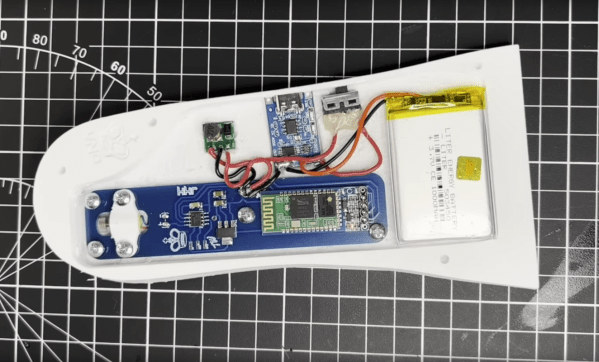
A small plastic case with an OLED screen showing a side-scrolling game

Game & Light Brings Video Games To Your Keychain

If you’re old enough to remember the 1990s, you might recall the sheer variety of portable gaming platforms that were around in those days. There was of course the ubiquitous hand-held Game Boy, and if you preferred something larger you could buy a Sega Game Gear or an Atari Lynx. But you could also go smaller with tiny LCD games like Nintendo’s Game and Watch series, with some versions literally the size of a wristwatch.

With all of these having gone the way of the dodo, we’re happy to see that [grossofabian] kept the tiny game world alive by designing the Game & Light: a tiny hand-held games platform with an OLED screen. It’s small enough to attach to your keychain and comes with an LED to act as a mini flashlight. But of course the main feature is the included video game: currently it comes with LEDboy Adventures, a side-scrolling platformer similar to Google’s T-Rex Game. A USB port can be used to recharge the device as well as to upload new games.

The Game & Light is housed in a 3D printed case and powered by a lithium-ion capacitor that can store enough charge for around 40 minutes of play time. The CPU is an ATtiny402 eight-pin microcontroller with 4 kB of flash, which is just enough to store the entire LEDboy game. Although currently only one game is available, the system is fully programmable and open sourced, so anyone who feels up to the task can help develop new games for the platform.

If you like keychain-sized games, you’re in luck: we recently featured the solar-powered but otherwise similar RunTinyRun. A bit longer ago, creative hackers even managed to squeeze entire Game Boys into tiny packages.

Continue reading Game & Light Brings Video Games To Your Keychain”

TWANG32 Brings LED Strip Gaming To The ESP32

Under the Hackaday TV is a modern game console, it’s a well-known model that many of you also probably have, and its main feature is a 3D accelerator which allows it to create the beautifully rendered worlds we’ve all come to know and love. [Mircemk] eschews such fripperies with the Twang project, because it’s a game that’s not 3D, nor 2D, but 1D. The display, indeed the entire gaming surface, is a single strip of addressable LEDs which can be seen int he video below the break.

Behind it all is an ESP32, and a unique one-dimensional joystick using an accelerometer. There’s an audio channel with a little piezoelectric speaker too, and the LED strip is a particularly high-density one from DFRobot. Because this is an ESP32-driven device it has WiFi, upon which is exposed an access point for a network over which is served the game stats as a web page. It may not displace that modern console, but it’s certainly inventive.

Long-time Hackaday readers will be aware that this is only the latest of a long line of one-dimensional games, including a 1D take on the famous PONG.

Continue reading TWANG32 Brings LED Strip Gaming To The ESP32″