Solid Oak Arcade Cabinet: When Particle Board Won’t Do

Having an arcade cabinet of one’s own is a common dream among those who grew up during the video game arcade heyday of the 80s and early 90s. It’s a fairly common build that doesn’t take too much specialized knowledge to build. This cabinet, on the other hand, pulled out all of the stops for the cabinet itself, demonstrating an impressive level of woodworking expertise.

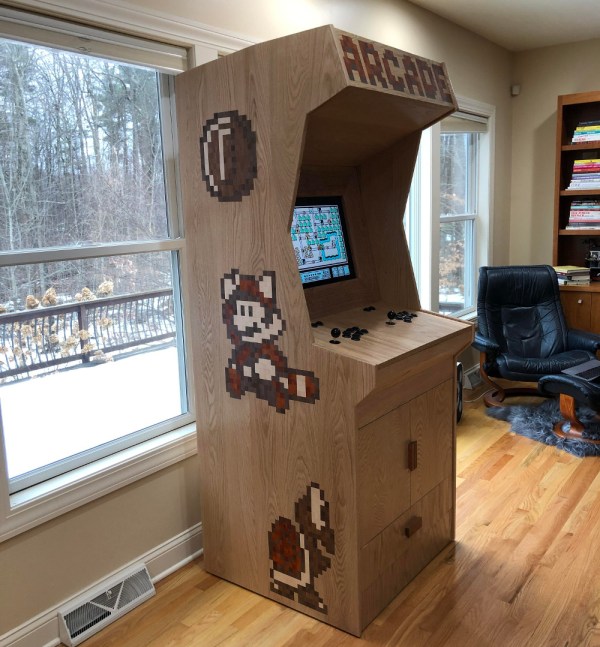
The cabinet enclosure is made with red oak boards, which the creator [Obstreperuss] sawed and planed and then glued together to create the various panels (more details are available on his Imgur album). The Mario artwork on the sides and front aren’t just vinyl stickers, either. He used various hardwoods cut into small squares to create pixel art inlays in the oak faces. After the fancy woodwork was completed, the build was finished out with some USB arcade controllers, a flat-panel screen, and a Raspberry Pi to run the games.

While the internals are pretty standard, we have to commend the incredible quality of the woodworking. It’s an impressive homage to classic arcade machines and we wouldn’t mind a similar one in our own homes. If you’re lacking the woodworking equipment, though, it’s possible to get a refined (yet smaller) arcade cabinet for yourself with a 3D printer instead.

Continue reading “Solid Oak Arcade Cabinet: When Particle Board Won’t Do”

Console Controller Mod Gets Amputee Back In The Game

No matter how it happens, losing one or more fingers is going to change one’s life in thousands of ways. We’re a manipulative species, very much accustomed to interacting with the world through the amazing appendages at the ends of our arms. Finding ways around the problems that result from amputations is serious business, of course, even when it’s just modifying a game console controller for use with a prosthetic hand.

We’ve gotten to know [Ian Davis] quite well around these parts, at least from his videos and Instagram posts. [Ian]’s hard to miss — he’s in the “Missing Parts Club” as he puts it, consisting of those who’ve lost all or part of a limb, which he has addressed through his completely mechanical partial-hand prosthetic. As amazing as the mechanical linkages of that prosthetic are, he hasn’t regained full function, at least not to the degree required to fully use a modern game console controller, so he put a couple of servos and a Trinket to work to help.

An array of three buttons lies within easy reach of [Ian]’s OEM thumb. Button presses there are translated into servo movements that depress the original bumper buttons, which are especially unfriendly to his after-market anatomy. Everything rides in an SLA-printed case that’s glued atop the Playstation controller. [Ian] went through several design iterations and even played with the idea of supporting rapid fire at one point before settling on the final design shown in the video below.

It may not make him competitive again, but the system does let him get back in the game. And he’s quite open about his goal of getting his designs seen by people in a position to make them widely available to other amputees. Here’s hoping this helps.

Continue reading “Console Controller Mod Gets Amputee Back In The Game”

PS2 Emulation On The Xbox Series S: A Story Of Walled Gardens

It’s hardly a secret any more at this point that today’s game consoles from Microsoft and Sony are essentially AMD gaming rigs packed up into a custom package and with tweaked system software. So it’s not too surprising that enterprising hackers got the Playstation 2 emulator of RetroArch running on an Xbox Series X|S game console despite Microsoft’s attempts to stop them. (Video, embedded below.)

It’s possible to sneak the RetroArch app past Microsoft’s security checkpoints by shelling out $19 for a Microsoft Developer Account, setting up Developer Mode on the XBox console, and getting the Universal Windows Platform (UWP) port of RetroArch from the official website. This has the advantage of it being a blessed-by-the-Redmond-gods approach. But one cannot play retail games in Developer Mode and large games due to a 2 GB limit.

More recently, a hacker by the name of [tunip3] found a flaw in the Xbox app distribution system which allows one to download a ‘retail’ version of RetroArch. This involves marking the RetroArch app as ‘private’, allowing it to skip a review by Microsoft. People whose email address is on a whitelist are then granted download permission for that app on their Xbox console. The advantage of this ‘retail’ approach is that it does not feature the 2 GB filesize limits. The disadvantage is that Microsoft is free to take the app down and ban [tunip3]’s developer account.

My Way Versus the Highway

A lot about this comes down to a simple question of ‘why?’. Why even jump through these hoops to set up a limited, possibly ToS-breaking emulator on what is ultimately a gaming PC running Windows 10? Why not use that Raspberry Pi 4 or NUC system that’s been giving you sad eyes for the past months from where it’s been stuffed into a dusty corner?

Continue reading “PS2 Emulation On The Xbox Series S: A Story Of Walled Gardens”

Mouse-Controller Hybrid Aims To Dominate In First-Person Shooters

The first person shooter genre found its feet in the PC world, relying on the holy combination of the keyboard and mouse for input. Over time, consoles have refined their own version of the experience, and the gamepad has become familiar territory for many FPS fans. [Tech Yesterday] was a die hard controller player, but after trying out  a mouse, didn’t want to go back. Instead, he built a truly impressive hybrid device.

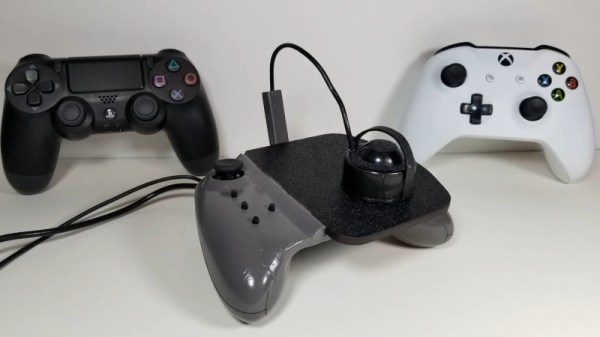
The build begins with a standard Xbox 360 wired controller, somewhat of a defacto standard for PC gamepads. The left analog stick and triggers remain untouched, however the face buttons are all relocated using mechanical keyboard switches. The D-pad has been relocated to the left hand side with tactile switches, and the right analog stick removed entirely. In its place, a cut-down optical mouse is used on a flat 4″x4″ mousepad attached to the controller, strapped to the player’s thumb.

The resulting controller combines the benefit of analog stick movement and the precision aiming of a mouse. We’re amazed at how comfortable the controller looks to use, particularly in the improved second revision. While currently only used on PC, we can imagine such controllers shaking up the console FPS scene in a serious way.

We see some great controller hacks around these parts; the force-feedback mouse is a particularly amusing example. Video after the break.

Continue reading “Mouse-Controller Hybrid Aims To Dominate In First-Person Shooters”

Homebuilt Racing Sim Does Almost Everything From Scratch

If you desire a sim gaming rig, there are off-the-shelf options up and down the market that stretch as high as your budget can afford. Some choose to eschew this route, however and build their own from scratch. Few people go quite so far as [Popicasa POPStuDio], however.

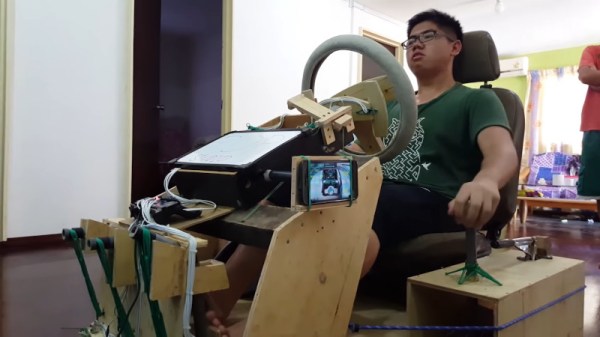
The first version of the rig is about as hacked as you can possibly get, and it’s a joy to see it built from scrap. The wheel itself and the pedals are all built out of old PVC pipe, with a bunch of old wood screwed together for the frame. A cheap USB gamepad serves to handle input to the PC for the pedals and H-shifter. The H-shifter uses simple power switches, repurposed in an ingenious way to sense gear position. The knob itself is cast out of what appears to be hot glue. Steering is done by connecting the wheel to a flexible shaft that tips a smartphone back and forth, using its internal accelerometers and gyros to sense rotation. It’s not clear how this is tied into the PC running Project CARS, but it’s impressive nonetheless.

Version 2 of the build takes things up a notch, using an Arduino Leonardo to handle steering and pedal functions as a Human Interface Device. There’s also force feedback, via a hefty motor attached to the steering shaft via a belt drive. This version implements an H-shifter as well as paddle shifters too for a more modern experience.

Both builds are unique in the modern era for eschewing CNC or 3D printed parts. It’s all done by hand, taking days of effort, and using only basic tools. It’s refreshing to see such a complex build done with nothing but simple materials and sheer commitment. We’re sure [Popicasa POPStuDio] enjoys the rig, and we can’t wait to see where it goes next. Perhaps the next iteration will even feature a motion platform, perhaps built out of old forklift parts? Only time will tell. Video after the break.

Continue reading “Homebuilt Racing Sim Does Almost Everything From Scratch”

Mind-Controlled Beer Pong Gets Easier As You Drink

Wouldn’t it be nice if beer pong could somehow get easier the more you drink? You know, so you can drink more? [Ty Palowski] has made it so with automated, mind-controlled beer pong.

[Ty] started by making a beer pong table that moves the cups back and forth at both ends. An Arduino Nano controls a stepper that controls a slider, and the cups move with the slider through the magic of magnets. The mind control part came cheaper than you might think. Back in 2009, Mattel released a game called Mind Flex that involves an EEG headset and using brain waves to guide a foam ball on a stream of air through a little obstacle course. These headsets are available for about $12 on ebay, or at least they were before this post went up.

[Ty] cracked open the headset added an HC-06 Bluetooth module to talk to the Arduino. It’s using a program called Brainwave OSC to get the raw data from the headset and break it into levels of concentration and relaxation. The Arduino program monitors the attention levels, and when a certain threshold of focus is reached, it moves the cups back and forth at a predetermined speed ranging from 1 to an impossible-looking 10. Check out the two videos after the break. The first one covers the making of the the automatic beer pong part, and the second is where [Ty] adds mind control.

We’ve seen a different headset — the hacker-friendly NeuroSky Mindwave — pop up a few times. Here’s one that’s been hacked to induce lucid dreaming.

Continue reading “Mind-Controlled Beer Pong Gets Easier As You Drink”

Inside CHIP-8

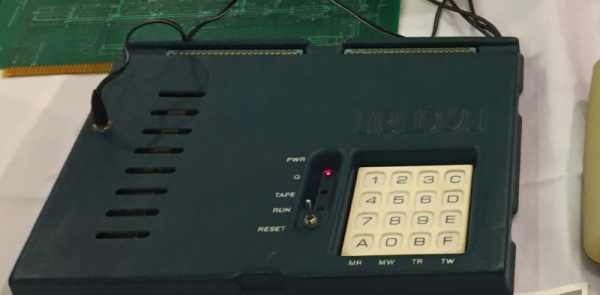
Certain old computers — most frequently those using the RCA 1802 — were fond of using an early form of byte-code interpreter for programs, especially games. The interpreter, CHIP-8, was very simple to create but offered high-level features that were tedious to recreate in the native assembly language. Because there are a fair number of simple games written in CHIP-8, there are of course, emulators for it, and [River Gillis] decided to look inside the CHIP-8 byte code interpreter.

Part of the power of CHIP-8 was it only had 35 virtual instructions. That was important when you were trying to shoehorn a game and the interpreter into a very small memory. Remember, in those days 1K of memory wasn’t an unusual number, although the prototypical CHIP-8 host would have 4K.

Continue reading “Inside CHIP-8”