Coffee Maker Gives Plants An Automatic Drip

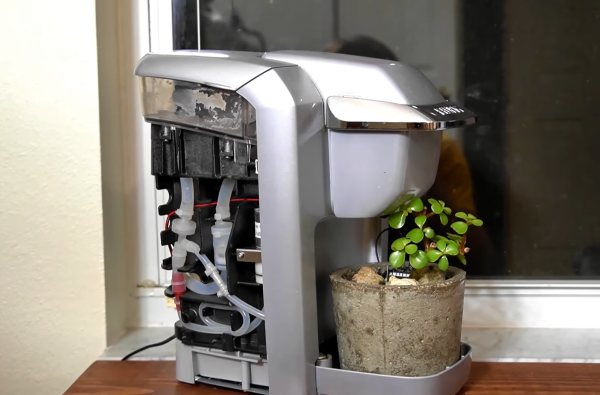
Somehow, [Jeremy S   Cook]’s wife was able to keep a Keurig machine going for 10 years before it quit slinging caffeine. [Jeremy] got it going again, but decided to buy a new one when he saw how it was inside from a decade of water deposits.

But why throw the machine out like spent coffee grinds? Since the pump is still good, he decided to turn it into an automatic plant watering machine. Now the Keurig pumps water using a Raspberry Pi Zero W and a transistor. [Jeremy] can set up watering cron jobs with PuTTY, or push water on demand during dry spells. We love that he wired up a soil moisture sensor to the red/blue LEDs around the brew button — red means the plant is thirsty, purple means water is flowing, and no light means the plant is quenched and happy.

This project is wide open, but cracking into the Keurig is up to you. Fortunately, that part of the build made it into the video, which is firmly planted after the break.

Old coffee makers really do seem suited to taking up plant care in retirement. Here’s a smart garden made from an espresso machine.

Continue reading “Coffee Maker Gives Plants An Automatic Drip”
An Arduino-Free Automatic Alcohol Administrator

With all the hands-free dispenser designs cropping up out there, the maker world could potentially be headed for an Arduino shortage. We say that in jest, but it’s far too easy to use an Arduino to prototype a design and then just leave it there doing all the work, even if you know going in that it’s overkill.

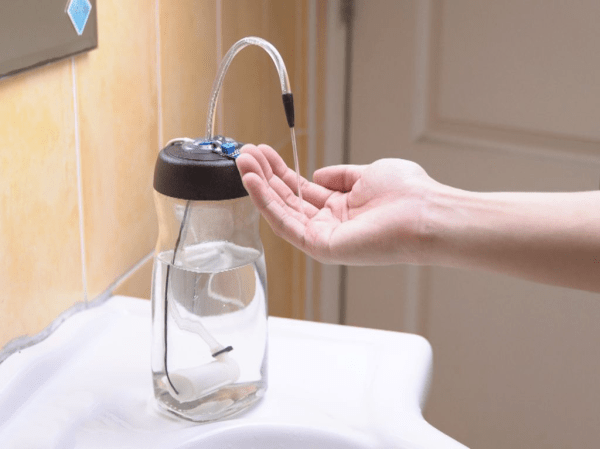
[ASCAS] took up the challenge and built a cheap and simple dispenser that relies on recycled parts and essential electronics. It uses an IR proximity sensor module to detect dirty digits, and a small submersible pump to push isopropyl alcohol, sanitizer, or soap up to your hovering hand. The power comes from a sacrificial USB cable and is switched through a transistor, so it could be plugged into the wall or a portable power pack.

We admire the amount of reuse in this project, especially the nozzle-narrowing ballpoint pen piece. Be sure to check out the build video after the break.

Hopefully, you’re all still washing your hands for the prescribed 20 seconds. If you’re starting to slip, why not build a digital hourglass and watch the pixels disappear?

Continue reading “An Arduino-Free Automatic Alcohol Administrator”

Wheelbarrow Bass Drives A Sound Garden

One of the best things about making music is that it’s so easy to do. There are countless ways to make interesting sounds out of nearly anything if you’re willing to experiment a little bit — just ask anyone who has ever made a guitar out of a cigar box and a broom handle.

[Vicious Squid] dug in to the fertile soil of the garden implement world and cultivated a three-string upright bass with a rich, soulful sound from a familiar workhorse — an aluminium wheelbarrow. Much of the build is made from reclaimed wood, like the solid mahogany neck from an old door frame, and a broom handle.

The bass is constructed arch-top style, meaning that the soundboard — the wood on the front with the f-holes — is a flat piece tacked to curved ribs that span the width of the ‘barrow. A broom handle sound post mounted front to back pushes vibrations from the soundboard to the aluminium body. To round out the agricultural aesthetic, [Vicious Squid] strung it with weed-whacker bass strings, which are no doubt inspired by the use of actual trimmer line.

It’s already plenty loud, but [Vicious Squid] added a piezo pickup for wheeling it into the recording studio. Slap your way past the break to hear a little ditty.

Are your instrument-building skills at the sapling stage? Start with something simpler, like a sliding rubber bandolin.

Continue reading “Wheelbarrow Bass Drives A Sound Garden”

Microbatteries On The Grid

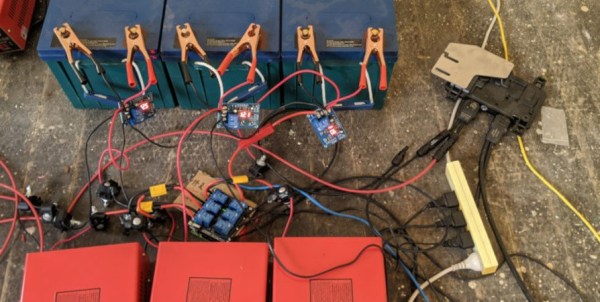
Not everybody has $6500 to toss into a Tesla Powerwall (and that’s a low estimate), but if you want the benefits of battery storage for your house, [Matt]’s modular “microbattery” storage system might be right up your alley. With a build-as-you-go model, virtually any battery can be placed on the grid in order to start storing power from a small solar installation or other power source.

The system works how any other battery installation would work. When demand is high, a series of microinverters turn on and deliver power to the grid. When demand is low, the batteries get charged. The major difference between this setup and a consumer-grade system is that this system is highly modular and each module is networked together to improve the efficiency of the overall system. Its all tied together with a Raspberry Pi that manages the entire setup.

While all of the software is available to set this up, it should go without saying that working with mains power is dangerous, besides the fact that you’ll need inverters capable of matching phase angle with the grid, a meter that handles reverse power flow, a power company that is willing to take the power, and a number of building code statutes to appease. If you don’t have all that together, you might want to go off-grid instead.

Homemade Masks In A Time Of Shortage

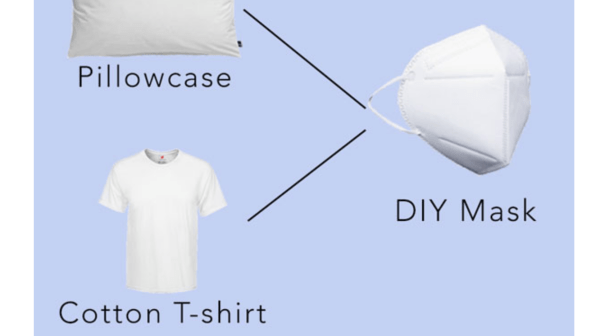
Due to the worldwide pandemic of COVID-19, there has been a huge shortage of N95 masks. [] from Smart Air has been working on designs for a DIY mask that may be able to protect those who haven’t been able to secure their own masks. While there may be an abundance of memes around the various material people have been able to use to substitute for the filters, there is some very real science behind the sorts of materials that can effectively protect us from the virus.

According to a studied performed at Cambridge University during the 2009 H1N1 flu pandemic, while surgical masks perform the best at capturing Bacillus atrophaeus bacteria (0.93-1.25 microns) and Bacteriophage MS virus (0.023 microns), vacuum cleaner bags, and tea towels, and cotton T-shirts were not too far behind. The coronavirus is 0.1-0.2 microns, well within the range for the results of the tests.

As it turns out, cotton homemade masks may be quite effective as alternatives – not to mention reusable. They also found out that double layering the masks didn’t help with improving the protection against viruses. On the other hand, one significant design choice was the breathability of the material. While vacuum cleaner bags may be quite effective at keeping out small particles, they aren’t as comfortable or easy to breathe in as cotton masks.

Have you tried making your own cotton masks? In a time when hospitals are running low on surgical masks, it’s possibly the best option for helping to keep much-needed medical supplies in the hands of those helping at the front line.

[Thanks to pie for the tip!]

Hearing Plants Giggle Is Just As Creepy As You Think

While best known for Charlie and the Chocolate Factory, Roald Dahl wrote quite a few similarly oddball stories in his time. One of them, The Sound Machine, is about a device that allowed the user to hear the anguished screams of trees as they were cut down. Sounds kind of weird to us, but [Roni Bandini] liked the idea so much he decided to build his own version.

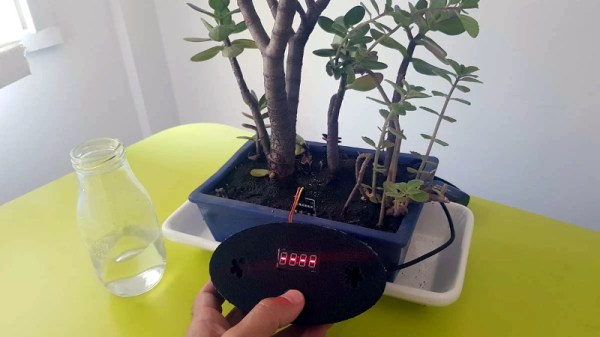
Now to be fair, the device doesn’t only scream in pain. In fact, most of the time it should be emitting laughs and happy noises. Using a moisture sensor driven into the soil of a plant’s pot, the device uses these audio cues to tell you the relative health of your leafy friend. So assuming you’ve got any sort of green thumb at all, things should be fine.

But once the soil gets too dry and the device determines the plant is in “pain”, things take a turn for the worse. We suppose it doesn’t technically scream out so much as grunt like a zombie, but it’s still not a noise we’d want to hear while walking through the house at night. Luckily, it seems you need to hit the button on the front of the 3D printed enclosure to get it to play the appropriate sound track from its DFPlayer module.

Personally we’d rather build something that makes sure the plants are being taken care of automatically than a gadget that cries out in anguish to remind us that we don’t know what we’re doing. But hey, everyone gets inspired in their own way.

Continue reading “Hearing Plants Giggle Is Just As Creepy As You Think”

John Deere And Nebraska’s Right To Repair, The Aftermath Of A Failed Piece Of Legislation

For the past few years now we’ve covered a long-running battle between American farmers and the manufacturers of their farm machinery, over their right to repair, with particular focus on the agricultural giant John Deere. The manufacturer of the familiar green and yellow machinery that lies in the heart and soul of American farming has attracted criticism for using restrictive DRM and closed-source embedded software to lock down the repair of its products into the hands of its dealer network.

This has been a hot-button issue in our community as it has with the farmers for years, but it’s failed to receive much traction in the wider world. It’s very encouraging then to see some mainstream coverage from Bloomberg Businessweek on the subject, in which they follow the latest in the saga of the Nebraska farmers’ quest for a right to repair bill. Particularly handy for readers wishing to digest it while doing something else, they’ve also recorded it as an easy-to-listen podcast.

We last visited the Nebraska farmers a couple of years ago when they were working towards the bill reaching their legislature. The Bloomberg piece brings the saga up to date, with the Nebraska Farm Bureau failing to advance it, and the consequent anger from the farmers themselves. It’s interesting in its laying bare the arguments of the manufacturer, also for its looking at the hidden aspect of the value of the data collected by these connected machines.

It’s likely that the wider hardware hacker community and the farming community have different outlooks on many fronts, but in our shared readiness to dive in and fix things and now in our concern over right to repair we have a common purpose. Watching these stories at a distance, from the agricultural heartland of the European country where this is being written, it’s striking how much the farmers featured are the quintessential salt-of-the-earth Americans representing what much of America still likes to believe that it is at heart. If a company such as John Deere has lost those guys, something really must have gone wrong in the world of green and yellow machinery.

Header image: Nheyob / CC BY-SA 4.0