This excellent content from the Hackaday writing crew highlights recurring topics and popular series like Linux-Fu, 3D-Printering, Hackaday Links, This Week in Security, Inputs of Interest, Profiles in Science, Retrotechtacular, Ask Hackaday, Teardowns, Reviews, and many more.
Hackaday Editors Elliot Williams and Mike Szczys talk turkey on the latest hacks. Random numbers, art, and electronic geekery combine into an entropic masterpiece. We saw Bart Dring bring new life to a cool little multi-pen plotter from the Atari age. Researchers at UCSD built a very very very slow soft robot, and a broken retrocomputer got a good dose of the space age. A 555 is sensing earthquakes, there’s an electric motor that wants to drop into any vehicle, and did you know someone used to have to read the current time into the telephone ad nauseam?
Take a look at the links below if you want to follow along, and as always tell us what you think about this episode in the comments!
Take a look at the links below if you want to follow along, and as always, tell us what you think about this episode in the comments!
The always interesting Project Zero has a pair of stories revolving around security research itself. The first, from this week, is all about one man’s quest to build a debug iPhone for research. [Brandon Azad] wanted iOS debugging features like single-stepping, turning off certain mitigations, and using the LLDB debugger. While Apple makes debug iPhones, those are rare devices and apparently difficult to get access to.
[Brandon] started looking at the iBoot bootloader, but quickly turned his attention to the debugging facilities baked into the Arm chipset. Between the available XNU source and public Arm documentation, he managed to find and access the CoreSight debug registers, giving him single-step control over a core at a time. By triggering a core halt and then interrupting that core during reset, he was able to disable the code execution protections, giving him essentially everything he was looking for. Accessing this debug interface still requires a kernel level vulnerability, so don’t worry about this research being used maliciously.
The second Google Zero story that caught my eye was published earlier in the month, and is all about finding useful information in unexpected places. Namely, finding debugging symbols in old versions of Adobe Reader. Trying to understand what’s happening under the hood of a running application is challenging when all you have is a decompiler output. Adobe doesn’t ship debug builds of Reader, and has never shipped debug information on Windows. Reader has been around for a long time, and has supported quite a few architectures over the years, and surprisingly quite a few debug builds have been shipped as a result.
How useful could ancient debugging data be? Keep in mind that Adobe changes as little as possible between releases. Some code paradigms, like enums, tend to be rather static as well. Additional elements might be added to the end of the enum, but the existing values are unlikely to change. [Mateusz Jurczyk], the article’s author, then walks us through an example of how to take that data and apply it to figuring out what’s going on with a crash. Continue reading “This Week In Security: Project Zero’s IPhone, BBC The Onion, Rooting Androids, And More”→
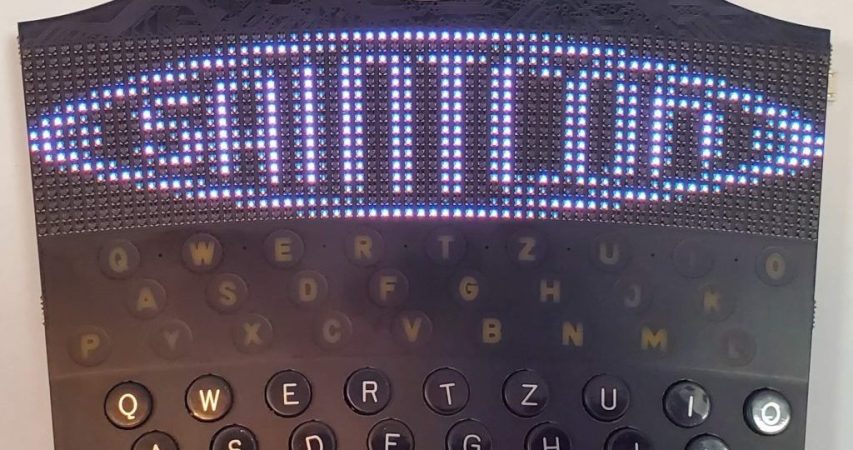
Through the weekend Twitter has been a-titter with news coming out of Saintcon, the annual security conference in Provo, Utah. Now that the weekend is over we can finally get our hands on full hardware and software sources for the curvy, LED-covered badge we’ve been salivating over and a write up by its creators [compukidmike] and [bashNinja]. Let’s dive in and see what’s waiting!
Design
This year’s badge is designed to represent a single tooth on a single rotor of an Enigma machine. The full function of an Enigma machine is quite complex, but an individual device has three rotors with 26 teeth each (one for each letter) as well as a keypad for input and a character display to show each enciphered letter. For reference, the back of the badge has a handy diagram of a badge’s place in the Enigma system.
Reminiscent of the WWII device which the badge design recalls, each unit includes a full QWERTZ keyboard (with labeled keys!) and RGB “lampboard” for individual character output, but unlike the original there’s also a curved 16 x 64 RGB LED display made from those beguiling little ~1mm x 1mm LEDs. All in, the device includes 1051 LEDs! Combined with the unusually non-rectilinear shape of the badge and the Enigma-style Saintcon logo it makes for an attractive, cohesive look.
It used to be that time was a lot more relative than it is today. With smartphones synced to GPS and network providers’ clocks, we all pretty much have access to an authoritative current time, giving few of us today the wiggle room to explain a tardy arrival at work to an impatient boss by saying our watch is running slow.
Even when that excuse was plausible, it was a bit weak, since almost every telephone system had some sort of time service. The correct time was but a phone call away, announced at first by live operators then later by machines called speaking clocks. Most of these services had been phased out long ago, but one, the speaking clock service in Australia, sounded for the last time at the end of September.
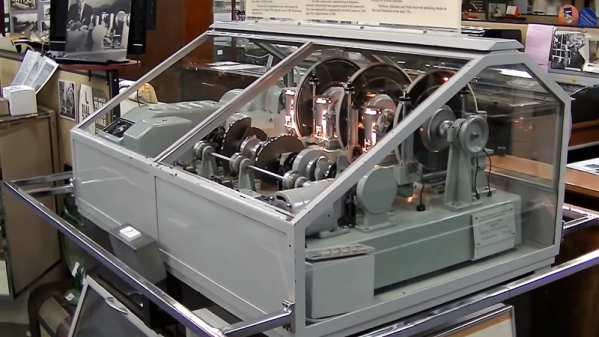
While the decommissioned machine was just another beige box living in a telco rack, the speaking clocks that preceded it were wonderfully complex electromechanical devices, and perfect fodder for a Retrotechtacular deep-dive. Here’s a look at the Australian speaking clock known as “George” and why speaking clocks were once the highest of technology.
In the late nineteenth century, there was only one Earthly frontier left to discover: the North Pole. Many men had died or gone insane trying to reach 90°N, which, unlike the solidly continental South Pole, hides within a shifting polar sea.
One of history’s most driven Pole-seekers, Robert Peary, shocked the world when he announced that his wife Josephine would accompany him on his expedition to Greenland. The world responded, saying that she, a Washington socialite with no specialized training, had absolutely no business going there. But if it weren’t for Jo’s contributions, Robert would probably have never made it to the Pole, or even out of Greenland. Sewing and cooking skills may not seem like much, but they are vital for surviving in the Arctic climate. She also hunted, and managed the group’s Inuit employees.
Josephine Peary was more than just the woman behind the man. An Arctic explorer in her own right, she spent three winters and eight summers on the harsh and unforgiving frontier. Back at home, her Arctic accounts painted a picture of a frozen and far-off world that most could only wonder about. Jo’s writing career brought in expedition money for her husband, which sometimes turned into bailout money.
Josephine Cecilia Diebitsch was born May 22nd, 1863 to German immigrant parents who encouraged her to explore the world. Her father, Hermann, was a linguist at the Smithsonian Institute. Because of his position, the Diebitsch family rubbed elbows with much of high society. Though Jo was raised to be a Victorian lady and upheld those values, she had progressive ideas about what women could do with themselves in addition to being wives and mothers. Continue reading “Josephine Peary, First Lady Of The Arctic”→
Persistence of Vision (POV) is a curious part of the human visual system. It’s the effect by which the perception of an image lingers after light has stopped entering the eye. It’s why a spinning propeller appears as a disc, and why a burning sparkler appears to leave a trail in the air. It’s also commonly used as a display technology, where a series of flashing LEDs can be used to create messages that appear to float in the air. POV displays are a popular microcontroller project, and today, we’ll explore the basic techniques and skills required in such builds.
It’s often said that engineers aren’t born, they’re made. Or more accurately, taught, tested, and accredited by universities. If you’re in high school, you’re probably starting to think about potential career paths and may be considering an engineering degree. A lot of work goes into a good college application, and it might seem like the hardest part is getting in. However, if your end goal is to get yourself a great engineering job at the end of your studies, it pays to have your head up from day 1!
I Just Need A Degree, Right?
Back in my freshman days, there was a saying that was popular on campus, particularly with those studying STEM topics. “Ps get degrees.” Your college’s grading system might use different letters, but the basic gist was that a pass mark was all that was required to get your piece of paper at the end of your four years. While this is technically true, it’s only really a useful ethos if your aim is to simply get a degree. If your goal is to use that degree to score yourself a plum job in your field, it would be unwise to follow this credo.
This attitude will net you plenty of wonderful memories at the bar, but it will dent your chances of landing a solid job upon graduation. All in moderation!
The reality of the modern job market is that it’s highly competitive. Recruiters can receive hundreds of applications for a single job, meaning the vast majority of applicants don’t even make it to the interview stage. To trim down the pile, various criteria are used to pick out the ideal candidates. An easy way to do this is to sort by grades. Having a low GPA can therefore see your application relegated to the trashcan, before you even get a chance to impress anyone with your carefully honed skills. Continue reading “The Young Engineers Guide To Career Planning”→