Voja Antonic: Designing The Cube

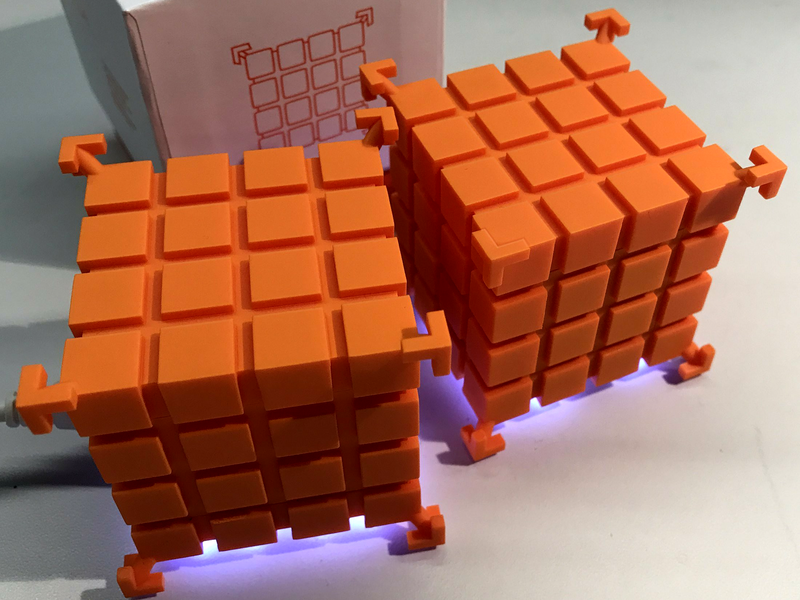
Voja Antonic designed this fantastic retrocomputing badge for Hackaday Belgrade in 2018, and it was so much fun that we wanted to bring it stateside to the Supercon essentially unaltered. And that meant that Voja had some free time to devote to a new hardware giveaway: the Cube. So while his talk at Supercon in November was ostensibly about the badge, he just couldn’t help but tell us about his newer love, and some of the extremely clever features hidden within.
It’s funny how the hardware we design can sometimes reflect so much on the creator. Voja designed then-Yugoslavia’s first widely used home computer (and published the DIY plans in a magazine!). Thousands were built from their kits. The Galaksija was a Z80-based design with a custom BASIC that was just barely squeezed into the available 4K of ROM. So you shouldn’t be shocked that the retro-badge has a working keyboard and a nice BASIC on board.

But let’s jump ahead to the Cube, because that’s even more of a passion project. On the outside, they’re very simple devices, with only a USB port and a sweet diffused LED ring visible. Aesthetic? Minimalistic? Beautiful, honestly.
Continue reading “Voja Antonic: Designing The Cube”


Oops… Britain Launched A Satellite, But Who Remembers It?

Did you know Britain launched its first satellite after the program had already been given the axe? Me neither, until some stories of my dad’s involvement in aerospace efforts came out and I dug a little deeper into the story.

I grew up on a small farm with a workshop next to the house, that housed my dad’s blacksmith business. In front of the workshop was a yard with a greenhouse beyond it, along one edge of which there lay a long gas cylinder about a foot (300mm) in diameter. To us kids it looked like a torpedo, and I remember my dad describing the scene when a similar cylinder fell off the side of a truck and fractured its valve, setting off at speed under the force of ejected liquid across a former WW2 airfield as its pressurised contents escaped.

Everybody’s parents have a past from before their children arrived, and after leaving the RAF my dad had spent a considerable part of the 1950s as a technician, a very small cog in the huge state-financed machine working on the UK’s rocket programme for nuclear and space launches. There were other tales, of long overnight drives to the test range in the north of England, and of narrowly averted industrial accidents that seem horrific from our health-and-safety obsessed viewpoint. Sometimes they came out of the blue, such as the one about a lake of  highly dangerous liquid oxidiser-fuel mix ejected from an engine that failed to ignite and which was quietly left to evaporate, which he told me about after dealing with a cylinder spewing liquid propane when somebody reversed a tractor into a grain dryer.

Bringing Home A Piece Of History

The remains of the Black Arrow first and second stages, taken from the Skyrora promotional video.

My dad’s tales from his youth came to mind recently with the news that a privately-owned Scottish space launch company is bringing back to the UK the remains of the rocket that made the first British satellite launch from where they had lain in Australia since crashing to earth in 1971. What makes this news special is that not only was it the first successful such launch, it was also the only one. Because here in good old Blighty we hold the dubious honour of being the only country in the world to have developed a space launch capability of our own before promptly abandoning it. Behind that launch lies a fascinating succession of forgotten projects that deserve a run-through of their own, they provide a window into both the technological and geopolitical history of that period of the Cold War.

Continue reading “Oops… Britain Launched A Satellite, But Who Remembers It?”

High-Altitude Ballooning Hack Chat

Join us on Wednesday at noon Pacific time for the high-altitude ballooning Hack Chat!

The Cope brothers are our hosts this week. Jeremy, a computer engineer, and Jason, a mechanical engineer, have recently caught the high-altitude ballooning (HAB) bug. In their initial flights they’ve racked up some successes and pushed the edge of space with interesting and varied missions. Their first flight just barely missed the 100,000 foot (30,000 meter) mark and carried a simple payload package of cameras and GPS instruments and allowed them to reach their goal of photographing the Earth’s curvature.

Flight 2 had a similar payload but managed to blow through the 100K foot altitude, capturing stunning video of the weather balloon breaking. Their most recent flight carried a more complex payload package, consisting of the usual camera and GPS but also a flight data recorder of their own devising, as well as a pair of particle detectors to measure the change in flux of subatomic particles with increasing altitude. That flight “only” reached 62,000 ft (19,000 meters) but managed to hitch a ride on the jet stream that nearly took the package out to sea.

The Cope brothers will be joining the Hack Chat to talk about the exciting field of DIY high-altitude ballooning and the challenges of getting a package halfway to space (depending on how that’s defined). Please join us as we discuss:

  • The basics of flight – balloons, rigging, payload protection, tracking, and recovery;
  • Getting started on the cheap;
  • Making a flight into a mission with interesting and innovative ideas for payload instrumentation;
  • Will hobbyist HABs ever break the Kármán Line? and
  • What’s in store for this year’s Global Space balloon Challenge?

You are, of course, encouraged to add your own questions to the discussion. You can do that by leaving a comment on the High-Altitude Ballooning Hack Chat event page and we’ll put that in the queue for the Hack Chat discussion.


Our Hack Chats are live community events on the Hackaday.io Hack Chat group messaging. This week we’ll be sitting down on Wednesday, February 6, at noon, Pacific time. If time zones have got you down, we have a handy time zone converter.

join-hack-chatClick that speech bubble to the right, and you’ll be taken directly to the Hack Chat group on Hackaday.io.

You don’t have to wait until Wednesday; join whenever you want and you can see what the community is talking about.

FAA Proposes Refined Drone Regulations

The wheels of government move slowly, far slower than the pace at which modern technology is evolving. So it’s not uncommon for laws and regulations to significantly lag behind the technology they’re aimed at reigning in. This can lead to something of a “Wild West” situation, which could either be seen as a good or bad thing depending on what side of the fence you’re on.

In the United States, it’s fair to say that we’ve officially moved past the “Wild West” stage when it comes to drone regulations. Which is not to say that remotely controlled (RC) aircraft were unregulated previously, but that the rules which governed them simply couldn’t keep up with the rapid evolution of the technology we’ve seen over the last few years. The previous FAA regulations for remotely operated aircraft were written in an era where RC flights were lower and slower, and long before remote video technology moved the operator out of the line of sight of their craft.

To address the spike in not only the capability of RC aircraft but their popularity, the Federal Aviation Administration was finally given the authority to oversee what are officially known as Unmanned Aerial Systems (UAS) with the repeal of Section 336 in the FAA Reauthorization Act of 2018. Section 336, known as the “Special Rule for Model Aircraft” was previously put in place to ensure the FAA’s authority was limited to “real” aircraft, and that small hobby RC aircraft would not be subject to the same scrutiny as their full-size counterparts. With Section 336 gone, one could interpret the new FAA directives as holding manned and unmanned aircraft and their operators to the same standards; an unreasonable position that many in the hobby strongly rejected.

At the time, the FAA argued that the repealing Section 336 would allow them to create new UAS regulations from a position of strength. In other words, start with harsh limits and regulations, and begin to whittle them down until a balance is found that everyone is happy with. U.S. Secretary of Transportation Elaine L. Chao has revealed the first of these refined rules are being worked on, and while they aren’t yet official, it seems like the FAA is keeping to their word of trying to find a reasonable middle ground for hobby fliers.

Continue reading “FAA Proposes Refined Drone Regulations”

Fail Of The Week: Electromigration Nearly Killed This Xerox Alto

The Living Computers museum in Seattle has a Xerox Alto, the machine famous for being the first to sport a mouse-based windowing graphical user interface. They received it in working condition and put it in their exhibit, but were dismayed when a year later it ceased to operate. Some detective work revealed that the power supply was failing to reach parts of the machine, and further investigation revealed an unlikely culprit. Electromigration had degraded the contacts between the supply pins and the backplane traces.

If electromigration is new to you, don’t feel ashamed, it was a new one to us too. It’s “the transport of material caused by the gradual movement of the ions in a conductor due to the momentum transfer between conducting electrons and diffusing metal atoms“, got it? Okay, that’s just a long way to say that passing a sufficiently high current through a conductor for a long time can physically move the metal of that conductor.

This one just doesn’t pop up very often. But in the case of the Alto, an under-specified power distribution system caused a lot of current to flow through too few solder joints. Those joints were left without enough metal to make a decent connection, so they failed.

The fix came with a set of sturdy busbars freshly soldered to the pins, but the interest in this piece comes more from the unusual phenomenon that caused it. That soldered joints can seemingly flow away defies belief. It’s still something most of us will never encounter, but like tales of ball lightning it’s one for the “Fancy that!” collection.

We’ve covered the Alto before, most notably [Ken Shirriff]’s work in restoring the Computer History Museum’s example.

Hackaday Links Column Banner

Hackaday Links: February 3, 2019

Once technology that was only available to expensive design teams, and high-end engineering work, 3D printers are now readily available to anyone. Designing a physical prototype with a 3D printer is now something anyone can afford. Did I say anyone? Yes, anyone, even the people trying to build perpetual motion machines. Here’s one on Kickstarter powered by physics. It’s repelling magnets turning wheels.

The study and development of Artificial Intelligence began in the late 1950s and early 1960s. There were conferences, there were talks, colloquium, journals, the works. It was the beginning of a golden age. That came to a screeching halt sometime around 1985. Now, we’re in a new golden age of AI. There’s even a conference. It’s being hosted by [Jeff Bezos], as the alternative, public version of the MARS (for Machine Learning, Automation, Robotics, and Space) conference. Read that link. The phrase, ‘the Bilderberg conference of California’ is in there.

A new Project Binky? Can it be true? Yes, it’s episode 22. The center console is in, the dash is in, and the doors look somewhat finished. What’s the deal this time? A bumpin’ stereo. Wiring! Milliput! It’s English blokes in a shed doing fabrication, your favorite genre of video.

Aaaay, wait a minute. Have you heard about KiCon? Yes, there will be a KiCad user conference. It’s in Chicago, April 26th and 27th, and it’s all about KiCad scripts, settings, tools, techniques, and triumphs. There’s a call for talks, although you shouldn’t try to submit a workshop discussing the difference between ‘Kai-Cad’ and ‘Key-Cad’. That workshop has already been rejected.

Have a 25 meter satellite dish lying around in your backyard? Of course you do. Well, you can hunt for satellites with that thing and a USB TV tuner. The SatNOGS team has been working with a (radio) observatory in the Netherlands, and they’re getting radio signals from overhead satellites. Not bad, and there are, actually, a surprising number of unused large radio dishes out there. Luckily, they’re mostly historic sites.

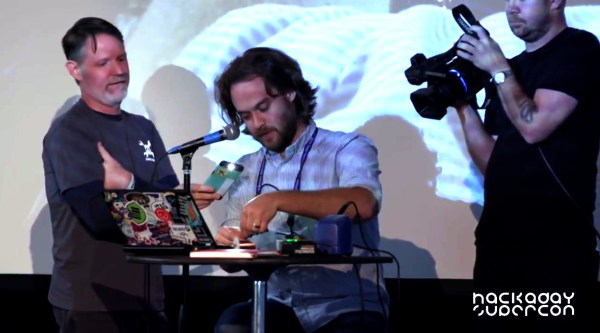
The Craziest Live Soldering Demo Is The Cyborg Ring

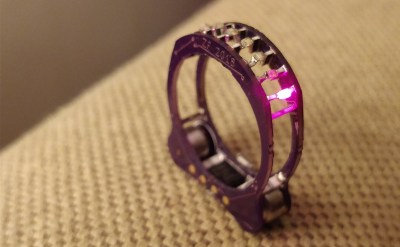
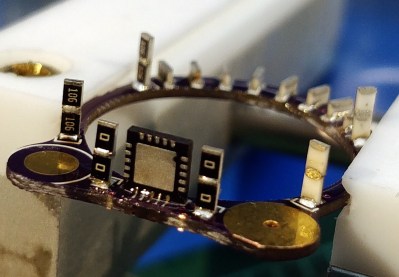
You can define the word crazy in myriad ways. Some would say using SMD resistors and QFN microcontrollers as structural elements is  crazy. Some would say hand soldering QFN is crazy, much less trying to do it on edge rather than in the orientation the footprint is designed for. And of course doing it live on stage in front of people who eat flux for breakfast is just bonkers. But Zach did it anyway and I’m delighted he did.

This is the cyborg ring, and it’s a one-of-a-kind leap in imagination — the kind of leap people have come to expect from Zach Fredin who modeled neurons on PCBs, depopulated an SMD LED matrix and airwired it, and replaced his ThinkPad fingerprint reader with an ARM debugger port. The construction leverages the precise nature of manufactured parts: the ATtiny85 that drives the ring is exactly twice the width of an 0805 component. This means he can bridge the two circuit boards that make up the ring with the QFN microcontroller, and then use two 10M Ohm resistors as structural spacers in a few places around the ring. The jewels in this gem of a project are red LEDs that can be addressed in an animated pattern.

There’s an adage that all live talk demos are doomed to fail, and indeed the uC in this project doesn’t want to speak to the programmer at the end of the 9-minute exhibition. But Zach did manage to solder the two halves on the ring together live on stage, and it’s worth enduring the camera issues and low starting volume at the start of this livestream to watch him perform some crazy magic. Good on you Zach for putting yourself out there and showing everyone that there’s more than one way to stack resistors.



If this demo leaves you wanting to hear more of what Zach’s adventures, we recommend checking out his 2016 Supercon talk on the Neurobytes development and manufacturing process.

Continue reading “The Craziest Live Soldering Demo Is The Cyborg Ring”