A Cloned Bluetooth Tracker Meets Its Maker

The holidays bring us many things. Family and friends are a given, as is the grand meal in which we invariably overindulge. It’s a chance for decades old songs and movies to somehow manage to bubble back up to the surface, and occasionally a little goodwill even slips in here or there. But perhaps above all, the holidays are a time for every retailer to stock themselves to the rafters with stuff. Do you need it? No. Do they want it? No. But it’s there on display anyway, and you’re almost certainly going to buy it.
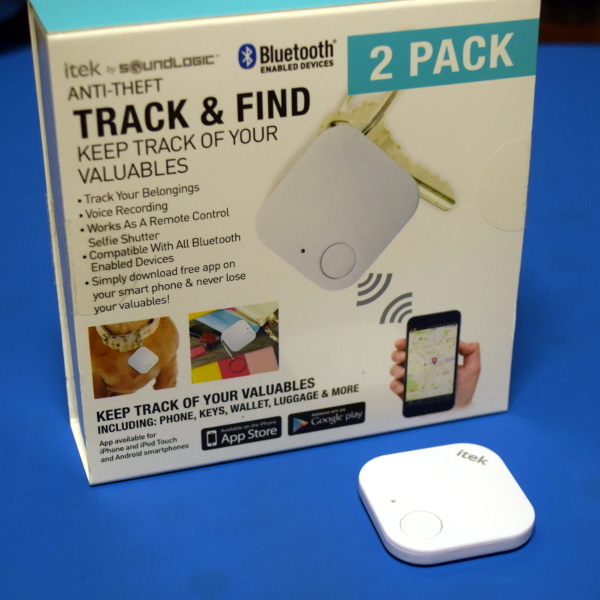
Which is precisely how I came to purchase a two pack of Bluetooth Low Energy (BLE) “trackers” for the princely sum of $10 USD. I didn’t expect much out of them for $5 each, but as this seemed an exceptionally low price for such technology in a brick and mortar store, I couldn’t resist. Plus there was something familiar about the look of the tracker that I couldn’t quite put my finger on while I was still in the store.

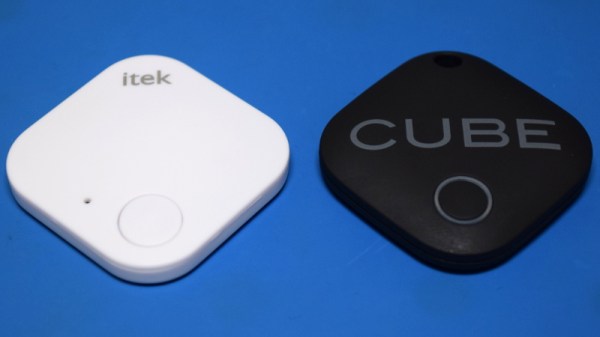
That vague feeling of recollection sent me digging through my parts bin as soon as I got home, convinced that I had seen something among the detritus that reminded me of my latest prize. Sure enough, I found a “Cube” Bluetooth tracker which, ironically, I had received as a Christmas gift some years ago. Putting them side by side, it was clear that the design of these “itek” trackers took more than a little inspiration from the better known (and five times as expensive) product.

The Cube was a bit thicker, but otherwise the shape, size, and even button placement on the itek was nearly identical. Reading through their respective manuals, the capabilities also seemed in perfect parity, down to being able to use the button on the device as a remote camera control for your smartphone. Which got me thinking: just how similar would these two devices be internally? Clearly they looked and functioned the same, but would they be built the same as well? They would have to cut costs somewhere.

Determined to find out how a company can put out what for all the world looks like a mirror image of a competitor’s device while undercutting them by such a large margin, I cracked both trackers open to get a bit more familiar with what makes them tick. What I found on closer inspection of these two similar gadgets is perhaps best summarized by that age old cautionary adage: “Don’t judge a book by its cover.”

Continue reading “A Cloned Bluetooth Tracker Meets Its Maker”

Hackaday Links Column Banner

Hackaday Links: CES Is Over

CES is over, and once again we have proof technology does not improve our lives. Here’s the takeaway from the @internetofshit. There’s a garbage can where you can drop your DNA sample. This is obviously not a Bay Area startup, because they just leave DNA samples on the sidewalk there. The ‘smart cooler’ market is heating up (literally) with a cooler that’s also a grill. Someone duct taped an air filter to a roomba, so your air filter can go to where all the dirty air is in your house. Internet of Rubik’s Cubes. The world’s first autonomous shower made an appearance. Now you can take a shower over the Internet. What a time to be alive.

Need some more bad news from CES? We have more proof the entire tech industry is astonishingly sexist. How so? Well, VR sex simulators can win best of show. That’s a given, obviously. But a ‘smart’ sex toy designed by and for women was selected for a CES 2019 Innovation Award in the Robotics and Drone category. This award was given, then rescinded, by the Consumer Technology Association (CTA) because it was, ‘immoral, obscene, indecent, profane or not in keeping with the CTA’s image’. We presume they mean the latter, but we’re not sure.

Sometimes, though, there are actual engineers behind some of the gadgets on display at CES. Bell (yes, the aerospace company) unveiled the Bell Nexus, a five-seat VTOL ‘taxi’ powered by six ducted fans. These fans are powered by a hybrid electric power system. We assume a turboshaft connected to a generator powering electric motors. Most interestingly, speculation is that this will be the vehicle Uber’s Elevate air taxi program. This initiative by Uber intends to turn a random parking lot in LA into the busiest airport in the world. This is what the official marketing material from Uber says, I am not making this up, and it’s beyond stupid. You know what, just have Uber buy the Santa Monica airport, close it down, and turn it into an air taxi hub. This is the dumbest and funniest possible future imaginable.

Okay, CES is terrible, but here’s something for you. You can get a free ‘maker license’ of Solidworks. Just go here and enter promo code ‘918MAKER’. This info comes from reddit.

The Impossible Project was founded in 2008 as an initiative to remanufacture Polaroid film and refurbish cameras. The project was a rousing success with many supporters. It is a beacon of hope for anyone who wants to keep obsolete formats alive. Now, another format will live on. MacEffects, a company (or eBay store) in Indiana is remanufacturing color ribbons for Apple ImageWriter II printers. The ImageWriter II was the dot-matrix printer in your elementary school’s computer lab if you’re in the Oregon Trail generation, and yes, it could print color pictures. It could print very high-quality color pictures. The problem is getting color ribbons, and now you can get new ones. We’re very interested in seeing the art that can be made with a color ribbon in an ImageWriter, so if you have a portfolio, send it on in. If you have an ImageWriter, try to print something. It’s a serial printer, not a parallel printer.

Hackaday Podcast 001: Seriously, We Know What We’re Doing

First podcast of the new year! Editors Elliot Williams and Mike Szczys look back on the most interesting hacks and can’t-miss articles from the past week (or so). Highlights include abusing IPv6 addresses, underclocking WiFi, taking Wii out of the livingroom, scratch built microphones, computer prophecy coming true, and the end of an automotive era. Full show notes below.

This week, Hackaday Contributor Bob Baddeley came on the show to discuss developments in facial recognition technology and its use in the wild.

Take a look at the links below if you want to follow along, and as always, tell us what you think about this episode in the comments!

Direct download (60 MB or so.)

Continue reading “Hackaday Podcast 001: Seriously, We Know What We’re Doing”

Ask Hackaday: Help Me Pick A CAD Package

Of all the skills that I have picked up over the years as an engineer, there is one that has stayed with me and been a constant over the last three decades. It has helped me work on electronic projects, on furniture, on car parts, robots, and even garments, and it is likely that I will continue using it periodically for the rest of my career. You see, I am a trained PAD expert.

Don't build this, it's fundamentally flawed! Sometimes the front of an envelope is as effective as its back.
Don’t build this, it’s fundamentally flawed! Sometimes the front of an envelope is as effective as its back.

PAD, you ask? OK, it’s an acronym of my own coinage, it stands for Pencil Aided Design, and it refers to the first-year undergraduate course I sat many years ago in which I learned technical drawing to the old British standard BS308. If I’m making something then by far the quickest way for me to visualise its design is to draw it, first a freehand sketch to get a feel of how everything will sit, then a series of isometric component drawings on graph paper with careful attention to dimensions and angles. Well, maybe I lied a little there, the graph paper only comes in when I’m doing something very fancy; the back of an envelope is fine as long as the dimensions on the diagram are correct.

Continue reading “Ask Hackaday: Help Me Pick A CAD Package”

Adventures In Automating A Candle Factory

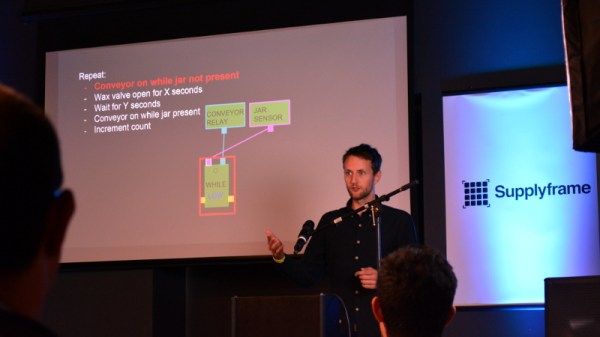
Have you ever considered the manufacture of candles? Not necessarily manufacturing them yourself, but how they are manufactured in a small-scale industrial setting? It’s something that has been of great concern to Michael Schuldt as he grappled with the task of automating a simple manual candle production process.

It’s not just an interesting subject, but the topic of manufacturing automation is something we can all learn from. This was the subject of his Adventures in Manufacturing Automation talk at the recent Hackaday Superconference which you’ll find below the break. Let’s dive in and see what this is all about!

Continue reading “Adventures In Automating A Candle Factory”

35C3: Biggest Communication Congress, Yet Little Chaos

Every year for the past 35 years, the German Chaos Computer Club has met just after Christmas for a few days of “Spaß am Gerät” — having fun with the machines. And that’s everything from trying to bring an old PDP-8 back into running condition to forging new software to replace the old and busted social media platforms that permeate our lives. The sum total of around 17,000 people doing the nerdy stuff that they love, and sharing it together, is both amazing and inspiring. Four days of little sleep and much socializing later, I bet there was still another four days’ worth of stuff to see.

The official theme this year was “Refreshing Memories” which honestly sounds a bit too much like a cola slogan, but was a great opportunity to think back on the hacks of the past that got us where we are. Assemblies put up shrines to their hacker heroes of the past. Retro computers were everywhere, in the talks and on the floor. This year’s Congress was a great time to look back and remember, but also to create new memories for the future. On that front, it was a total success.

But the unofficial theme this year was “Smooth Running”. Everything went very well, which is no small feat considering that the infrastructure, decoration, security, and even the medical response teams are from the Chaos community. It’s the depth of engagement that makes this work: of the 17,000 people who showed up, just over 4,000 of them volunteered for “angel” shifts — meaning they helped guard the doors, staff the info desks, or build up or tear down. It was the largest ever CCC, and you could feel it, but they pulled it off, and then some.

The angels are geeks just like you and me, and since everything went so smoothly, they had time to play. For instance, the phone operations people offer DECT phone service so that attendees can bring in their home phones and use them at Congress. In years past, the lines to register and enroll phones were painfully long. This year, it all happened online, and the result is that the phone ops crew got bored. That explains how they had time to establish roaming home-phone wireless service in some of the normal Leipzig city trams. Wait, what?

Continue reading “35C3: Biggest Communication Congress, Yet Little Chaos”

Linux Fu: The Kitchen Sync

One of the great things about Linux and similar operating systems is they are configurable. If you don’t like something, there’s a great chance you can change it easily with a few entries in a file somewhere. For example, take bash — a very popular shell by any measure. If you want a different style of command line editing, there’s an option. You want the tab key to match files regardless of case? Another option. Usually, these are set in one of your so-called profile files like .bashrc in your home directory.

As long as you are sitting in front of your single computer working, this is great. You customize your .bashrc and other files to your heart’s content and then you work in an environment that acts the way you want it to. The problem is when you have a lot of computers. Maybe you have a web server, a desktop, a firewall machine, and a few dozen Raspberry Pi computers. How do you keep all the configurations the same? Then once they are the same, how do you keep them up to date?

Continue reading “Linux Fu: The Kitchen Sync”