Biasing That Transistor Part 4: Don’t Forget The FET

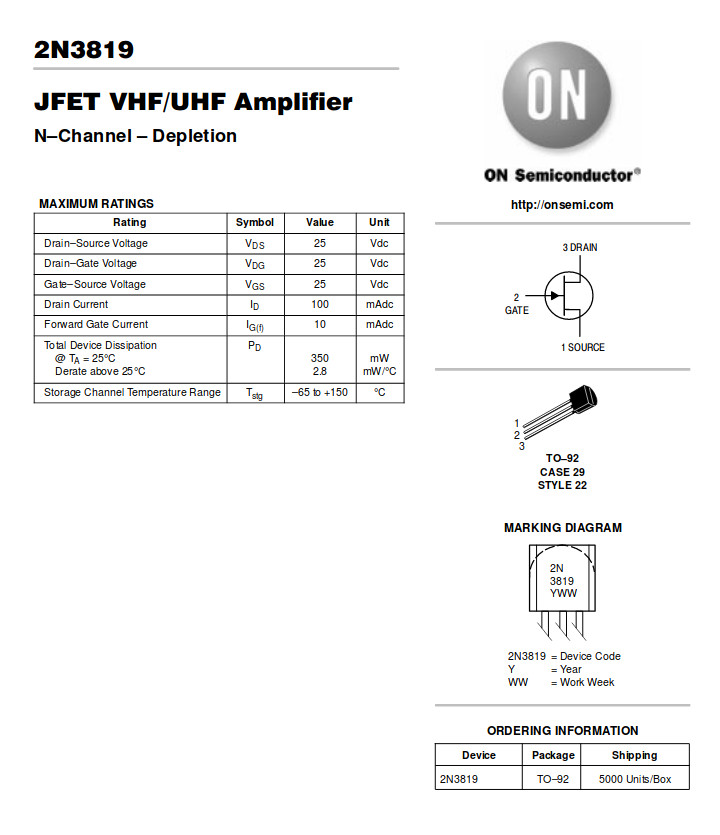
The 2N3819 is the archetypal general-purpose N-channel FET. (ON Semiconductor)

Over the recent weeks here at Hackaday, we’ve been taking a look at the humble transistor. In a series whose impetus came from a friend musing upon his students arriving with highly developed knowledge of microcontrollers but little of basic electronic circuitry, we’ve examined the bipolar transistor in all its configurations. It would however be improper to round off the series without also admitting that bipolar transistors are only part of the story. There is another family of transistors which have analogous circuit configurations to their bipolar cousins but work in a completely different way: the Field Effect Transistors, or FETs.

In a way it’s less pertinent to look at FETs in the way we did bipolar transistors, because while they are very interesting devices that power much of what you will do with electronics, you will encounter them as discrete components surprisingly rarely. Every CMOS device you deal with relies on FETs for its operation and every high-quality op-amp you throw a signal at will do so through a FET input, but these FETs are buried inside the chip and you’d be hard-pressed to know they were there if we hadn’t told you. You’d use a FET if you needed a high-impedance audio preamp or a low-noise RF amplifier, and FETs are a good choice for high-current switching applications, but sadly you will probably never have a pile of general-purpose FETs in the way you will their bipolar equivalents.

That said, the FET is a fascinating device. Join us as we take an in-depth look at their operation, and how and where you might use one.

FET basics
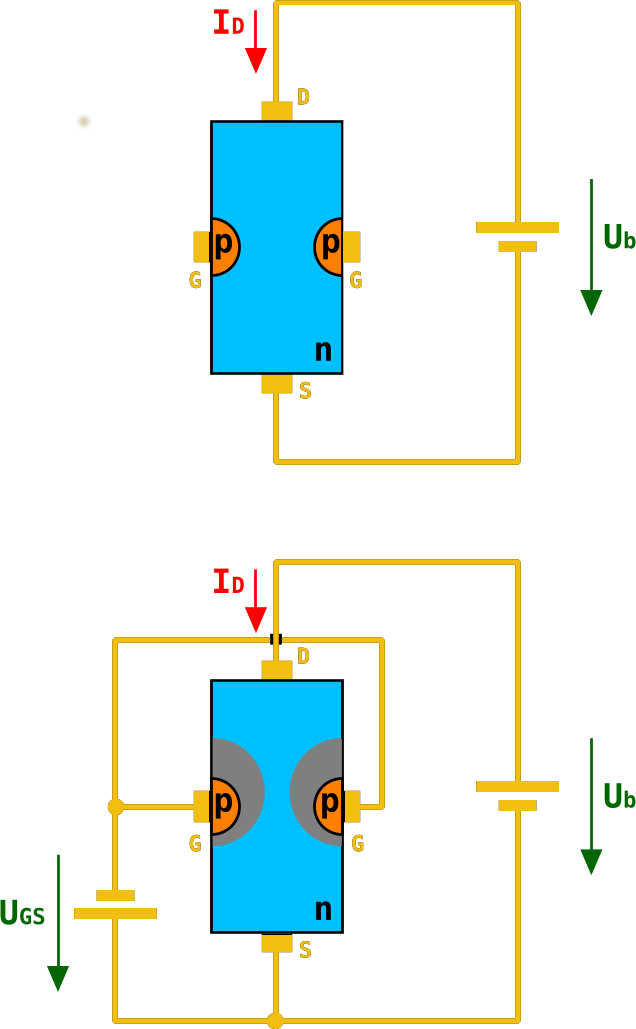
A diagram of an n-channel JFET. As the negative gate voltage on the p-type silicon decreases in the lower diagram, its electric field restricts the area through which electrons can flow in the n-type channel. Chtaube,(CC BY-SA 2.0 DE)

A basic FET has three terminals, a source (the source of electrons), a gate (the control terminal), and a drain (where electrons leave the device). These are analogous to the terminals on a bipolar transistor, in that the source fulfills a similar role to the emitter, the gate to the base, and the drain to the collector. Thus the three basic bipolar transistor circuit configurations have equivalents with a FET; common-emitter becomes common-source, common-base becomes common-gate, and an emitter follower becomes a source follower. It is dangerous to stretch the analogy between bipolar transistors and FETs too far, though, because of their different mode of operation. A closer similarity exists between a FET and a triode tube, if that helps.

The simplest FET for demonstration purposes has a piece of N-type semiconductor with source and drain connections at opposite ends, and a zone of P-type semiconductor deposited in its middle. This is referred to as an N-channel junction FET or JFET, because the channel through which current flows is N-type semiconductor, and because a diode junction exists between gate and channel. There are equivalent P-channel devices, just as there are PNP and NPN bipolar transistors.

Were you to bias an n-channel JFET as you would a bipolar transistor with a positive bias on its gate, the diode between gate and source would conduct, and the transistor would remain a diode with two cathode terminals. If however you give the gate a negative bias compared to the source, the diode becomes reverse-biased, and no current to speak of flows in the gate.

A characteristic of a reverse-biased diode is that it has a depletion zone between anode and cathode, an area in which there are no electrons. This is what causes the diode to no longer conduct, and the size of the depletion zone depends upon the size of the electric field that exists across it. If you’ve ever used a varicap diode, the capacitance between the two sides of this variable-width zone is the property you are exploiting.

In a FET, the depletion zone stretches from the gate region into the channel, and since its size can be adjusted by the gate voltage it can be used to “pinch” the remaining conductive region within the channel. Thus the area through which electrons can flow is controlled by the gate voltage, and thus the current that flows between drain and source is proportional to the gate voltage. We have an amplifier.

A simple FET radio receiver circuit showing FET biasing. The gate is biased at ground potential through the inductor, and the source is held above ground by the current in the 5K resistor. Herbertweidner [Public domain].
In the JFET diagram above, the negative gate bias is represented by a battery. Tube enthusiasts may have encountered equipment that derives negative grid bias from a power supply, and you will find tube power units that include a -150 V rail for this purpose. In general though this is inconvenient in a FET circuit even though the voltage is lower, because of the extra cost of a negative regulator.. Instead the gate is held at a lower potential than the source by careful selection of a source resistor such that the current flowing through it brings the source up above ground, and a gate bias circuit that holds the gate close to ground. The base resistor chain from the bipolar circuit is for this reason often replaced with either a single resistor to ground, or a gate circuit with a very low DC resistance to ground such as an inductor.

MOSFETs, where the FET becomes more useful

Internal structure of an N-channel MOSFET. Fred the Oyster [Public domain].
The JFET we have described is the simplest of field-effect devices, but it is not the one you will encounter most frequently. MOSFETs, short for Metal Oxide Semiconductor FETs, have a similar source, gate, and drain, but instead of relying on a depletion zone in a reverse-biased diode, they have a thin layer of insulation. The electric field from the gate acts across this insulation and pinches the conductive region in the channel through repulsion of electrons, with the same effect as it has in the JFET. It is beyond the scope of this piece to go into their mechanisms, but you will encounter two types of MOSFET: depletion mode devices that require the same negative bias as the JFET, and enhancement mode MOSFETS that require a positive bias.

Why would you use a FET?

So we’ve described the FET, and noted that while its mode of operation is different to that of a bipolar transistor it does a substantially similar job. Why would we use a FET then, what advantages does it offer us? The answer comes from the gate being insulated either by a depletion region in a JFET or by an insulating layer in a MOSFET. A FET is a voltage amplifier rather than a current amplifier, its input impedance is many orders higher than that of a bipolar transistor, and thus you will find FETs used in many applications that require a high impedance small-signal amplifier. The input of a high-performance op-amp will almost certainly be a FET, for example.
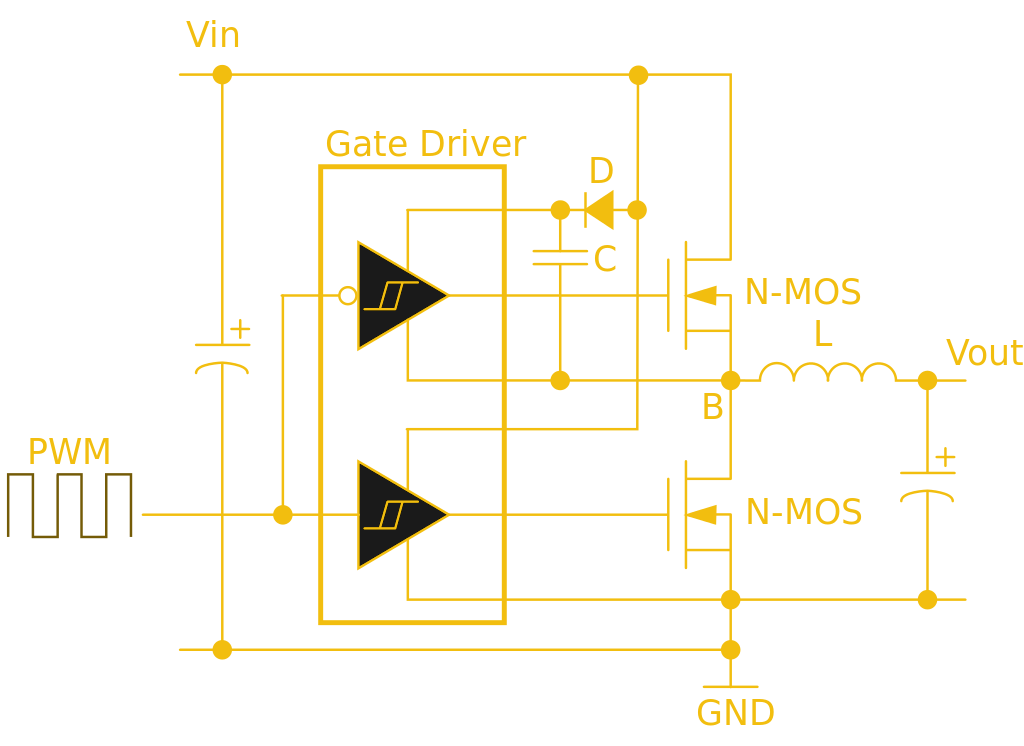
This half-bridge power MOSFET driver circuit uses a specialist gate driver IC with a pair of Schmidt buffers to deliver the initial surge required for a fast-turn-on time. Wdwd (CC BY 3.0).

The high input impedance has another effect less coupled to small signal work. Where a bipolar transistor requires significant base current to turn itself on, the corresponding FET requires almost none. Thus almost all complex integrated circuit logic devices are FET-based rather than bipolar because of the huge power saving that can be made by not needing to supply the base current demands of many thousands of bipolar transistors.

The same effect influences the choice of FETs for power switching, while a bipolar transistor’s base current is proportional to its collector current and thus it will need a significant driver, by contrast a power MOSFET requires virtually no standing gate current after an initial surge. A MOSFET power switch can thus be built requiring much less in the way of drive electronics and much more efficiently than a corresponding bipolar switch, and makes possible some of the tiny driver boards you might be used to for driving motors in your 3D printer, or your multirotor.

Through the course of this series you should have acquired a solid grounding in basic bipolar transistor principles, and now you should be able to add FETs to that knowledge base. We suggested you buy a bag of 2N3904s to experiment with in one of the previous articles, can we now suggest you do the same with a bag of 2N3819s?


Linux Fu: Watch That Filesystem

The UNIX Way™ is to cobble together different, single-purpose programs to get the effect you want, for instance in a Bash script that you run by typing its name into the command line. But sometimes you want the system to react to changes in the system without your intervention. For example, you might like to watch a directory and kick off some program automatically when a file appears from a completed FTP transaction, without having to sit there and refresh the directory yourself.

The simple but ugly way to do this just scans the directory periodically. Here’s a really dumb shell script:

#!/bin/bash
while true
 do
   for I in `ls`
    do cat $I; rm $I
   done
 sleep 10
done

Just for an example, I dump the file to the console and remove it, but in real life, you’d do something more interesting. This is really not a good script because it executes all the time and it just isn’t a very elegant solution. (If you think I should use for I in *, try doing that in an empty directory and you’ll see why I use the ls command instead.)

Continue reading “Linux Fu: Watch That Filesystem”

Ask Hackaday: What Is The Future Of Implanted Electronics?

Biohacking is the new frontier. In just a few years, millions of people will have implanted RFID chips under the skin between their thumb and index finger. Already, thousands of people in Sweden have chipped themselves to make their daily lives easier. With a tiny electronic implant, Swedish rail passengers can pay their train ticket, and it goes without saying how convenient opening an RFID lock is without having to pull out your wallet.

That said, embedding RFID chips under the skin has been around for decades; my thirteen-year-old cat has had a chip since he was a kitten. Despite being around for a very, very long time, modern-day cyborgs are rare. The fact that only thousands of people are using chips on a train is a newsworthy event. There simply aren’t many people who would find the convenience of opening locks with a wave of a hand worth the effort of getting chipped.

Why hasn’t the most popular example of biohacking caught on? Why aren’t more people getting chipped? Is it because no one wants to be branded with the Mark of the Beast? Are the reasons for a dearth of biohacking more subtle? That’s what we’re here to find out, so we’re asking you: what is the future of implanted electronics?

Continue reading “Ask Hackaday: What Is The Future Of Implanted Electronics?”

Friday Hack Chat: Hacking The Wild

It’s nearly summer, and that means we’re right at the start of conference season, at least for the tech and netsec crowd. Conferences, if you’re not aware, are a conspiracy for the hotel-industrial complex and a terrible way to spend thousands of dollars on a crappy hotel room and twenty-five dollar hamburgers.

[Andrew Quitmeyer] is working on an experimental academic conference that might just put an end to the horrors of conference season. He’s creating his own conference called Dinacon, and it’s going to be cheaper to attend, even though it’s on a tropical island in the Pacific.

For this week’s Hack Chat, we’re going to be talking with [Andrew] about Dinacon, a free, two-month-long conference with over 140 attendees from every continent except Antarctica. [Andrew]’s research is in ‘digital naturalism’ at the National University of Singapore and blends biological fieldwork with DIY crafting. The focus of this conference will be workshops where participants build technology in the wild meant to interact with nature.

Not only is the intersection of DIY electronics interesting to the Hackaday community, this is also an interesting conference from a logistical standpoint. The conference philosophy spells it out pretty clearly, with the main takeaway being that [Andrew] is self-funding this conference himself. It’s only going to take about $10,000 USD to host this conference (!), and there are even a few travel stipends to go around. This is also a two-month-long conference. I assure you, after dealing with Supercons, Hackaday meetups, and all the other events Hackaday puts on, this is exceptionally interesting. It’s unheard of, even.

For this week’s Hack Chat, we’re going to be discussing:

  • What is digital Naturalism?
  • What does DIY electronics look like in the forest? 
  • What did you learn from Hacking The Wild
  • What kind of things do people make at Dinacon? 
  • What is the biggest bug that ever got into one of your electronics experiments? 

You are, of course, encouraged to add your own questions to the discussion. You can do that by leaving a comment on the Hack Chat Event Page and we’ll put that in the queue for the Hack Chat discussion.join-hack-chat

Our Hack Chats are live community events on the Hackaday.io Hack Chat group messaging. This week is just like any other, and we’ll be gathering ’round our video terminals at noon, Pacific, on Friday, June 8th.  Here’s a clock counting down the time until the Hack Chat starts.

Click that speech bubble to the right, and you’ll be taken directly to the Hack Chat group on Hackaday.io.

You don’t have to wait until Friday; join whenever you want and you can see what the community is talking about.

Mechanisms: Abrasives

In our “Mechanisms” series, we’ve featured the fascinating bits and pieces that go into making our mechanical world work. From simple machines such as screws and levers, from springs to couplings, and even more complex mechanisms like zippers and solenoids, we’ve covered the gamut. But we haven’t talked about one of the very earliest mechanisms, captured from nature by our clever ancestors to do useful work like grinding grain and shaping materials into tools: grit, sand, abrasives.

Continue reading “Mechanisms: Abrasives”

Ted Dabney, Atari, And The Video Game Revolution

It may be hard for those raised on cinematic video games to conceive of the wonder of watching a plain white dot tracing across a black screen, reflecting off walls and bounced by a little paddle that responded instantly to the twist of a wrist. But there was a time when Pong was all we had, and it was fascinating. People lined up for hours for the privilege of exchanging a quarter for a few minutes of monochrome distraction. In an arcade stuffed with noisy pinball machines with garish artwork and flashing lights, Pong seemed like a calm oasis, and you could almost feel your brain doing the geometry to figure out where to place the paddle so as not to miss the shot.

As primitive as it now seems, Pong was at the forefront of the video game revolution, and that little game spawned an industry that raked in $108 billion last year alone. It also spawned one of the early success stories of the industry, Atari, a company founded in 1972. Just last week, Ted Dabney, one of the co-founders of Atari, died at the age of 81. It’s sad that we’re getting to the point where we’re losing some of the pioneers of the industry, but it’s the way of things. All we can do is reflect on Dabney’s life and legacy, and examine the improbable path that led him to be one of the fathers of the video game industry.

Continue reading “Ted Dabney, Atari, And The Video Game Revolution”

Power Harvesting Challenge: Scavenge Some Power, Win Prizes

It’s a brand new day as the Power Harvesting Challenge begins. This is the newest part of the 2018 Hackaday Prize and we’re looking for 20 entries who will each receive $1,000 and move onto the finals to compete for the top five spots, scoring cash prizes of $50k, $25k, $15k, $10k, and $5k.

Put simply, Power Harvesting is anything you can do that will pull some of the energy you need from a source other than wall-power or traditional battery tech. The most obvious power harvesting technologies are solar and wind. Ditch the battery in your doorbell for a solar panel, or turn your time-lapse camera rig into one that tops its battery with a tiny wind turbine. On the other end of the spectrum you could go nuts with chemistry and develop your own take on harvesting power from saltwater, or sip off the ambient RF waves all around us.

Every Idea Matters

We live in an amazing time as chip manufacturers have squeezed every low power trick out of their silicon dies that they possibly can. The Power Harvesting Challenge is the complement to those achievements: can we now squeeze as much energy out of non-traditional sources as possible to further reduce our energy footprints?

Continue reading “Power Harvesting Challenge: Scavenge Some Power, Win Prizes”