Hackaday Links Column Banner

Hackaday Links: January 7, 2018

Whelp, Spectre and Meltdown are the tech news du jour right now, and everyone is wondering: what is the effect of this problem on real hardware in real server rooms? Epic Games patched their machines and found something shocking. The CPU utilization for one of their online services increased about 100%. We don’t know what this server is doing, or what this process is, but the Spectre and Meltdown patches will increase CPU load depending on the actual code running. This is bad for Epic — they now have to buy an entirely new server farm. This is doubly bad for Intel, and there is speculation of a class action suit floating around the darker corners of the Interwebs.

It is with a heavy heart that I must report the passing of John Young, the only person to have commanded four different classes of spacecraft (five if you include the lunar rover), including the first launch of the Space Shuttle. He was, simply, the most badass astronaut to ever live. Need proof of that? His heart rate during the launch of a Saturn V was seventy.

By the time this post is published, you’ll have less than twenty-four hours to submit your project to the Coin Cell Challenge. Get to it!

A short reminder that Shmoocon is a mere two weeks away. What is Shmoocon? A totally chill cyber/sec/hacker con at the Washington D.C. Hilton (yes, where Reagan was shot). We’ll be there, and we’re looking for some like-minded Hackaday peeps to chill out with. Want a meetup? Reply in the comments.

A few years ago, the ESP8266 appeared out of the blue in a few Chinese reseller’s web shops, and everything has been gravy since. Now there’s a new magic do-everything chip appearing on AliExpress and Taobao. It’s the RDA5981, a chip with an ARM Cortex M4 core, 32Mbit of Flash, 192k or user RAM, b/g/n WiFi, I2S, and enough peripherals to be useful. Given the support for a MIC, line in, MP3, WAV, WMA and AAC, it appears this is an all-in-one chip designed for Bluetooth speakers or some other audio application. You can find modules on Alibaba and a few breakout boards on Taobao.

According to my sources (the press releases that somehow slipped through the ‘CES’ filter on my email), the world’s fastest, smallest, biggest, least expensive, and newest drone is set to be unveiled at CES in Vegas this week.
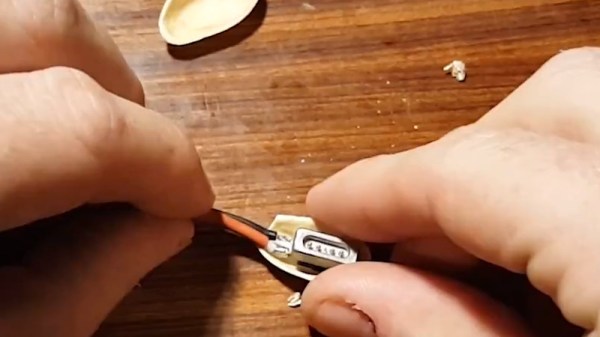

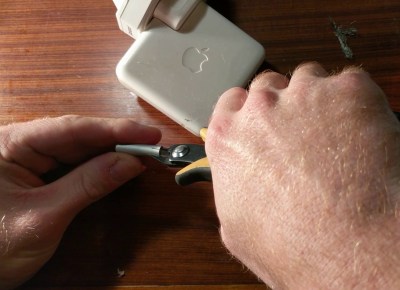
Repairing A Macbook Charger… With A Pistachio Nut

Laptop chargers face a hard life. They’re repeatedly plugged and unplugged, coiled up, stuffed into bags, thrown around, and just generally treated fairly poorly. Combine this with fairly lightweight design and it’s not uncommon for a laptop charger to fail after a few years. It’s usually the connector that goes first. Such was the case when I found myself face to face with a failed Macbook charger, and figured it’d be a simple fix. Alas, I was wrong.

Unlike most PC manufacturers, who rely on the humble barrel jack and its readily available variants, Apple liked to use the Magsafe connector on its Macbook line. This connector has many benefits, such as quick release in the event someone trips over the cable, and the fact that it can be plugged in without regard to orientation. However, it’s not the easiest to fix. When the charger began failing, I noticed two symptoms. The first was that the charger would only function if the cable was held just so, in exactly the right orientation. The other, was that even when it would charge, the connector would become very hot. This led me to suspect an intermittent connection was the culprit, and it was quite a poor one at that; the high resistance leading to the heat issue.

It’s at this point with any other charger that you get out your trusty sidecutters, lop the end off, and tap away at Digikey to get a replacement part on the way. With Magsafe? No dice. Replacement parts simply aren’t available — a common problem with proprietary connectors. I endeavoured to fix the problem anyway. I began to strip away the metal shell around the back of the connector with my sidecutters, and eventually an angle grinder. A Dremel would have been the perfect tool for the job, actually, but I persevered regardless. After much consternation, I had the connector peeled back and was able to identify the problem.

Continue reading “Repairing A Macbook Charger… With A Pistachio Nut”

Lunar New Year Is Coming, Shipping Times May Vary

With one holiday period coming to a close, another looms on the horizon: Lunar New Year. That means three things in my mind: nice weather, a beautiful holiday with great food, and that I had better get all my orders for electronic parts for the next few months out immediately. In fact, I should have done it last month but I’m a bit closer to the source than many of you are.

In any case, Lunar New Year affects our ability to order neat gadgets at a time of year when some of us have received a little money to spend. So I thought I’d take a moment away from hacking to share with you how important this holiday is to much of the world so we can manage our expectations for quick global shipping accordingly.

Continue reading “Lunar New Year Is Coming, Shipping Times May Vary”

Friday Hack Chat: The State Of KiCad

KiCad is twenty-five years old — like most PCB design software — and right now it’s the best Open Source tool to lay out your circuits, plop down a few resistors, and create a PCB from scratch. Over the last few years, a lot of people have been turning to KiCad to design some very impressive boards, something no doubt related to the fact that KiCad is free in both the beer and speech senses.

Join us this Friday for Hack Chat, we’re talking all about KiCad. If you have grievances or praise to heave onto the developers, this is the place to do it. Our guest for this week’s Hack Chat will be Wayne Stambaugh, project lead for KiCad. Among other things, Wayne is responsible for leading the KiCad product roadmap and he’s also one of the authors of the CvPcb Reference Manual

During this Hack Chat, we’ll discuss current and future features in everyone’s favorite Open Source EDA suite. This is a great chance to make suggestions and put forth wish list items. Wondering if KiCad is pronounced ‘Kai-CAD’ or ‘Key-CAD’? It’s the latter, but don’t let that stop you from asking Wayne to change that.

Items up for discussion include:

  • The new features on the 2018 roadmap
  • What’s happened in KiCad since the last KiCad Hack Chat
  • What goes on under the hood, and why should you never trust the autorouter?
  • Where do you turn when you’re just starting out in KiCad?

If you have something you’d like to ask the KiCad devs, make sure to add it to our discussion sheet. To do that, just leave a comment on the Hack Chat Event Page.

join-hack-chat

Our Hack Chats are live community events on the Hackaday.io Hack Chat group messaging. This Hack Chat is going down Friday, January 5th at noon, Pacific time. Time Zones got you down? Here’s a handy countdown timer!

Click that speech bubble to the left, and you’ll be taken directly to the Hack Chat group on Hackaday.io.

You don’t have to wait until Friday; join whenever you want and you can see what the community is talking about.

44 Layers Of Katharine Burr Blodgett

Whether you realize it or not, Katharine Burr Blodgett has made your life better. If you’ve ever looked through a viewfinder, a telescope, or the windshield of a car, you’ve been face to face with her greatest achievement, non-reflective glass.

Katharine was a surface chemist for General Electric and a visionary engineer who discovered a way to make ordinary glass 99% transparent. Her invention enabled the low-cost production of nearly invisible panes and lenses for everything from picture frames and projectors to eyeglasses and spyglasses.

Katharine’s education and ingenuity along with her place in the zeitgeist led her into other fields throughout her career. When World War II erupted, GE shifted their focus to military applications. Katharine rolled up her sleeves and got down in the scientific trenches with the men of the Research Lab. She invented a method for de-icing airplane wings, engineered better gas masks, and created a more economical oil-based smokescreen. She was a versatile, insightful scientist who gave humanity a clearer view of the universe.

Continue reading “44 Layers Of Katharine Burr Blodgett”

Great People And Culture At 34th Chaos Communication Congress

If you’ve been to a Chaos Communication Congress, you know the feeling — the strange realization after it’s all over that you’re back in the “real world”. It’s somehow alienating and unfriendly in comparison to being surrounded by computer freaks, artists, hackers, activists, coders, and other like-minded individuals over the four days of the Congress. A hand-written poster by the podcasting center read “Endlich, normale Leute” — “At last, normal people” — which is irony piled on irony but the sentiment is still right for certain strange values of “normal”. Normal hackers? You’d probably fit right in.

We cover a lot of the talks from the Congress, because they’re first-class and because you can play along at home, but the real soul of the Congress is people getting together, making something temporary and crazy, talking over their common plans, learning new things directly from one-another, and simply having fun. Here’s our chance to give you a little of the other side of the Congress.
Continue reading “Great People And Culture At 34th Chaos Communication Congress”

Retrotechtacular: 1950s Televisions Were Beasts

Television has been around for a long time, but what we point to and call a TV these days is a completely different object from what consumers first fell in love with. This video of RCA factory tours from the 1950s drives home how foreign the old designs are to modern eyes.

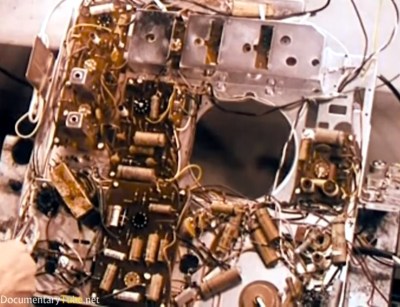
Right from the start the apparent chaos of the circuitry is mindboggling, with some components on circuit boards but many being wired point-to-point. The narrator even makes comments on the “new technique for making electrical connections” that uses a wire wrapping gun. The claim is that this is cleaner, faster, and neater than soldering. ([Bil Herd] might agree.) Not all of the methods are lost in today’s manufacturing though. The hand-stuffing and wave soldering of PCBs is still used on lower-cost goods, and frequently with power supplies (at least the ones where space isn’t at a premium).

It’s no surprise when talking about 60+ year-old-designs that these were tube televisions. But this goes beyond the Cathode Ray Tube (CRT) that generates the picture. They are using vacuum tubes, and a good portion of the video delves into the manufacture and testing of them. You’ll get a glimpse of this at 3:20, but what you really want to see is the automated testing machine at 4:30. Each tube travels along a specialized conveyor where the testing goes so far as to give a  few automated whacks from corks on the ends of actuators. As the tube gauntlet progresses, we see the “aging” process (around 6:00) when each tube is run at 3-4 times the rated filament voltages. Wild!

There’s a segment detailing the manufacture of the CRT tubes as well, although these color tubes don’t seem to be for the model of TV being followed during the rest of the films. At about 7:07 they call them “Color Kinescopes”, an early name for RCA’s CRT technology.

During the factory tours we get the overwhelming feeling that this manufacturing is more related to automotive than modern electronic. These were the days when televisions (and radios) were more like pieces of furniture, and seeing the hulking chassis transported by hanging conveyors is just one part of it. The enclosure plant is churning out legions of identical wooden consoles. This begins at 11:55 and the automation shown is very similar to what we’d expect to see today. It seems woodworking efficiency was already a solved problem in the ’50s.

Continue reading “Retrotechtacular: 1950s Televisions Were Beasts”