Circuit Design? Spread The Joy

Accountants and MBAs use spreadsheets to play “what if” scenarios with business and financial data. Can you do the same thing with electronic circuits? The answer–perhaps not surprisingly–is yes.

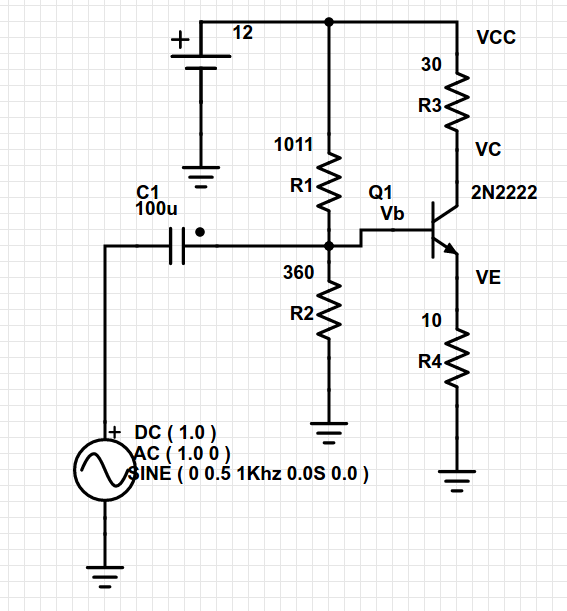
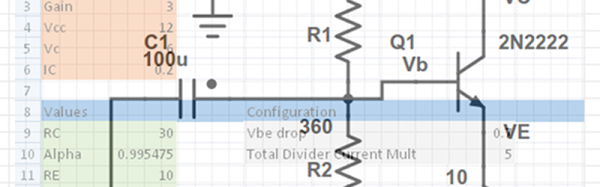
Consider this simple common emitter amplifier (I modeled it in PartSim, if you’d like to open it):

In this particular case, there are several key design parameters. The beta of the transistor (current gain) is 220. The amplifier has an overall voltage gain of about 3 (30/10). I say about, because unless the transistor is ideal, it won’t be quite that. The supply voltage (Vcc) is 12 volts and I wanted the collector voltage (VC) to idle at 6V to allow the maximum possible positive and negative swing. I wanted the collector current (IC) to be 200mA.

Continue reading “Circuit Design? Spread The Joy”

Four Of Our Favorite Hardware Talks

The Hackaday SuperConference is the greatest gathering of hardware hackers on the planet. Last year at the SuperCon, we saw talks on building systems from scratch, creating new and interesting uses for technology, and bringing those electronic bits to market. What are we talking about? Here are four of the best talks from last year’s Hackaday SuperConference:

Continue reading “Four Of Our Favorite Hardware Talks”

Shell Game

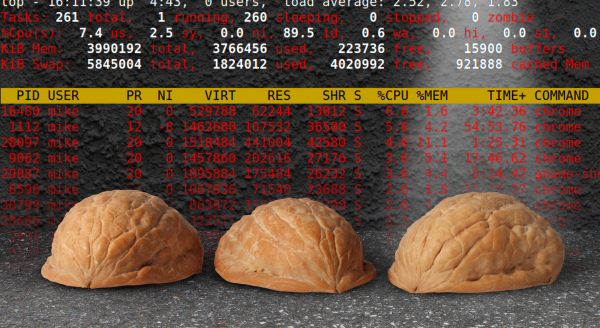
A lot of us spend a lot of time switching between Windows and Linux. Now that platforms like the Raspberry Pi are popular, that number is probably increasing every day. While I run Linux on nearly everything I own (with the exception of a laptop), my work computers mostly run Windows. The laptop is on Windows, too, because I got tired of trying to get all the fancy rotation sensors and pen features working properly under Linux.

What I hate most about Windows is how hard is it to see what’s going on under the hood. My HP laptop works with a cheap Dell active stylus. Sort of. It is great except around the screen edges where it goes wild. Calibration never works. On Linux, I could drill down to the lowest levels of the OS if I were so inclined. With Windows, it is just tough.

War is Shell

One place where Linux always used to have an advantage over DOS and Windows was the shell. There are lots of variations available under Linux, but bash seems to be the current pick for most people. If you want more power, you can move to some alternatives, but even bash is pretty powerful if you learn how to use it and have the right external programs (if you don’t believe it, check out this web server).

Continue reading “Shell Game”

Hackaday Prize: 20 Projects That Are The Height Of Automation

Automation makes the world go around. Whether it’s replacing elevator attendants with buttons, replacing songwriters with computer algorithms, or giving rovers on Mars the same sense and avoid capability as a Tesla, Automation makes our lives easier and better. Today we’re excited to announce the twenty projects that best demonstrate the possibilities of Automation in the running for the 2016 Hackaday Prize. These projects tackled problems ranging from improving the common stepper motor to flying Lidar around a neighborhood on a gigantic ducted fan.

The winners of the Hackaday Prize automation challenge are, in no particular order:

If your project is on the list, congrats. You just won $1000 for your hardware project, and are now moving up to the Hackaday Prize finals where you’ll have a chance to win $150,000 and a residency at the Supplyframe DesignLab in Pasadena.

Assistive TechnologiesIf your project didn’t make the cut, there’s still an oppurtunity for you to build the next great piece of hardware for The Hackaday Prize. The Assistive Technologies Challenge is currently under way challenging you to build a project that helps others move better, see better, or live better.

We’re looking for exoskeletons, a real-life Iron Man, a better wheelchair, a digital braille display, or the best educational software you can imagine.

Like the Design Your ConceptAnything GoesCitizen Science, and Automation rounds of the the Hackaday Prize, the top twenty projects will each win $1000 and move on to the Hackaday Prize finals for a chance to win $150,000 and a residency at the Supplyframe DesignLab in Pasadena

If you don’t have a project up on Hackaday.io, you can start one right now and submit it to the Hackaday Prize. If you’re already working on the next great idea in assistive technologies, add it to the Assistive Technologies challenge using the dropdown menu on the sidebar of your project page.

The Hackaday Prize is the greatest hardware competition on Earth. We want to see the next great Open Hardware project benefit everyone. We’re working toward that by recognizing people who build, make, and design the coolest and most useful devices around.

Hyperuniformity — A Hidden Order Found In The Greatest Set Of Eyes

Of all the things evolution has stumbled across, the eye is one of the most remarkable. Acting as sort of a ‘biological electromagnetic transducer’, the eye converts incoming photons into electrical and chemical spikes, known as action potentials. These spikes then drive the brain of the host life form. Billions of years of natural selection has produced several types of eyes, with some better than others. It would be an honest mistake to think that the human eye is at the top of the food chain, as this is not the case. Mammals underwent a long stint scurrying around in dark caves and crevasses, causing our eyes to take a back seat to other more important functions, such as the development of a cortex.

There are color sensitive cones in all eyes. Mammals have three types of cones, which are…wait for it…Red, Blue and Green. Our red and green cones are relatively recent on the evolutionary timescale – appearing about 30 million years ago.

The way these cones are distributed around our eyes is not perfect. They’re scattered around in lumpy, uneven patterns, and thus give us an uneven light sampling of our world. Evolution simply has not had enough time to optimize our eyes.

There is another animal on this planet, however, that never went through “the dark ages” as mammals did. This animal has been soaring high above its predators for over 60 million years, allowing its eyes to reach the pinnacle of the natural selection process. A bald eagle can spot a mouse from over a mile away. Birds eyes have 5 types of light sensitive cones – red, blue and green like our own. But add in violet and a type of cone that can detect no light, or black. But it is the way these cones are distributed around the bird’s eye that is most fascinating, and the subject of today’s article.

Continue reading “Hyperuniformity — A Hidden Order Found In The Greatest Set Of Eyes”

Hackaday Links: August 28, 2016

E-paper looks awesome, but it’s a pain to work with. You need only look at the homebrew implementations of e-paper drivers and the mess of SMD components for proof of that. [jarek] wanted to play around with e-paper and developed this tiny little driver for a Teensy. It’s a fun toy, and the simplest possible circuit necessary to drive this particular e-paper module.

I am once again asking if anyone knows where to buy this computer case. No, not a complete system – I just want the case, folding keyboard, and monitor integrated into an mATX enclosure.

Back in 1985, a young [Matthias Wandel] built a remote control forklift out of a few windshield wiper motors, wood, and not much else. He’s rebuilt this toy recently, just to prove you can build anything with a stack of plywood and a wood gear template generator.

More Adafruit muppets they probably can’t call muppets. Yaaay. This time it’s J is for Joule. Watts that? A second.

The Raspberry Pi Project, one of our favorite projects in the Hackaday Prize that uses a Raspberry Pi, one of the most liked, viewed, and followed projects on Hackaday.io, and a technological tour de force the likes of which have not been seen since the invention of the steam engine got an update this week. [Arsenijs] and the rest of the Raspberry Pi Project team have released a version of their Raspberry Pi pinout helper. Previously, this tool was only used internally to the project, but since this pinout helper has such far-reaching utility they’ve decided to release a public version. Truly, they are kings among men.

This is possibly the coolest use of stacked plywood I’ve ever seen. It’s a spiral staircase, with each step made of 12 layers of plywood. The ‘spine’ of this staircase is a 3″ sch 40 steel pipe, with a proper foundation. The layer of ply are adhered to the pipe with construction adhesive, and each layer of ply is glued together with wood glue. No, it’s not up to code yet, but it was cheaper to build than just buying a spiral staircase.

[Brek] wrote a graphics library for the ubiquitous 128×64 monochromatic LCDs. It’s written for PICs, but damned if we can’t find a link to the library itself. Hopefully [Brek] will jump in the comments below.

Those really, really cheap ESP8266 modules only have 512kB of Flash in them. Here’s how you upgrade those modules to 4MB. You can do it without a hot air gun, and all you need is a few cheap Flash chips.

Here’s a sound card for a Raspberry Pi. No, that’s not a completely dumb idea. This sound card uses quality op-amps, 24-bit ADCs and DACs, and has MIDI. If you’re experimenting with Pure Data or any other Linux audio toy, this could be a useful addition to your Pi stack.

Hacklet 122 – Spectrometers

There is always something interesting to find when browsing the projects on Hackaday.io. I’m always amazed at how much hackers can get done in their basements and home labs. One surprising trend I’ve found is the sheer number of spectrometer projects people across the globe are working on. I’ve always known what a spectrometer is, but I never knew so many hackers would want them. The numbers don’t lie though – plenty of hackers around the world want to measure the spectra of light — be it to test out a new LED, or determine the structure of an object. This week we’re checking out some of the best spectrometer projects on Hackaday.io!

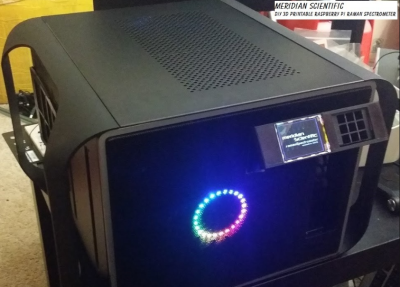
ramanpiWe start with [fl@C@] and ramanPi – Raman Spectrometer. RamanPi is one of the first spectrometer projects on Hackaday.io. [fl@C@] entered his project in the 2014 Hackaday Prize, and was one of 5 finalists. As the name implies, ramanPi is a raman spectrometer, a type often used in chemistry. [fl@C@’s] original use for the machine was determining atomic bond angles. RamanPi uses 3D printed parts created with standard desktop printers wherever possible. A Raspberry Pi runs the system, originally a model B, though now I’m sure a Pi 3 would fit the bill. The detector is a Toshiba linear CCD.


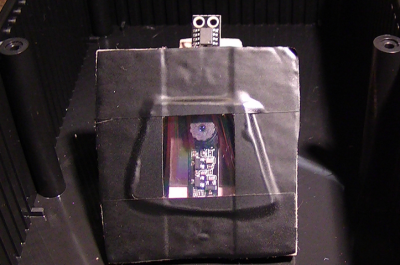
dh-specNext up is [David H Haffner Sr] with DH 4.0 Spectrometer V 4 ( upgrade 2 ). [David’s] project doesn’t give a lot of background in the description text – he dives right in to the technical details of designing and building a spectrometer. His sensor is a JDEPC-OV04, which is a webcam module intended for use in laptops. Much of [David’s] recent work has been on the optical path. Optical spectrometers can use a diffraction grating and a slit to split light into spectra. [David] is using a recordable DVD as his diffraction grating. The slit is a bit more home-made. Two Gillette razor blades and an acetate strip are used to form an optical slit only 0.11 mm wide. [David] has already used his spectrometer to analyze crude oil.

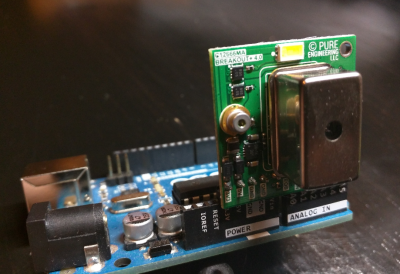
pure-engNext we have [Pure Engineering] with C12666MA Micro-Spectrometer. Electro-Optics manufacturer Hamamatsu has created an optical spectrometer in a fingertip sized can. Their C12666MA micro-spectrometer sounds like it must be magic — and it is. The magic of Microelectromechanical systems (MEMS) have brought this device to life. Bringing one of these devices up isn’t exactly an easy task though. [Pure Engineering] has designed a breakout board for the C12666MA. They’ve even included a 404nm laser diode and a white LED for illumination. The board can plug into a standard Arduino header.

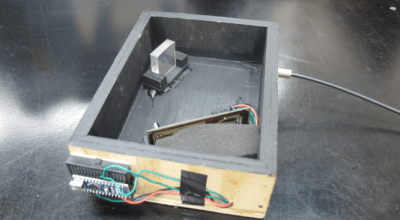
adamFinally, we have [Adam] with Handheld VNIR Spectrometer. VNIR in this case stands for visible and near-infrared. [Adam] created this device so he could learn how spectrometers worked. That’s a noble purpose if I ever heard one. He is building his system to be portable, so he can take measurements outside the lab. The sensor is a Sony ILX511B linear CCD. An Arduino nano reads the CCD and passes the data on to a PC for analysis. [Adam’s] diffraction grating is a concave holographic affair from Public Lab. [Adam] is also using an acetate slit purchased from Public Lab. Illumination enters via a fiber optic bundle.

If you want to see more spectrometer projects, check out our new spectrometer projects list. See a project I might have missed? Don’t be shy, just drop me a message on Hackaday.io. That’s it for this week’s Hacklet, As always, see you next week. Same hack time, same hack channel, bringing you the best of Hackaday.io!