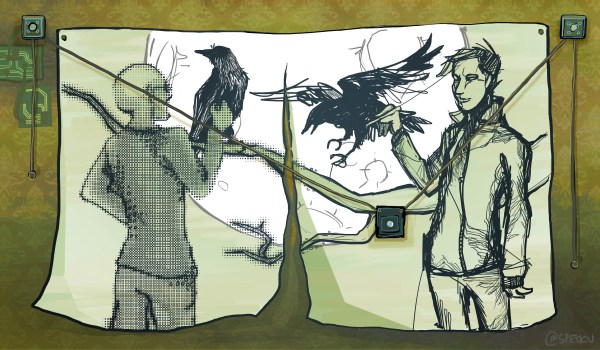
Supercon 2023: [Cory Doctorow] With An Audacious Plan To Halt The Internet’s Enshittification And Throw It Into Reverse

Those of us old enough to remember BBS servers or even rainbow banners often go down the nostalgia hole about how the internet was better “back in the day” than it is now as a handful of middlemen with a stranglehold on the way we interact with information, commerce, and even other people. Where’s the disintermediated future we were promised? More importantly, can we make a “new good web” that puts users first? [Cory Doctorow] has a plan to reverse what he’s come to call enshittification, or the lifecycle of the extractionist tech platform, and he shared it with us as the Supercon 2023 keynote.

As [Doctorow] sees it, there’s a particular arc to every evil platform’s lifecycle. First, the platform will treat its users fairly and provide enough value to accumulate as many as possible. Then, once a certain critical mass is reached, the platform pivots to exploiting those users to sell them out to the business customers of the platform. Once there’s enough buy-in by business customers, the platform squeezes both users and businesses to eke out every cent for their investors before collapsing in on itself.

Doctorow tells us, “Enshittification isn’t inevitable.” There have been tech platforms that rose and fell without it, but he describes a set of three criteria that make the process unavoidable.

  1. Lack of competition in the market via mergers and acquisitions
  2. Companies change things on the back end (“twiddle their knobs”) to improve their fortunes and have a united, consolidated front to prevent any lawmaking that might constrain them
  3. Companies then embrace tech law to prevent new entrants into the market or consumer rights (see: DMCA, etc.)

Continue reading “Supercon 2023: [Cory Doctorow] With An Audacious Plan To Halt The Internet’s Enshittification And Throw It Into Reverse”

FLOSS Weekly Episode 803: Unconferencing With OggCamp

This week Jonathan Bennett and and Simon Phipps chat with Gary Williams about OggCamp! It’s the Free Software and Free culture unconference happening soon in Manchester! What exactly is an unconference? How long has OggCamp been around, and what should you expect to see there? Listen to find out!

Continue reading “FLOSS Weekly Episode 803: Unconferencing With OggCamp”

Retrotechtacular: Another Thing Your TV No Longer Needs

As Hackaday writers we don’t always know what our colleagues are working on until publication time, so we all look forward to seeing what other writers come up with. This week it was [Al Williams] with “Things Your TV No Longer Needs“, a range of gadgets from the analogue TV era, now consigned to the history books. On the bench here is a device that might have joined them, so in taking a look at it now it’s by way of an addendum to Al’s piece.

When VHF Was Not Enough

In a Dutch second-had store while on my hacker camp travels this summer, I noticed a small grey box. It was mine for the princely sum of five euros, because while I’d never seen one before I was able to guess exactly what it was. The “Super 2” weighing down my backpack was a UHF converter, a set-top box from before set-top boxes, and dating from the moment around five or six decades ago when that country expanded its TV broadcast network to include the UHF bands. If your TV was VHF it couldn’t receive the new channels, and this box was the answer to connecting your UHF antenna to that old TV.

It’s a relatively small plastic case about the size of a chunky paperback book, on the front of which is a tuning knob and scale in channels and MHz, on the top of which are a couple of buttons for VHF and UHF, and on the back are a set of balanced connectors for antennas and TV set. It’s mains powered, so there’s a mains lead with an older version of the ubiquitous European mains plug. Surprisingly it comes open with a couple of large coin screws on the underside, so it’s time to take a look inside. Continue reading “Retrotechtacular: Another Thing Your TV No Longer Needs”

Supercon 2023: Thea Flowers Renders KiCad Projects On The Web

Last year’s Supercon, we’ve had the pleasure of hosting Thea [Stargirl] Flowers, who told us about her KiCanvas project, with its trials, its tribulations, and its triumphs. KiCanvas brings interactive display of KiCad boards and schematics into your browser, letting you embed your PCB’s information right into your blog post or online documentation.

Give the KiCanvas plugin a URL to your KiCad file, and it will render your file in the browser, fully on the fly. There’s no .jpg to update and re-upload, no jobs to re-run each time you find a mistake and update your board – your files are always up to date, and your audience is always able to check it out without launching KiCad.

Images are an intuitive representation for schematics and PCB files, but they’re letting hackers down massively. Thea’s KiCanvas project is about making our KiCad projects all that more accessible to newcomers, and it’s succeeded – nowadays, you can encounter KiCanvas schematic embeds in the wild on various hackers’ blogs. The Typescript code didn’t write itself, and neither was it easy – she’s brought a fair few war stories to the DesignLab stage.

A hacker’s passion to share can move mountains. Thea’s task was a formidable one, too – KiCad is a monumental project with a decades-long history. There are quite respectable reasons for someone to move this particular mountain – helping you share your projects quickly but extensively, and letting people learn about your projects without breaking a sweat.

Continue reading “Supercon 2023: Thea Flowers Renders KiCad Projects On The Web”

Supercon 2023 – Going Into Deep Logic Waters With The Pico’s PIO And The Pi’s SMI

The Raspberry Pi has been around for over a decade now in various forms, and we’ve become plenty familiar with the Pi Pico in the last three years as well. Still, these devices have a great deal of potential if you know where to look. If you wade beyond the official datasheets, you might even find more than you expected.

Kumar is presently a software engineer with Google, having previously worked for Analog Devices earlier in his career. But more than that, Kumar has been doing a deep dive into maxing out the capabilities of the Raspberry Pi and the Pi Pico, and shared some great findings in an excellent talk at the 2023 Hackaday Supercon.

Continue reading “Supercon 2023 – Going Into Deep Logic Waters With The Pico’s PIO And The Pi’s SMI”

Hackaday Links Column Banner

Hackaday Links: September 29, 2024

There was movement in the “AM Radio in Every Vehicle Act” last week, with the bill advancing out of the US House of Representatives Energy and Commerce Committee and heading to a full floor vote. For those not playing along at home, auto manufacturers have been making moves toward deleting AM radios from cars because they’re too sensitive to all the RF interference generated by modern vehicles. The trouble with that is that the government has spent a lot of effort on making AM broadcasters the centerpiece of a robust and survivable emergency communications system that reaches 90% of the US population.

The bill would require cars and trucks manufactured or sold in the US to be equipped to receive AM broadcasts without further fees or subscriptions, and seems to enjoy bipartisan support in both the House and the Senate. Critics of the bill will likely point out that while the AM broadcast system is a fantastic resource for emergency communications, if nobody is listening to it when an event happens, what’s the point? That’s fair, but short-sighted; emergency communications isn’t just about warning people that something is going to happen, but coordinating the response after the fact. We imagine Hurricane Helene’s path of devastation from Florida to Pennsylvania this week and the subsequent emergency response might bring that fact into focus a bit.

Continue reading “Hackaday Links: September 29, 2024”

What’s The Deal With AI Art?

A couple weeks ago, we had a kerfuffle here on Hackaday: A writer put out a piece with AI-generated headline art. It was, honestly, pretty good, but it was also subject to all of the usual horrors that get generated along the way. If you have played around with any of the image generators you know the AI-art uncanny style, where it looks good enough at first glance, but then you notice limbs in the wrong place if you look hard enough. We replaced it shortly after an editor noticed.

The story is that the writer couldn’t find any nice visuals to go with the blog post, with was about encoding data in QR codes and printing them out for storage. This is a problem we have frequently here, actually. When people write up a code hack, for instance, there’s usually just no good image to go along with it. Our writers have to get creative. In this case, he tossed it off to Stable Diffusion.

Some commenters were afraid that this meant that we were outsourcing work from our fantastic, and very human, art director Joe Kim, whose trademark style you’ve seen on many of our longer-form original articles. Of course we’re not! He’s a genius, and when we tell him we need some art about topics ranging from refining cobalt to Wimshurst machines to generate static electricity, he comes through. I think that all of us probably have wanted to make a poster out of one or more of his headline art pieces. Joe is a treasure.

But for our daily blog posts, which cover your works, we usually just use a picture of the project. We can’t ask Joe to make ten pieces of art per day, and we never have. At least as far as Hackaday is concerned, AI-generated art is just as good as finding some cleared-for-use clip art out there, right?

Except it’s not. There is a lot of uncertainty about the data that the algorithms are trained on, whether the copyright of the original artists was respected or needed to be, ethically or legally. Some people even worry that the whole thing is going to bring about the end of Art. (They worried about this at the introduction of the camera as well.) But then there’s also the extra limbs, and AI-generated art’s cliche styles, which we fear will get old and boring after we’re all saturated with them.

So we’re not using AI-generated art as a policy for now, but that’s not to say that we don’t see both the benefits and the risks. We’re not Luddites, after all, but we are also in favor of artists getting paid for their work, and of respect for the commons when people copyleft license their images. We’re very interested to see how this all plays out in the future, but for now, we’re sitting on the sidelines. Sorry if that means more headlines with colorful code!