Bluetooth Speaker With Neopixel Visual Display!

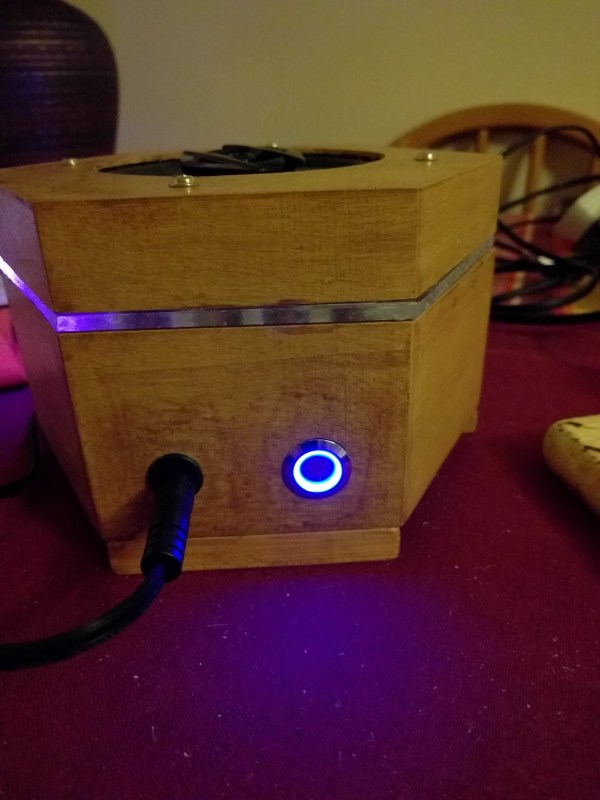
Finding a product that is everything you want isn’t always possible. Making your own that checks off all those boxes can be. [Peter Clough] took the latter route and built a small Bluetooth speaker with an LED visualization display that he calls Magic Box.

A beefy 20W, 4Ohm speaker was screwed to the lid of a wooden box converted to the purpose. [Clough] cut a clear plastic sheet to the dimensions of the box, notching it 2cm from the edge to glue what would become the sound reactive neopixel strip into place — made possible by an electret microphone amplifier. There ended up being plenty of room inside the speaker box to cram an Arduino Pro Mini 3.3V, the RN-52 Bluetooth receiver, and the rest of the components, with an aux cable running out the base of the speaker. As a neat touch, neodymium magnets hold the lid closed.

Continue reading “Bluetooth Speaker With Neopixel Visual Display!”

Solving IoT Problems With Node.js For Hardware

Tod Kurt knows a thing or two about IoT devices. As the creator of blink(1), he’s shipped over 30,000 units that are now out in the wild and in use for custom signaling on everything from compile status to those emotionally important social media indicators. His talk at the 2016 Hackaday SuperConference covers the last mile that bridges your Internet of Things devices with its intended use. This is where IoT actually happens, and of course where it usually goes astray.

Continue reading “Solving IoT Problems With Node.js For Hardware”

A Beacon Suitable For Tracking Santa’s Sleigh?

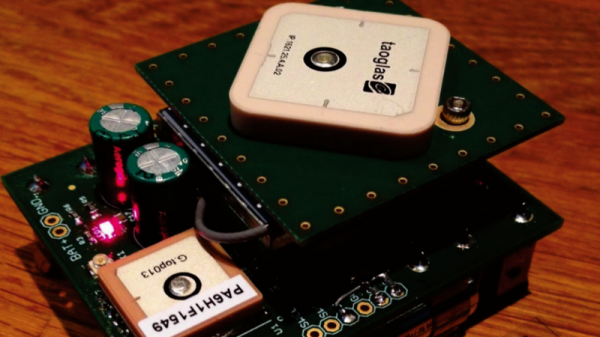
High-altitude ballooning is becoming a popular activity for many universities, schools and hacker spaces. The balloons, which can climb up to 40 km in the stratosphere, usually have recovery parachutes to help get the payload, with its precious data, back to solid ground safely. But when you live in areas where the balloon is likely to be flying over the sea most of the time, recovery of the payload becomes tricky business. [Paul Clark] and his team from Durham University’s Centre for Advanced Instrumentation are working on building a small, autonomous glider – essentially a flying hard drive – to navigate from 30 km up in the stratosphere to a drop zone somewhere near a major road. An important element of such a system is the locator beacon to help find it. They have now shared their design for an “Iridium 9603 Beacon” — a small Arduino-compatible unit which can transmit its location and other data from anywhere via the Iridium satellite network.

The beacon uses the Short Burst Data service which sends email to a designated mail box with its date, time, location, altitude, speed, heading, temperature, pressure and battery voltage. To do all of this, it incorporates a SAMD21G18 M0 processor; FGPMMOPA6H GPS module; MPL3115A2 altitude sensor; Iridium 9603 Short Burst Data module + antenna and an LTC3225 supercapacitor charger. Including the batteries and antenna, the whole thing weighs in at 72.6 g, making it perfectly suited for high altitude ballooning. The whole package is powered by three ‘AAA’ Energizer Ultimate Lithium batteries which ought to be able to withstand the -56° C encountered during the flight. The supercapacitors are required to provide the high current needed when the beacon transmits data.

The team have tested individual components up to 35 km on a balloon flight from NASA’s Columbia Scientific Balloon Facility and the first production unit will be flown on a much smaller balloon, launched from the UK around Christmas. The GitHub repository contains detailed information about the project along with the EagleCAD hardware files and the Arduino code. Now, if only Santa carried this on his Sleigh, it would be easy for NORAD to track his progress in real time.

Ask Hackaday: Dude, Where’s My MOSFET?

(Bipolar Junction) Transistors versus MOSFETs: both have their obvious niches. FETs are great for relatively high power applications because they have such a low on-resistance, but transistors are often easier to drive from low voltage microcontrollers because all they require is a current. It’s uncanny, though, how often we find ourselves in the middle between these extremes. What we’d really love is a part that has the virtues of both.

The ask in today’s Ask Hackaday is for your favorite part that fills a particular gap: a MOSFET device that’s able to move a handful of amps of low-voltage current without losing too much to heat, that is still drivable from a 3.3 V microcontroller, with bonus points for PWM ability at a frequency above human hearing. Imagine driving a moderately robust small DC robot motor forwards with a microcontroller, all running on a LiPo — a simple application that doesn’t need a full motor driver IC, but requires a high-efficiency, moderate current, and low-voltage-logic compatible transistor. If you’ve been here and done that, what did you use?

Continue reading “Ask Hackaday: Dude, Where’s My MOSFET?”

[CNLohr] Reverses Vive, Valve Engineers Play Along

[CNLohr] needs no introduction around these parts. He’s pulled off a few really epic hacks. Recently, he’s set his sights on writing a simple, easy to extend library to work with the HTC Vive VR controller equipment, and in particular the Watchman controller.

There’s been a lot of previous work on the device, so [Charles] wasn’t starting from scratch, and he live-streamed his work, allowing others to play along. In the process, two engineers who actually worked on the hardware in question, [Alan Yates] and [Ben Jackson], stopped by and gave some oblique hints and “warmer-cooler” guidance. A much-condensed version is up on YouTube (and embedded below). In the links, you’ll find code and the live streams in their original glory, if you want to see what went down blow by blow. Code and more docs are in this Gist.

Continue reading “[CNLohr] Reverses Vive, Valve Engineers Play Along”

Body Cardio Weighing Scale Teardown

If you weigh yourself by standing on a bathroom scale, not liking the result, then balancing towards one corner to knock a few pounds off the dial, you are stuck in a previous century. Modern bathroom scales have not only moved from the mechanical to the electronic, they also gather body composition measurements and pack significant computing power.

Yet they’re a piece of domestic electronics that sits in our bathroom and rarely comes under scrutiny. How do they work, and what do they contain? The team at November Five tore down a top-of-the-range Withings Body Cardio scale to find out.

After a struggle with double-sided sticky pads, the scale revealed its secrets: a simple yet accomplished device. There are four load cells and the electrodes for the body measurement, and the PCB. On the board is a 120 MHz ARM Cortex M4 microcontroller, a wireless chipset, battery management, and the analogue measurement chipset. This last is particularly interesting, a Texas Instruments AFE4300, a specialised analogue front-end for this application. It’s a chip most of us will never use, but as always an obscure datasheet is worth a read.

The rather pretty fractal antenna.

Finally, the wireless antenna is not the normal simple angular trace you’ll be used to from the likes of ESP8266 boards, but an organic squiggle. It’s a fractal antenna, presumably designed to present a carefully calculated bandwidth to the chipset. A nice touch, though one the consumer will never be aware of.

We’ve shown you quite a few bathroom scales over the years. There was this wisecracking Raspberry Pi scale, this scale reverse engineered to gather weight data, and this one laid bare for use as a controller.

Do You Miss The Sound Of Your Model M?

There is one aspect of desktop computing in which there has been surprisingly little progress over the years. The keyboard you type on today will not be significantly different to the one in front of your predecessor from the 1970s. It may weigh less, its controller may be less power-hungry, and its interface will be different, but the typing experience is substantially identical. Or at least, in theory it will be identical. In fact it might be worse than the older peripheral, because its switches are likely to be more cheaply made.

The famous buckled springs in operation. Shaddim [CC BY-SA 3.0], via Wikimedia Commons.
The famous buckled spring in operation. Shaddim [CC BY-SA 3.0], via Wikimedia Commons.
Thus among keyboard aficionados the prized possessions are not necessarily the latest and greatest, but can often be the input devices of yesteryear. And one of the more famous of these old keyboards is the IBM Model M, a 1984 introduction from the computer behemoth that remains in production to this day. Its famous buckled-spring switches have a very positive action and a unique sound that once heard can never be forgotten.
Continue reading “Do You Miss The Sound Of Your Model M?”