Have A Face For Radio?

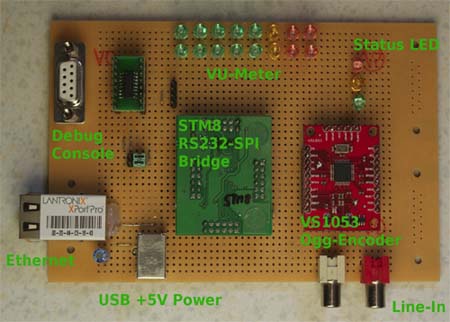
The help of fellow members of the Austrian technology collective/hackerspace [Otelo] allowed [Georg] to develop a networked audio streaming board, with less than $20 worth of components. Dubbed the OggStreamer for obvious reason, it’s designed to relay audio from a mixing board to an Icecast server (an open source implementation of SHOUTcast) in real-time. The board is based on the STM8 Discovery kit and the Xport Pro. It features stereo input, an onboard OGG Vorbis encoder, and (to top it off) is running uClinux. We think it’s very well thought out – but don’t take our word for it… the OggStreamer won second place last year in the Lantronix XPort Pro Design Contest, and [Georg] has documented it extensively (pdf).
Nokia LCD, Nunchuck, And MSP430 Join Forces

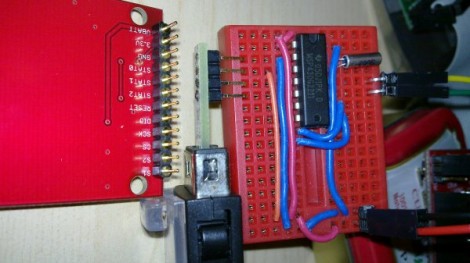
[JB’s] driving a Nokia 6100 LCD using an MSP430 with input from a Wii Nunchuck. He’s using the G2211 microprocessor that came with the Launchpad, and developing his code with MSP-GCC. As you can see in the video after the break, this works but there’s some room for improvement. That’s being said, he is bumping up against the code memory limit, with just around 500 bytes left to work with. The LCD screen is SPI and currently it’s hogging the pins that are used for the hardware i2c. Since he needs an i2c bus to talk to the nunchuck he had to go with software i2c which explains part of his program memory troubles.

We’re in no way experts on this, but it seems like he could save space (and improve the input responsiveness) by rewriting his LCD drivers in order to remap the pins. Then again, it might just be better to move up to a larger MSP430. If you’ve got some advice, make sure to share it by leaving a comment.

Continue reading “Nokia LCD, Nunchuck, And MSP430 Join Forces”

TI Evalbot Development Under Linux

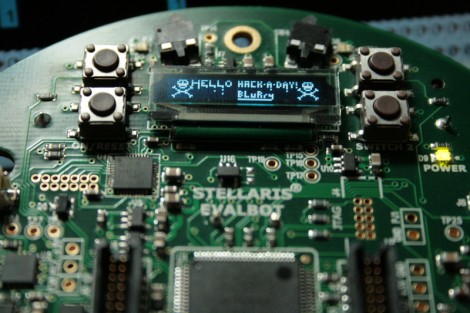
We have some beefs about how Texas Instruments does things, the biggest of which is their lack of support for development under Linux operating systems. But if they build it, someone will try to get Linux involved in one form or another. This time around, [BLuRry] put together a guide to developing for the Evalbot under Linux. He got a shove in the right direction from the code package that went along with that nunchuck-controlled Evalbot. Picking apart that example to the bare essentials he wrote up the process of setting up the cross-compiling toolchain in a virtual machine so as not to clutter your system. From there he details how to set up and use Eclipse when starting a new project. What what did he choose for a Hello World experience? Well a plain “Hello World” was first but right on its heels is the “Hello Hack-A-Day” seen above. So if you’ve got one of these on hand get out there and start coding for it.

Digital Measuring Tape

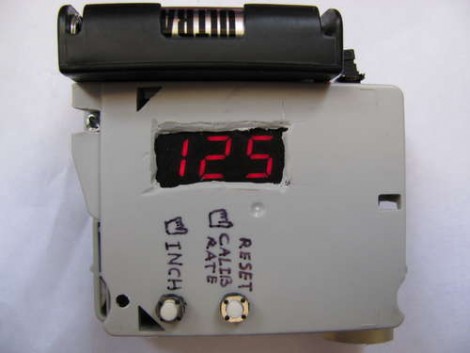
You’ll never come up short with this measuring tape. That’s because there isn’t actually any tape in the device; it measures distance based on the rotation of a wheel. Roll it across the room and you’ll get an accurate measurement of the distance the little bugger traveled. Like the Etch-a-Sketch from Monday this uses the encoder wheel from a mouse as the input. The IR emitter and sensor from the ubiquitous peripheral find a new home on the PCB that hosts the PIC 16F819. It monitors the rotation, turns it into inches, then spits that number out on a 7 segment display. Handy, and cheap!

Hands-on With EZ430-F2013

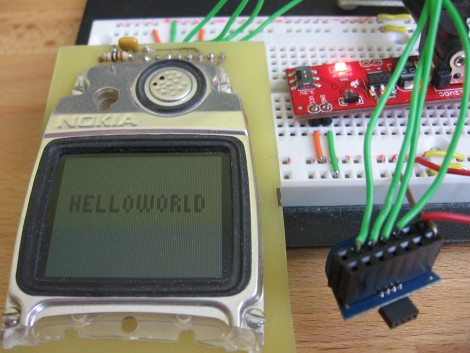
At the beginning of the Month we came across a coupon code for a free eZ430-F2013 development stick. TI has given these things now and again so we took the opportunity to acquire one. It arrived yesterday and we’ve spent just a bit of time looking it over. Above you can see the first project completed; Hello World on a salvaged Nokia cell phone screen. Join us after the break for our thoughts on the device, as well as more pictures and details.

Continue reading “Hands-on With EZ430-F2013”

Ego Box Monitors Web Hits

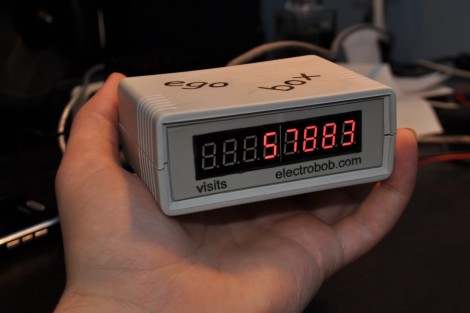
[Bogdan’s] latest project is a box that displays web hits for a chosen site. He calls it the Ego Box because depending on how traffic goes it either bloats or crushes your ego. This provides similar functionality as our Troll Sniffing Rat but the biggest difference is that this is a stand-alone Ethernet device. That’s thanks to the ENC28J60 Ethernet controller chip which manages the stack and has been quite popular in DIY electronic projects. In order to monitor your hits [Bogdan] crafted a bit of code to add to the header of your index page. It increments the counter file each time the page is loaded, and the Ego Box simply monitors that file, displaying the traffic on an eight digit 7 segment display.

[via Adafruit]

Simple Sensors To Calculate RPM

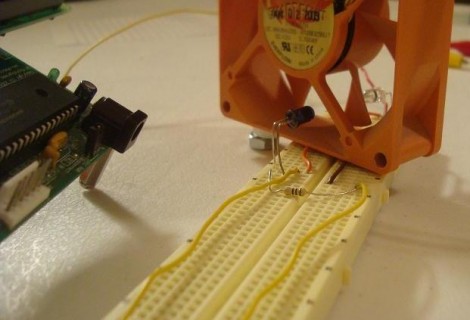
Ever wonder how to calculate revolutions per minute using a microcontroller? This project shows you how by purposing an IR emitter and detector and a computer fan. As the fan blades spin they disrupt the beam of infrared light between the emitter and the receiver. This results in a waveform on the receiver’s circuit which can be easily used to trigger interrupts in any microcontroller. In this case a PIC 18F452 monitors the detector’s signals for a rising edge. By measuring time data between interrupts the period can be established and RPM calculated. You can see a video of the test rig after the break.

So what can you use this for? It’s the method that most spinning POV displays use to stabilize the display. You won’t be limited to an IR sensor, but can use a hall effect sensor in the same basic fashion.

Continue reading “Simple Sensors To Calculate RPM”