G-speak Spatial Operating Environment

[vimeo 2229299]

Our fascination with multitouch is fairly well known, but it expands even further to cover all sorts of man machine interaction. Embedded above is a tech demo of g-speak, a spatial operating environment. The user combines gestures and spatial location to interact with on screen objects. If it seems familiar, it’s because one of the company’s founders advised on Minority Report. We doubt all this hand waving is going to catch on very quickly though. Our bet is on someone developing a multitouch Cintiq style device for people to use as a secondary monitor. It would bridge the gap between between our standard 2D interactions and gestures without making a full leap to 3D metaphors.

[via Create Digital Motion]
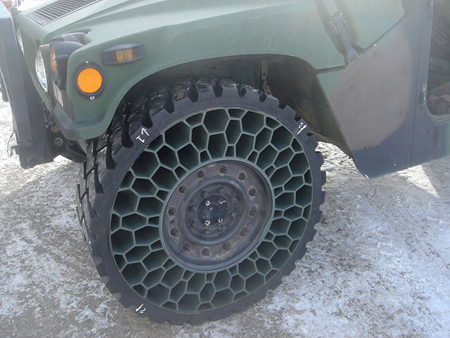
Honeycomb Tire Won’t Go Flat

A new breed of tire has been developed that won’t go flat, even if it gets bombed. Resilient Technologies L.L.C. has started making these decidedly cool looking tires for the military. The honeycomb of stiff but flexible plastic acts as a shock absorber just as an air filled tire would. Unlike a normal tire, it won’t pop. You would have to completely destroy the tire to stop these. The article mentions that this isn’t the first of its kind. Michelin has made the “tweel” for industrial uses, but you may recall the video of the Audi driving around a course using them. If not, check it out after the break.

Continue reading “Honeycomb Tire Won’t Go Flat”

Case Prototyping

[youtube=http://www.youtube.com/watch?v=KsqNPXCm3jc]

[Deviant Ollam], lockpicker and beverage cooling contest host, was recently in Vienna, presumably for DeepSec. While there, he stopped by the Metalab hackerspace and checked out their RepRap rapid prototyping machine. You can see video of his visit above. He had them construct a custom fitted cover for the flash of his point and shoot camera. That’s what we love about rapid prototyping. Many of the projects we cover here solve a particular problem, but would never be considered commercially viable enough to put into production. With the availability of rapid prototyping increasing, hackers can start moving toward producing even more complex objects specific to their needs with a finish closer to commercial products.

Overhauling LED Marquees

led-sign

In a previous job, [sprite_tm] was responsible for wrangling many different LED text ad marquees. The hardware was fairly simple and he always figured they could be pushed much further with a little work. He recently acquired ten 32×16 LED displays a decided to see what he could do with them. By the end of the project, he had full motion video running on the display. This is a great project to read up on if you’ve ever wondered about LED matrix displays. He starts by reverse engineering the electronics on the board. He then attached an ATmega88 to drive the display module. Multiple display modules were daisy chained together over serial. The article covers PWM control and refresh timing as well. Check out one of a few demo videos below. Continue reading “Overhauling LED Marquees”

Scratch Built RFID Tags

rfid

[nmarquardt] has put up an interesting instructable that covers building RFID tags. Most of them are constructed using adhesive copper tape on cardstock. The first version just has a cap and a low power LED to prove that the antenna is receiving power. The next iteration uses tilt switches so the tag is only active in certain orientations. The conclusion shows several different variations: different antenna lengths, conductive paint, light activated and more.

Messing With Barcodes

stencil

[nico] just received his credentials for an upcoming conference. On each badge, there’s a 2D barcode with the participant’s bio and contact info. These are meant to be scanned by vendors for future contact. [nico] isn’t so interested in that and plans on updating his personal info by generating a new barcode. To this end, he’s collected a number of links to help out barcode hackers. He used the SWIPE toolkit to identify the format and decode (it has an online component too). There are also several online encoders you can use, like this one from [Terry Burton]. If you’re wondering what sort of shenanigans you can get into faking barcodes, check out [fx]’s presentation from 24C3.

[photo: seanbonner]