A Passive Mixer’s Adventure Through Product Development

The year was 2014, and KORG’s volca line of pint-sized synthesizers were the latest craze in the music world. Cheap synths and drum machines were suddenly a reality, all in a backpack-friendly form factor. Now practically anyone could become an electronic music sensation!

I attended a jam with friends from my record label, and as was the style at the time, we all showed up with our latest and greatest gear. There was the microKORG, a MiniNova, and a couple of guitars, but all attention was on the volcas, which were just so much fun to pick up and play with.

There was just one problem. Like any game-changing low-cost hardware, sacrifices had been made. The volcas used 3.5mm jacks for audio and sync pulses, and the initial lineup came with a bassline, lead, and drum synth. Syncing was easy, by daisy chaining cables between the boxes, but if you wanted to record or mix, you’d generally need to stack adapters to get your signals in a more typical 6.5mm TS format used by other music hardware.

After mucking around, I did some research on what other people were doing. Most were suffering just like we were, trying to patch these little machines into full-sized mixing desks. It seemed like overkill — when you just want to muck around, it’s a bit much to drag out a 24 channel powered mixer. I wanted a way to hook up 3 of these machines to a single set of headphones and just groove out.

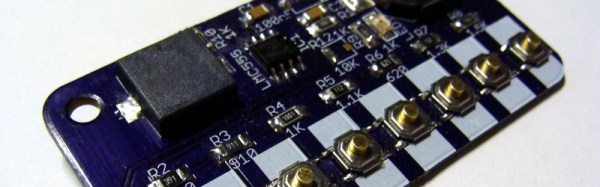
To solve this problem, we needed a mixer to match the philosophy of the volcas; simple, accessible, and compact. It didn’t need to be gold-plated or capable of amazing sonic feats, it just had to take a few 3.5mm audio sources, and mix them down for a pair of headphones.

I’d heard of people using headphone splitters with mixed results, and it got me thinking about passive mixing. Suddenly it all seemed so clear — I could probably get away with a bunch of potentiometers and some passives and call it a day! With a friend desperate to get their hands on a solution, I decided to mock up a prototype and took it round to the studio to try out.

Continue reading “A Passive Mixer’s Adventure Through Product Development”

The Grafofon: An Optomechanical Sequencer

There are quick hacks, there are weekend projects and then there are years long journeys towards completion.  [Boris Vitazek]’s grafofon falls into the latter category. His creation can best be described as electromechanical sequencer synthesizer with a multiplayer mode.
The storage medium and interface for this sequencer is a thirteen-meter loop of paper that is mounted like a conveyor belt. Music is composed by drawing on the paper or placing objects on it. This is usually done by the audience and the fact that the marker isn’t erased make the result collaborative and incremental.
 These ‘scores’ are read by a camera and interpreted by software.This is a very vague description of this device, for a reason: the build went on over six years and both hard- and software went through several revisions in that time. It started as a trigger for MIDI notes and evolved from there.
In his write up [Boris] explains the technical aspects of each iteration. He also tells the stories of the people he met while working on the grafofon and how they influenced the build. If this look into the art world reminds you of your local hackerspace, it is because these worlds aren’t that far apart.

Continue reading “The Grafofon: An Optomechanical Sequencer”

MIDI And A Real Vox Humana Come To A Century-Old Melodeon

A hundred years or more of consumer-level recorded music have moved us to a position in which most of us unconsciously consider music to be a recorded rather than live experience. Over a century ago this was not the case, and instead of a hi-fi or other device, many households would have had some form of musical instrument for their own entertainment. The more expensive ones could become significant status symbols, and there was a thriving industry producing pianos and other instruments for well-to-do parlours everywhere.

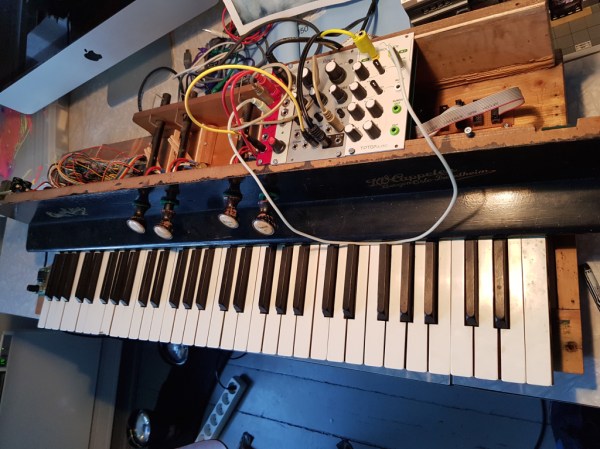
One of these parlour instruments came the way of [Alec Smecher], a pump organ, also known as a harmonium, or a melodeon. He’s carefully added a MIDI capability to it, and thus replaced its broken “Vox Humana” tremolo effect intended as a 19th century simulation of a choir, with a set of genuine human sounds. There is an almost Monty Python quality to his demonstration of this real Vox Humana, as you can see in the video below.

Lest you think though that he’s gutted the organ in the process of conversion, be rest assured that this is a sensitively applied piece of work. A microswitch has been placed beneath each key, leaving the original mechanism intact and working. An Arduino Leonardo has the microswitches multiplexed into a matrix similar to a keyboard, and emulates a USB MIDI device. It’s fair to say that it therefore lacks the force sensitivity you might need to emulate a piano, but it does result in rather an attractive MIDI instrument that also doubles as a real organ.

Continue reading “MIDI And A Real Vox Humana Come To A Century-Old Melodeon”

MIDISWAY Promises To Step Up Your Live Show

If you like to read with gentle music playing, do yourself a favor and start the video while you’re reading about [Hugo Swift]’s MIDISWAY. The song is Promises, also by [SWIFT], which has piano phrases modulated during the actual playing, not in post-production.

The MIDISWAY is a stage-worthy looking box to sit atop your keys and pulse a happy little LED. The pulsing corresponds to the amount of pitch bending being sent to your instrument over a MIDI DIN connector. This modulation is generated by an Arduino and meant to recreate the effect of analog recording devices like an off-center vinyl or a tape that wasn’t tracking perfectly.

While recording fidelity keeps inching closer to perfect recreation, it takes an engineer like [Hugo Swift] to decide that a step backward is worth a few days of hacking. Now that you know what the MIDISWAY is supposed to do, listen closely at 2:24 in the video when the piano starts. The effect is subtle but hard to miss when you know what to listen for.

MIDI projects abound at Hackaday like this MIDI → USB converter for getting MIDI out of your keyboard once you’ve modulated it with a MIDISWAY. Maybe you are more interested in a MIDI fighter for controlling your DAW. MIDI is a robust and time-tested protocol which started in the early 1980s and will be around for many more years.

Continue reading “MIDISWAY Promises To Step Up Your Live Show”

This Synth Is Okay

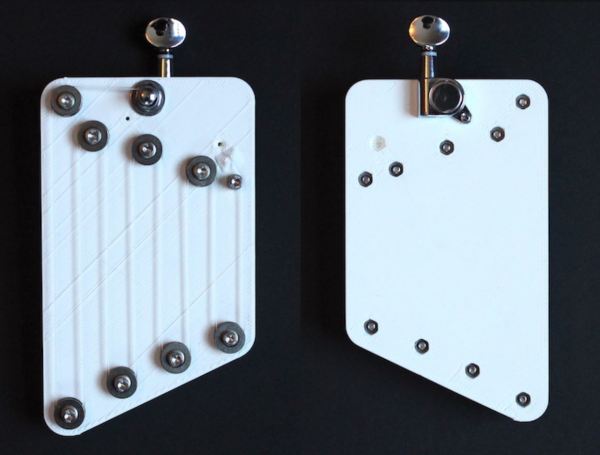
While this 3D printed synthesizer might just be okay, we’re going to say it’s better than that. Why? [oskitone] did something with a 555 timer.

The Okay synth from [oskitone] uses a completely 3D printed enclosure. Even the keys are printed. Underneath these keys is a small PCB loaded up with tact switches and small potentiometers. This board runs to another board loaded up with a 555 timer and a CD4040 frequency divider. This, in turn, goes into an LM386 amplifier. It’s more or less the simplest synth you can make.

If this synth looks familiar, you’re right. A few months ago, [oskitone] released the Hello F0 synth, a simple wooden box with 3D printed keys, a few switches, and a single 4046 PLL oscillator. It’s the simplest synth you can build, but it is something that can be extended into a real, proper synthesizer with different waveforms, LFOs, and envelope generators.

The sound of this chip is a very hard square wave with none of the subtleties of A,S,D, or R. Turn down the octave knob and it makes a great bass synth, or turn the octave knob to the middle for some great chiptune tones. All the 3D models for this synth are available on Thingiverse, so if you’d like to print your own, have at it.

You can check out the demo of the Okay synth below.

Continue reading “This Synth Is Okay”

MIDI To CV/Gate The Easy Way

Let’s say you’ve got a modular synthesizer. You’re probably a pretty cool person. But all your cool laptop DJ friends keep showing off their MIDI-controlled hardware, and you’re getting jealous. Well, [little-scale] has the build for you.

The Teensy 3.6 is the current top-of-the-line Teensy from PJRC, and it’s [little-scale]’s weapon of choice here. With USB-MIDI and two 12-bit DACs on board, it’s made creating an interface between the worlds of analog and digital music into a remarkably simple job. Control voltages for pitch and velocity are pushed out over the analog pins, while pin 29 is used for gate signals.

It’s a testament to the amount of development that has gone into the Teensy platform that such projects can be built with virtually no off-board components. The build is a further step forward in simplicity from [little-scale]’s previous work, using a Teensy 2 with an offboard DAC to generate the output voltages.

Here at Hackaday, we’ve always been big fans of adding computer control to analog hardware. This CNC mod to a guitar pickup winding machine is a great example.

Cheap DIY MIDI To USB Adapter

[Joonas] became frustrated with cheap but crappy MIDI to USB converters, and the better commercial ones were beyond his budget. He used a Teensy LC to build one for himself and it did the job quite well. But he needed several converters, and using the Teensy LC was going to cost him a lot more than he was willing to spend. With some tinkering, he was able to build one using an Adafruit Pro Trinket which has onboard hardware UART (but no USB). This lack of USB support was a deal killer for him, so after hunting some more he settled on a clone of the Sparkfun Pro Micro. Based on the ATmega32U4, these clones were just right for his application, and the cheapest to boot. He reckons it cost him about $5 to build each of his cheap USB MIDI adapters which receive notes and pedal data from the keyboard’s MIDI OUT and transmit them to a computer

Besides the Pro Micro clone, the only other parts he used are a generic opto-coupler, a couple of resistors and a MIDI connector. After testing his simple circuit on a bread board, he managed to squeeze it all inside an old USB dongle housing, stuffing it in dead-bug style.

The heavy lifting is all done in the firmware, for which [Joonas] used LUFA — the Lightweight USB Framework for AVR’s. He wrote his own code to handle MIDI (UART) to USB MIDI messages conversion. The interesting part is his use of a 32.15 kbps baud rate even though the MIDI specification requires 31.25 kbps. He found that a slightly higher baud rate fixes a problem in the AVR USART implementation which tends to miss consecutive bytes due to the START edge not being detected. Besides this, his code is limited in functionality to only handle a few messages, mainly for playing a piano, and does not have full-fledged MIDI capabilities.

We’ve featured several of [Joonas]’s hacks here over the years, the most recent being the Beaglebone Pin-Toggling Torture Test and from earlier, How to Turn A PC On With a Knock And An ATTiny.