The Only Cassette Player Worth Owning In 2019

Vinyl has the audiophiles to keep it relevant, and CDs still have the people who are scared of streaming music, but who mourns for the cassette tape? Yesterday we would have said nobody, but now that [Igor Afanasyev] has unleashed his latest creation onto an unsuspecting world, we aren’t so sure anymore. A portable tape player that started as a $5 find from the Goodwill is now an outrageously gorgeous piece of electronic art thanks to 3D printing and a liberal application of LEDs.

After freeing the tape mechanism from the original enclosure and extraneous electronics like the AM/FM tuner, [Igor] got to work designing a retro styled enclosure for the hardware which would show off the complex electromechanical bits which would traditionally be hidden. With the addition of a clever 3D printed holder, he was even able to add microswitches under the original player’s buttons so he could detect the player’s current state without having to modify the electronics. This lets the finished player change the color of the RGB LEDs based on what it’s currently doing.

[Igor] came up with a very clever way of integrating light-up icons into the case by placing bright LEDs behind specially crafted thin sections of the print. It looked awesome in his tests, but after the considerable sanding, priming, and painting it took to turn the 3D printed parts into a production-quality enclosure, the LEDs are no longer visible on the final product. Even though they didn’t work in this particular case, we think it’s a brilliant technique worthy of stealing further research.

The detail that [Igor] but into this build is phenomenal. Seeing all the individual components he had to design and print to make the final product come together is really nothing short of inspirational. Projects like these are where 3D printing really shines, as trying to replicate this build with traditional manufacturing techniques would be an absolute nightmare.

If you can’t quite shake the feeling that you’ve seen this name or attention to detail before, it’s for good reason. Last year we covered another build showing the knack [Igor] has for turning the ordinary into the extraordinary.

Continue reading “The Only Cassette Player Worth Owning In 2019”

MIDI To CV The DIY Way

MIDI has been a remarkably popular interface since its inception way back in 1983. Based on existing serial interfaces, and with a broad enough set of features, it remains the defacto standard for communication between musical gear. However, older gear and many modular synths simply don’t grok digital data, instead using analog control voltages to get the job done. Never fear, though – you can convert from one to the other with the goMIDI2CV.

It’s a simple device, hewn from an ATTINY microcontroller. MIDI signals are received at TTL voltage levels, and converted to output voltages by the ATTINY via use of the PWM hardware. A lowpass filter is added to remove the high-frequency content from the output signal.  A 6N138 optocoupler completes the project, to comply with the MIDI standard and ensure the device is not subject to any dangerous voltages from the hardware plugged in.

It’s a simple way to control older non-MIDI compliant hardware, and might make an old modular rig just that much more useful in the studio of today. We’ve seen similar builds before, like this combined CV and Gate converter. 

The Multichannel Field Recorder You Can Build Right Now

Field recorders, or backpackable audio recorders with a few XLR jacks and an SD card slot, are a niche device, and no matter what commercial field recorder you choose you’ll always compromise on what features you want versus what features you’ll get. [Ben Biles] didn’t feel like compromising so he built his own multichannel audio DSP field recorder. It has a four channel balanced master outputs, with two stereo headphone outputs, eight or more inputs, digital I/O, and enough routing for multitrack recording.

Mechanically, the design of the system is a 3D printed box studded on every side with various connectors and patch points. This is what you get when you want a lot of I/O, and yep, those are panel mount connectors so get ready to pony up on the price of your connectors. The analog front end is a backplane sort of thing on a piece of perfboard, containing an eight channel differential I/O.

Of course any audio recorder is awful to use unless there’s a great user interface, and for that you can’t get any better than a high-resolution touchscreen on a phone. This led [Ben] to use Bluetooth to connect to an app showing the gain, levels, a toggle for phantom power, and a checkbox for line or microphone. If that’s not enough there are also some MIDI knobs for volume, because MIDI is still great for user input. It’s everything you want in a portable recording rig, and yes, there is a soundcloud demo. You can also check out a demo video below.

Continue reading “The Multichannel Field Recorder You Can Build Right Now”

MIDI Grid Can Glow Up With The Best Of Them

Traditional musical instruments have a variety of interfaces, some simple, some complex. The piano is a fairly intuitive machine with a key for every note and a couple of pedals you can ignore if you like. The saxophone is a little more complex, with its many interoperable keys used to produce varying pitches. However, modern electronic instruments are not constrained by physicalities, and there has been an explosion in such devices that simply present a MIDI interface and a big pile of glowing addressable buttons. [Gediminas]’s MIDI Grid build is a great example of the type.

The build relies on an STM32 to do the heavy lifting, talking to an 8×8 array of buttons, each with addressable RGB LEDs. These are combined with silicone pads for a wonderfully tactile feel. There are then a further 17 buttons on the side for various purposes, along with two rotary encoders – useful for implementing smooth fades and intoxicating filter sweeps. Unusually for this type of instrument, in addition to USB there’s also a hardware serial MIDI interface. Finally, a Nokia 5110 LCD is implemented to display relevant data.

There are precious few details on the case, but it appears to be made from lasercut wood pieces, with a nice stain giving it a rich color. Buttons also have printed labels for a more professional look.

The build has functionality most similar to Novation’s Launchpad line. [Gediminas] currently has it working primarily with Ableton Live, however there is scope for further work to integrate the device with other DAWs or MIDI hardware.

With electronic instruments such as these, it’s possible to make musical life more accessible through smart design choices – and the Kord Kontroller is another great example.

Truly Random MIDI Control

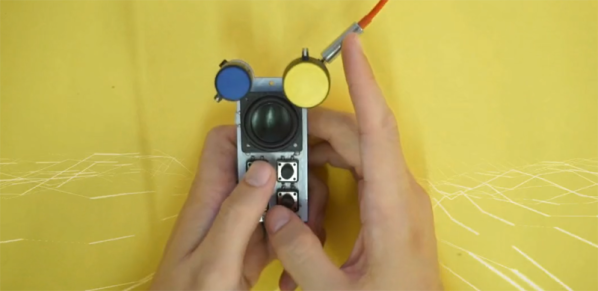
Generating random data is incredibly hard, and most of the random data around you isn’t truly random, but merely pseudo-random. For really random data, you’ll have to look at something like radioactive decay or *holds up spork* something like this. YouTube commenters will also suffice. The idea of using random data for generating musical notes is nothing new, but [Danny]’s experimental MIDI controller is something else. It’s a MIDI controller with the control removed, generating random musical notes based on radioactive decay.

The design of this controller is based on an off-the-shelf Geiger counter kit attached to an Arduino. The Arduino code simply counts up in a loop, and when the Geiger tube is triggered, an interrupt sets off a bit of code to generate a MIDI note. That’s simple enough, but where this project excels is its documentation. There’s a zine going through all the functions of this MIDI controller. There are single note or sequencer functions, a definable root note and scale type, an octave range, and velocity of the note can be set.

This is just a MIDI controller and doesn’t generate any noise on its own, but the video of the device in action shows off the range. [Danny] is getting everything from driving bass lines to strange ambient music out of this thing with the help of some synths and samplers. All the code and necessary files are available on the GitHub, with the video available below.

Continue reading “Truly Random MIDI Control”

Simple Hack Completely Changes The Sound Of This Piano

We’re partial to musical instrument hacks around here, mainly because we find instruments to be fascinating machines. Few are more complex than the piano, and, as it turns out, few are quite so hackable. Still, we have to admit that this ragtime piano hack took us by surprise.

We always thought that the rich variety of tones that can be coaxed from a piano, from the tinny sound of an Old West saloon piano to the rich tones of a concert grand, were due mainly to the construction of the instrument and the way it’s played. Not so, apparently, as [Measured Workshop] demonstrated by installing a “mandolin rail” in a small upright piano. The instrument had seen better days, so step one was disassembly and cleaning. A wooden rail spanning the entire width of the string board was added, with a curtain of fabric draping down to the level of the hammers. The curtain was cut into a fringe in the same spacing as the hammers – marking the hammer locations with cornstarch was a nice trick – and metal clips were crimped to each fringe. The completed mandolin rail can be raised and lowered using a new foot pedal, completely changing the tone as the hammers hit the strings with the metal clips rather than their soft felt heads. It makes the piano sound a little like a harpsichord, or the aforementioned saloon instrument, and at the touch of a foot, it’s back to its original tone.

Most of the piano hacks we offer tend toward the electronic variety, so it’s nice to see a purely mechanical piano hack for a change. And if the hacked piano doesn’t work out as an instrument, you can always turn it into a workbench.

Continue reading “Simple Hack Completely Changes The Sound Of This Piano”

Live Hacking And A MIDI Keytar

We can’t think of where you’d buy a new, cheap, MIDI keytar that’s just a keyboard and a handle with some pitch and mod wheels or ribbon controllers. This is a format that died in the 90s or thereabouts. Yes, the Rock Band controller exists, but my point stands. In fact, the closest you can get to a cheap, simple MIDI keytar is the Alesis Vortex Wireless 2 Keytar, but the buttons on the handle don’t make any sense. [marcan] of Wii and Kinect hacking fame took note. (YouTube, embedded below.)

Reverse engineering is a research project, and all research projects begin with looking at the docs. When it comes to consumer electronics, the best resource is the documents a company is required to submit to the FCC (shout out to FCC.io), which gave [marcan] the user manual, and photos of the guts of the keytar. The ‘system update download’ files are living on the Alesis servers, and that’s really all you need to reverse engineer a keytar.

The first step is extracting the actual device firmware from whatever software package appears on the desktop when you download the software update. This is a simple job for 7zip, and after looking at a binary dump of the firmware, [marcan] discovered this was for an STM chip. With the datasheet of the chip, [marcan] got the entry point for the firmware, some values, and the real hardware hacking began. All of this was done with IDA.

This is a five-hour hacking session of cross-referencing the MIDI spec and a microcontroller built thirty years after this spec was developed. It’s an amazing bit of work just to find the bit of code than handled the buttons on the keytar grip, and it gets even better when the patched firmware is uploaded. If you want to ‘learn hacking’, as so many submitters on our tip line want to do, this is what you need to watch. Thanks [hmn] for the tip.

Continue reading “Live Hacking And A MIDI Keytar”