NVIDIA Unveils Jetson AGX Orin Developer Kit

When you think of high-performance computing powered by NVIDIA hardware, you probably think of applications leveraging the capabilities of the company’s graphics cards. In many cases, you’d be right. But naturally there are situations where the traditional combination of x86 computer and bolt-on GPU simply isn’t going to cut it; try packing a modern gaming computer onto a quadcopter and let us know how it goes.

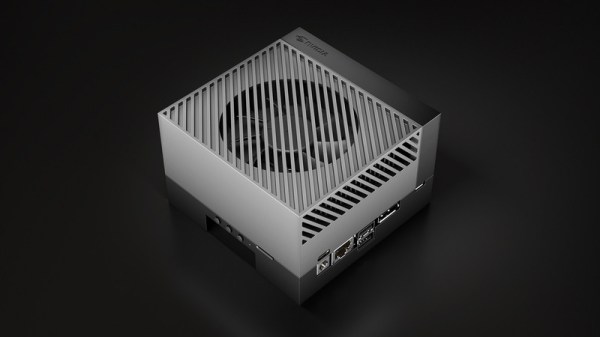
For these so-called “edge computing” situations, NVIDIA offers the Jetson line of ARM single-board computers which include a scaled-down GPU that gives them vastly improved performance for machine learning applications than something like the Raspberry Pi. Today during their annual GPU Technology Conference (GTC), NVIDIA announced the immediate availability of the Jetson AGX Orin Developer Kit, which the company promises can deliver “server-class AI performance” in a package small enough for use in IoT or robotics.

As with the earlier Jetsons, the palm-sized development kit acts as a sort of breakout board for the far smaller module slotted into it. This gives developers access to the full suite of the connectivity and I/O options offered by the Jetson module in a desktop-friendly form that makes prototyping the software side of things much easier. Once the code is working as intended, you can simply pop the Jetson module out of the development kit and install it in your final hardware.

NVIDIA is offering the Orin module in a range of configurations, depending on your computational needs and budget. At the high end is the AGX Orin 64 GB at $1599 USD; which offers a 12-core ARM Cortex-A78AE processor, 32 GB of DDR5 RAM, 64 GB of onboard flash, and a Ampere GPU with 2048 CUDA cores and 64 Tensor cores, which all told enables it to perform an incredible 275 trillion operations per second (TOPS).

At the other end of the spectrum is the Orin NX 8 GB, a SO-DIMM module that delivers 70 TOPS for $399. It’s worth noting that even this low-end flavor of the Orin is capable of more than double the operations per second as 2018’s Jetson AGX Xavier, which until now was the most powerful entry in the product line.

The Jetson AGX Orin Developer Kit is available for $1,999 USD, and includes the AGX Orin 64 GB module. Interestingly, NVIDIA says the onboard software is able to emulate any of of the lower tier modules, so you won’t necessarily have to swap out the internal modules if your final hardware will end up using one of the cheaper modules. Of course the inverse of that is even folks who only planned on using the more budget-friendly units either have to shell out for an expensive dev kit, or try to spin their own breakout board.

While the $50 USD Jetson Nano is far more likely to be on the workbench of the average Hackaday reader, we have to admit that the specs of these new Orin modules are very exciting. Then again, we’ve covered several projects that used the previously top-of-the-line Jetson Xavier, so we don’t doubt one of you is already reaching for their wallet to pick up this latest entry into NVIDIA’s line of diminutive powerhouses.


One Giant Leap (Backwards) For Humankind: What The Russia-Ukraine War Means For The ISS

The International Space Station was built not only in the name of science and exploration, but as a symbol of unity. Five space agencies, some representing countries who had been bitter Cold War rivals hardly a decade before the ISS was launched, came together to build something out of a sci-fi novel: a home among the stars (well, in Low Earth Orbit) for humans from around the globe to work with one another for the sake of scientific advancement, high above the terrestrial politics that governed rock below. That was the idea, at least.

So far, while there has been considerable sound and fury in social media channels, international cooperation in space seems to continue unhindered. What are we to make of all this bluster, and what effects could it have on the actual ISS?

Continue reading “One Giant Leap (Backwards) For Humankind: What The Russia-Ukraine War Means For The ISS”

Clockwork DevTerm R-01 Takes RISC-V Out For A Spin

If you’re anything like us you’ve been keeping a close eye on the development of RISC-V: an open standard instruction set architecture (ISA) that’s been threatening to change the computing status quo for what seems like forever. From its humble beginnings as a teaching tool in Berkeley’s Parallel Computing Lab in 2010, it’s popped up in various development boards and gadgets from time to time. It even showed up in the 2019 Hackaday Supercon badge, albeit in FPGA form. But getting your hands on an actual RISC-V computer has been another story entirely. Until now, that is.

Clockwork has recently announced the availability of the DevTerm R-01, a variant of their existing portable computer that’s powered by a RISC-V module rather than the ARM chips featured in the earlier A04 and A06 models. Interestingly the newest member of the family is actually the cheapest at $239 USD, though it’s worth mentioning that not only does this new model only include 1 GB of RAM, but the product page makes it clear that the RISC-V version is intended for experienced penguin wranglers who aren’t afraid of the occasional bug.

Newbies are persona non grata for the R-01.

Beyond the RISC-V CPU and slimmed down main memory, this is the same DevTerm that our very own [Donald Papp] reviewed earlier this month. Thanks to the modular nature of the portable machine, this sort of component swapping is a breeze, though frankly we’re impressed that the Clockwork team is willing to go out on such a limb this early in the product’s life. In our first look at the device we figured at best they would release an updated CPU board to accommodate the Raspberry Pi 4 Compute Module, but supporting a whole new architecture is a considerably bolder move. One wonders that other plans they may have for the retro-futuristic machine. Perhaps a low-power x86 chip isn’t out of the question?

This Week In Security: More Protestware, Another Linux Vuln, And TLStorm

It seems I have made my tiny, indelible mark on internet security history, with the term “protestware“. As far as I can tell, I first coined this particular flavor of malware while covering the Faker.js/Colors.js vandalism in January.

Yet another developer, [RIAEvangelist] has inserted some malicious code (Mirror, since the complaint has been deleted) in an existing project, in protest of something, in this case the war in Ukraine. The behavior here is to write a nice note on the desktop, preaching “peace not war”. However, a few versions of this sample have a nasty surprise — it does a GeoIP lookup, and attempts to wipe the entire drive if it detects a Russian location. Yes, node-ipc versions 10.1.1 and 10.1.2 contain straight-up malware. It’s not clear how many users ran the potentially malicious code, as it was quickly reverted and released 10.1.3. Up-to-date versions of node-ipc still create the desktop file, and Unity Hub has already confirmed they shipped the library in this state, and have since issued a hotfix.
Continue reading “This Week In Security: More Protestware, Another Linux Vuln, And TLStorm”

Owning A ShortWave Radio Is Once Again A Subversive Activity

An abiding memory for a teen fascinated by electronics and radio in the 1970s and 1980s is the proliferation of propaganda stations that covered the shortwave spectrum. Some of them were slightly surreal such as Albania’s Radio Tirana which would proudly inform 1980s Western Europe that every village in the country now possessed a telephone, but most stations were the more mainstream ideological gladiating of Voice of America and Radio Moscow.

It’s a long-gone era as the Cold War is a distant memory and citizens East and West get their info from the Internet, but perhaps there’s an echo of those times following the invasion of the Ukraine. With most external news agencies thrown out of Russia and their websites blocked, international broadcasters are launching new shortwave services to get the news through. Owning a shortwave radio in Russia may once again be a subversive activity. Let’s build one!

Continue reading “Owning A ShortWave Radio Is Once Again A Subversive Activity”

Hackers Beware: Shenzhen Is Closing

If you’re among those of us with immediate plans for a PCB or parts order from China, watch out – Shenzhen just recently got put on a week-long lockdown. Factories, non-essential stores and public places are closed, and people are required to spend time at home – for a city that makes hardware thrive, this sounds like a harsh restriction. Work moves to remote where possible, but some PCB fabs and component warehouses might not be at our service for at least a week.

It might be puzzling to hear that the amount of cases resulting in closures is as low as 121, for a city of 12.6 million people. The zero-tolerance policy towards COVID has been highly effective for the city, with regular testing, adhered-to masking requirements and vaccinations – which is how we’ve been free to order any kinds of boards and components we needed throughout the past two years. In fact, 121 cases in one day is an unprecedented number for Shenzhen, and given their track record and swift reaction, it is reasonable to expect the case count dropping back to the regular (under 10 cases per day) levels soon.

Not all manufacturing facilities are located in Shenzhen, either. Despite what certain headlines might have you believe, supply chain shortages aren’t a certainty from here. A lot of the usual suspects like PCBWay and JLCPCB are merely reporting increased lead times as they reallocate resources, and while some projects are delayed for now, a lot of fabs you’d use continue operating with minor delays at most. SeeedStudio has its operations impacted more severely, and your Aliexpress orders might get shipped a bit later than usual – but don’t go around calling this a Chinese New Year v2 just yet. For those who want to keep a closer eye on the situation and numbers, the [Shenzhen Pages] Twitter account provides from-the-ground updates on the situation.

Wondering how your supply chain might be affected? We’ve talked about this way back in February 2020, addressing then-warranted worries that Chinese New Year would grow into a longer disruption than planned due to COVID becoming into a factor to manage. If you’re yet to discover the significance of Shenzhen, books have been written on this marvellous city, where you can build a successful hardware company in a week’s time. We’ve even had a meetup there once!

Header image: Charlie fong, CC BY-SA 4.0.

This Week In Security: DDoS Techniques, Dirty Pipe, And Lapsus$ Continued

Denial-of-Service (DoS) amplification. Relatively early in the history of the Internet — it was only 14 years old at the time — the first DoS amplification attack was discovered. [TFreak] put together smurf.c, likely in 1997, though it’s difficult to nail the date down precisely.

The first real DoS attack had only happened a year before, in 1996. Smurf worked by crafting ICMP packets with spoofed source addresses, and sending those packets to a network’s broadcast address. A host that received the request would send the packet to the target, and if multiple hosts responded, you got a bigger DoS attack for free. Fast forward to 1999, and the first botnet pulled off a Distributed DoS, DDoS, attack. Ever since then, there’s been an ongoing escalation of DDoS traffic size and the capability of mitigations.

DNS and NTP quickly became the popular choice for amplification, with NTP requests managing an amplification factor of 556, meaning that for every byte an attacker sent, the amplifying intermediary would send 556 bytes on to the victim. You may notice that so far, none of the vulnerable services use TCP. The three-way handshake of TCP generally prevents the sort of misdirection needed for an amplified attack. Put simply, you can’t effectively spoof your source address with TCP.

There are a pair of new games in town, with the first being a clever use of “middleboxes”, devices like firewalls, Intrusion Prevention Systems, and content filters. These devices watch traffic and filter content or potential attacks. The key here is that many such devices aren’t actually tracking TCP handshakes, it would be prohibitively memory and CPU intensive. Instead, most such devices just inspect as many packets as they can. This has the unexpected effect of defeating the built-in anti-spoofing of TCP.

An attacker can send a spoofed TCP packet, no handshake required, and a vulnerable middlebox will miss the fact that it’s spoofed. While that’s interesting in itself, what’s really notable is what happens when the packet appears to be a request for a vulnerable or blocked resource. The appliance tries to interrupt the stream, and inject an error message back to the requester. Since the requestor can be spoofed, this allows using these devices as DDoS amplifiers. As some of these services respond to a single packet with what is essentially an entire web page to convey the error, the amplification factor is literally off the charts. This research was published August 2021, and late February of this year, researchers at Akamai have seen DDoS attacks actually using this technique in the wild.

The second new technique is even more alien. Certain Mitel PBXs have a stress-test capability, essentially a speed test on steroids. It’s intended to only be used on an internal network, not an external target, but until a recent firmware update that wasn’t enforced. For nearly 3,000 of these devices, an attacker could send a single packet, and trigger the test against an arbitrary host. This attack, too, has recently been seen in the wild, though in what appears to be test runs. The stress test can last up to 14 hours at worst, leading to a maximum amplification factor if over four billion, measured in packets. The biggest problem is that phone systems like these a generally never touched unless there’s a problem, and there’s a decent chance that no one on site has the login credentials. That is to say, expect these to be vulnerable for a long time to come. Continue reading “This Week In Security: DDoS Techniques, Dirty Pipe, And Lapsus$ Continued”