Solar System Wars: Walmart Versus Tesla

It seems like hardly a day goes by that doesn’t see some news story splashed across our feeds that has something to do with Elon Musk and one or another of his myriad companies. The news is often spectacular and the coverage deservedly laudatory, as when Space X nails another double landing of its boosters after a successful trip to space. But all too often, it’s Elon’s baby Tesla that makes headlines, and usually of the kind that gives media relations people ulcers.

The PR team on the automotive side of Tesla can take a bit of a breather now, though. This time it’s Elon’s solar power venture, Tesla Energy Operations, that’s taking the heat. Literally — they’ve been sued by Walmart for rooftop solar installations that have burst into flames atop several of the retail giant’s stores. While thankfully no lives have been lost and no major injuries were reported, Walmart is understandably miffed at the turn of events, leading to the litigation.

Walmart isn’t alone in their exposure to potential Tesla solar problems, so it’s worth a look to see what exactly happened with these installations, why they failed, and what we as hackers can learn from the situation. As we’ll see, it all boils down to taking electrical work very seriously and adhering to standards designed to keep everyone safe, even when they just seem like a nuisance.

Continue reading “Solar System Wars: Walmart Versus Tesla”

How Would You Like Your Steak Printed?

An Israeli start-up company, Redefine Meat recently raisedabout $6 million to perfect and commercialize its technology to 3D print meat alternatives, sometimes called alt-meat. The company claims that producing animal protein for consumption is unsustainable but that their product reduces environmental impact by 95% and has other benefits such as containing no cholesterol and a lower cost to consumers.

Reports say the ingredients of the faux meat includes three different plant protein sources, fat, and water. We assume the fat is also plant-based. The prototype printer can produce about two pounds of “meat” an hour, but their next machine is supposed to be capable of about ten times that production.

They aren’t the only company in the space, either. Novameat is also 3D printing meat. There’s also competition from companies that are basically growing real animal tissue in labs without the animals–so-called cultured meat.

Continue reading “How Would You Like Your Steak Printed?”

WiringPi Library To Be Deprecated

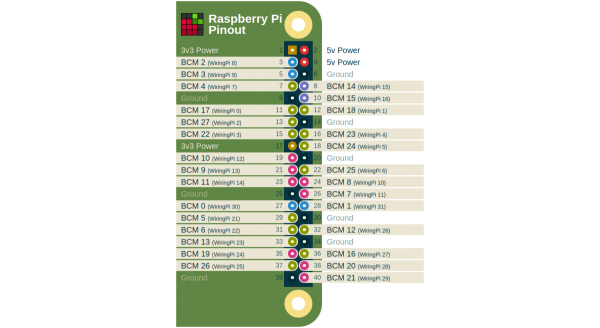
Since the release of the original Raspberry Pi single board computer, the WiringPi library by [Gordon] has been the easy way to interface with the GPIO and peripherals – such as I2C and SPI – on the Broadcom SoCs which power these platforms. Unfortunately, [Gordon] is now deprecating the library, choosing to move on rather than deal with a community which he no longer recognizes.

Among the points which he lists are the (commercial) abuse of his code, and the increasing amount of emails and messages on social media from folk who either failed to read the friendly manual, or are simply rude and inconsiderate. As [Gordon] puts it, WiringPi was never meant to be statically linked into code, nor to be used with anything other than C and RTB BASIC programmers. He never supported the use of the library with other languages, or having it statically integrated into some Java/JavaScript/NodeJS project.

As this secondary use is what’s draining the fun out of the project, he has decided to put out one final release, before making it a closed-source project, for use by himself and presumably paying clients. What the impact of this will be has to be seen. Perhaps a new fork will become the new ‘WiringPi’?

Suffice it to say, none of this is a good thing. The illegal use of open source code and the support nightmare that gets poured on the authors of said code by less than informed users is enough to drive anyone away from putting their projects out there. Fighting abuse and junking the ‘spam’ is one way to deal with it, but who has the time and energy (and money) for this?

What are your thoughts on this news, and this issue in general? How should an open source developer deal with it?

Thanks to [Dirk-Jan Faber] for sending this one in.

Trill: Easy Positional Touch Sensors For Your Projects

Creating capacitive touch-sensitive buttons is easy these days; many microcontrollers have cap-sense hardware built-in. This will work for simple on/off control, but what if you want a linear, position-sensitive input, like you’d find on a computer touchpad or your smartphone screen? Not so easy — at least until now. Trill is a family of capacitive touch sensors you can add to your projects as a linear slider, a square touchpad, or by creating your own touch surface.

Trill was created by the same team that designed Bela, an embedded platform for low-latency interactive applications, especially with audio. The new trio of Trill sensors rely on capacitive sensing to track finger movement, and communicate over I2C with your microcontroller or development board of choice. The Trill I2C library targets Arduino and Bela, but should be easy to port to any I2C host.

The hardware and software are both open-source — or will be as the Kickstarter that launched this morning has already met its goal. The firmware for the Cypress CY8C20636A (PDF) controller that powers these sensors will be released CC-BY-NC-SA. But, starting with the controller itself sounds like a lot of work that Trill has already done for you, so let’s have a look at what we know so far, along with a healthy dose of speculation.

Continue reading “Trill: Easy Positional Touch Sensors For Your Projects”

Norovirus Smartphone: Using Megapixels And Microfluidics To Fight The Other Kind Of Virus Infection

Chances are pretty good that at some time in your life, you’ve crossed paths with a norovirus. And chances are that you remember the encounter vividly, or at least its aftermath. I recall a run-in with the bug one Christmas, when my parents brought over more than just toys for the kids when they visited. Within a day, everyone in the house was sharing the joy. Twas the season; they don’t call it the winter vomiting bug for nothing.

Most of the 685 million norovirus infections each year resolve after a few miserable days, but some require hospitalization and 200,000 of them result in death, mainly from dehydration and mainly children. An easy to use, cheap, and accurate means of detecting the virus in the field would be quite a boon to public health. And soon, smartphones may be able to do just that.

Continue reading “Norovirus Smartphone: Using Megapixels And Microfluidics To Fight The Other Kind Of Virus Infection”

This CT Scan Of A PCB Is The Accidental ASMR We Didn’t Know We Needed

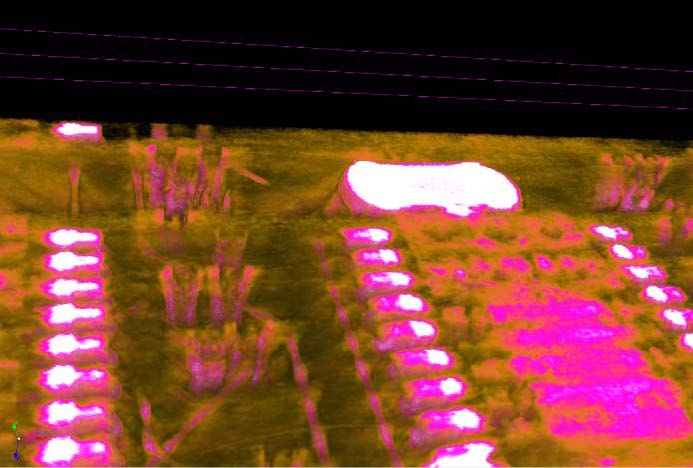
At risk of getting any ASMR buffs who might be reading cranky because there’s no audio, [Chris], or [@no1089] on Twitter, has gifted us with this visually stunning scan of his Maxim MAX86160 in-ear heart monitor mounted on a rigidflex PCB. You can take a look, in the video below the break.

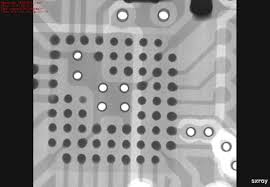
If you’re wondering why anyone would scan a board, other than boredom, know that it’s actually quite common. X-Ray machines are commonly used as a quick, passive way to check a board that’s fresh off the production line. These aren’t the X-Rays like those of broken bones you’re (hopefully not too) used to seeing though, they’re Computed Tomography scans (CT scans, CAT scans), in effect just 3D X-Rays.

CT Scan of a BGA

For electronics manufacturers and assemblers, CT scans are incredibly useful because they provide a non-destructive way to check for errors. For example, how do you know if that middle BGA pin is actually soldered correctly? You could run a functional test and make sure everything is working (at least, everything you check), but that takes time. The longer it takes to validate, the higher the manufacturing cost. In manager speak: “cost bad. Fast good.”

It’s also common to use a CT scan to create a full 3D model of a board. This makes it easy to check every little detail, especially the ones that are visually obscured by surface mount devices or critical signal paths that are buried under board layers.

Highlight of solder joints on small-outline integrated circuit (SOIC) to a PCB’s pads.

If you want to geek out on CT scans, you can learn more about the lab that did this scan or by wading into this unclassified research paper from Australia’s Cyber and Electronic Warfare Division.

But we know you really want more of this video, but better. And we’ve got the goods. For the chill folk among you, here’s a 55-minute version without all the CT scan info cluttering the screen. For those of you currently blasting eDM in your headphones, here’s a 30 second clip of it looping at ~5x speed. Eat your heart out:

Continue reading “This CT Scan Of A PCB Is The Accidental ASMR We Didn’t Know We Needed”

Anatomy Of A Power Outage: Explaining The August Outage Affecting 5% Of Britain

Without warning on an early August evening a significant proportion of the electricity grid in the UK went dark. It was still daylight so the disruption caused was not as large as it might have been, but it does highlight how we take a stable power grid for granted.

The story is a fascinating one of a 76-second chain of unexpected shutdown events in which individual systems reacted according to their programming, resulted in a partial grid load shedding — what we might refer to as a shutdown. [Mitch O’Neill] has provided an analysis of the official report which translates the timeline into easily accessible text.

It started with a lightning strike on a segment of the high-voltage National Grid, which triggered a transient surge and a consequent disconnect of about 500MW of small-scale generation such as solar farms. This in turn led to a large offshore wind farm deloading itself, and then a steam turbine at Little Barford power station. The grid responded by bringing emergency capacity online, presumably including the Dinorwig pumped-storage plant we visited back in 2017.

Perhaps the most interesting part followed is that the steam turbine was part of a combined cycle plant, processing the heat from a pair of gas turbine generators. As it came offline it caused the two gas turbines feeding it to experience high steam pressure, meaning that they too had to come offline. The grid had no further spare capacity at this point, and as its frequency dropped below a trigger point of 48.8 Hz an automatic deloading began, in effect a controlled shutdown of part of the grid to reduce load.

This is a hidden world that few outside the high-power generation and transmission industries will ever see, so it’s very much worth a read. It’s something we’ve touched on before with the South American grid shutdown back in June, and for entirely different reasons in 2018 when an international disagreement caused the entire European grid to slow down.

Header image: Little Barford combined-cycle power station against the sunset. Tony Foster, (CC BY-SA 2.0).