The Simulated Universe Thought Experiment And Information Entropy

Do we live in a simulation? This is one of those questions which has kept at least part of humanity awake at night, and which has led to a number of successful books and movies being made on the subject, topped perhaps by the blockbuster  movie The Matrix. Yet the traditional interpretation of the ‘simulated universe’ thought experiment is one in which we – including our brains and bodies – are just data zipping about in a hyper-advanced simulation rather than physical brains jacked into a computer. This simulation would have been set up by (presumably) a hyper-advanced species who seem to like to run their own version of The Sims on a Universe-sized scale.

Regardless of the ‘why’, the aspect of this question where at least some scientific inquiry is possible concerns whether or not it would be possible to distinguish anything uniquely simulation-like in our environment that’d give the game away, like a sudden feeling of déjà vu in the world of The Matrix where you can suddenly perceive the fabric of the simulation. However, the major problem which we have to consider when trying to catch a simulation in the act is that to this point we cannot ourselves create even a miniature galaxy and intelligent beings inside it to provide a testable hypothesis.

Beyond popular media like movies and series like Rick & Morty, what do science and philosophy have to say about this oddly controversial subject? According to some, we have already found the smoking gun, while others are decidedly more skeptical.

Continue reading “The Simulated Universe Thought Experiment And Information Entropy”

Game Graphics: Racing The Beam

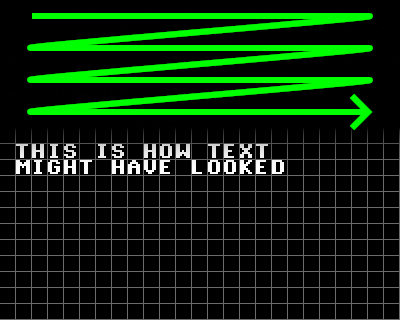
Have you ever wondered how the graphics in your favorite video games worked? This is the start of a series on game graphics, and what better place to start than how exactly the original Mario Bros. got those glorious pixely pixels onto the screen. Buckle in, because we’re “racing the beam” with systems like the NES, Commodore 64, and many other classics from the 1980s.

And to understand the 1980’s, it’s important to understand how the televisions of the time worked. Cathode Ray Tube (CRT) televisions work by precisely bombarding a phosphor layer with electrons, which excites the phosphor, which then releases visible light. The beam scans from left to right then top to bottom, giving each pixel a small fraction of a second of time. All of this effectively means that pixel data needs be sent at the same time as when the pixels are being lit up, which is why this type of graphics is often dubbed “racing the beam”.

Continue reading “Game Graphics: Racing The Beam”

You’ve Got Mail: Grilled, Scrambled, And Other Delicious Stamps

Well, we’re just zipping right through this series, no? So far we’ve looked at various postal machines and how they work to flip mail around, cancel the postage, and sort it, all in a matter of seconds. We explored the first automated post office and found out why it was a failure, and we learned why it all depends on ZIP code. Now, it’s finally time for some really fun stuff: the stamp trivia.

Now I’m no philatelist by any standard, though I do have a few hundred stamps strewn about the house. The danger in philately is that you learn all sorts of cool things about stamps and their history, and you just want to buy more and more of them. So let’s go!

Continue reading “You’ve Got Mail: Grilled, Scrambled, And Other Delicious Stamps”

You’ve Got Mail: It All Depends On ZIP Code

Previously on You’ve Got Mail, we looked at a few services that were designed to speed up the mail at various points along the way. But these improvements were all taking place on the USPS’ side of the the fence. Was there anything the customer could be doing to help out?

A post card from my collection.

As it turns out, yes. And it was almost too late. Whereas you could once address a letter or postcard simply to “Fred Minke, Somerset, Wis.” and it would reach him, the volume of mail was getting completely out of hand with the rise of computers, automated billing, and advertising. Something was needed to improve routing and speed up delivery.

We all know enough about ZIP codes to use them, but where did they come from? How many types are out there? What do they even mean? Let’s find out.

Continue reading “You’ve Got Mail: It All Depends On ZIP Code”

Could Moon Dust Help Reduce Global Temperatures?

The impacts of climate change continue to mount on human civilization, with warning signs that worse times are yet to come. Despite the scientific community raising an early warning as to the risks of continued air pollution and greenhouse gas output, efforts to stem emissions have thus far had minimal impact. Continued inaction has led some scientists to consider alternative solutions to stave off the worst from occurring.

Geoengineering has long been touted as a potential solution for our global warming woes. Now, the idea of launching a gigantic dust cloud from the moon to combat Earth’s rising temperatures is under the spotlight. However, this very sci-fi solution has some serious implications if pursued, if humanity can even achieve the feat in the first place.

Continue reading “Could Moon Dust Help Reduce Global Temperatures?”

Robotic Mic Swarm Helps Pull Voices Out Of Crowded Room Of Multiple Speakers

One of the persistent challenges in audio technology has been distinguishing individual voices in a room full of chatter. In virtual meeting settings, the moderator can simply hit the mute button to focus on a single speaker. When there’s multiple people making noise in the same room, though, there’s no easy way to isolate a desired voice from the rest. But what if we ‘mute’ out these other boisterous talkers with technology?

Enter the University of Washington’s research team, who have developed a groundbreaking method to address this very challenge. Their innovation? A smart speaker equipped with self-deploying microphones that can zone in on individual speech patterns and locations, thanks to some clever algorithms.

Continue reading “Robotic Mic Swarm Helps Pull Voices Out Of Crowded Room Of Multiple Speakers”

Chip Shortage Engineering: Misusing DIP Packages

After years of seeing people showing off and trading their badge Simple Add-Ons (SAOs) at Supercon, this year I finally decided to make one myself. Now for a first attempt, it would have been enough to come up with some cool PCB art and stick a few LEDs on it. But naturally I started with a concept that was far more ambitious than necessary, and before long, had convinced myself that the only way to do the thing justice was to have an onboard microcontroller.

My first thought was to go with the venerable ATtiny85, and since I already had a considerable stock of the classic eight-pin DIP MCUs on hand, that’s what I started prototyping with. After I had something working on the breadboard, the plan was to switch over to the SOIC-8 version of the chip which would be far more appropriate for something as small as an SAO.

Unfortunately, that’s where things got tricky. I quickly found that none of the major players actually had the SMD version of the chip in stock. Both DigiKey and Mouser said they didn’t expect to get more in until early 2024, and while Arrow briefly showed around 3,000 on hand, they were all gone by the time I checked back. But that was only half the problem — even if they had them, $1.50 a piece seems a hell of a lot of money for an 8-bit MCU with 8K of flash in 2023.

The whole thing was made all the more frustrating by the pile of DIP8 ATtiny85s sitting on the bench, mocking me. Under normal circumstances, using them in an SAO wouldn’t really be a problem, but eight hand-soldered leads popping through the front artwork would screw up the look I had in mind.

While brooding over the situation my eyes happened to fall on one of the chips I had been fiddling with, it’s legs badly bent from repeated trips through the programmer. Suddenly it occurred to me that maybe there was a way to use the parts I already had…

Continue reading “Chip Shortage Engineering: Misusing DIP Packages”