Game Boy HDD Update: The Guts

gameboy_hdd_cover_image

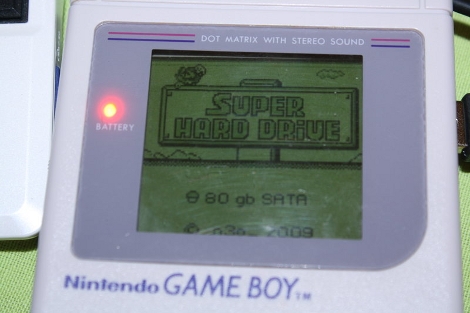
Last week we showed you the ingenious hard drive enclosure made from a broken Game Boy. We caught up with [_n3o_], the person responsible for this mod, and he was nice enough to share some pictures of the inside of the project. Let’s get down to business and take a look. Continue reading “Game Boy HDD Update: The Guts”

Arduino Email Alert

email

The Arduino makes a great platform for alert systems because it doesn’t need additional parts, other than an LED or motor. [Torchris] made email notifier, and used an Ethernet shield to make it standalone. The Arduino polls your POP server seeing if there are unread emails. POP is an incredibly simple protocol, even simpler than HTTP; this made it easy to communicate with, even with little processing power. He hopes to add a servo or serial display to present the data better, but his current system seems to work well. Video of it in action after the break.

Continue reading “Arduino Email Alert”

80 Gig Drive Inside A Game Boy

[_n3o_] put together a nice external storage mod by fitting a 2.5″ drive into a broken Game Boy. This mod fooled quite a few people because it appears that the device still plays games with the drive stuffed inside of it. Sadly, this is not the case. The reflective backing has been removed from the screen and replaced by a piece of paper with a graphic printed on it. The LED from the hard drive was moved to the battery indicator for the Game Boy for added realism. There is no build log for this project but [_n3o_] did give a short explanation of it in a forum post. You can see two more pictures of the project after the break. Continue reading “80 Gig Drive Inside A Game Boy”

Guitar Hero Strum Bar As Guitar Kill Switch

guitar_hero_killswitch

[Ray] had a Guitar Hero controller for PlayStation 2 sitting around. Because he moved on to playing the game on Xbox 360, he decided to cannibalize the older controller for its parts. He removed the strum bar and fit it inside of a mid-1980’s Peavy Patriot electric guitar. Once wired up, it works as a kill switch; it stops all sound from making it to the amp whenever the strum bar switch is actuated. Don’t miss hearing this effect in the video after the break and keep sending in those Guitar Hero mods. Continue reading “Guitar Hero Strum Bar As Guitar Kill Switch”

Custom Cable Management

3386152715_53461c9c30

You would be hard pressed to find a hacker who doesn’t have in some form a rats nest of wires and cables behind their computer desk. [Antoine] decided to tackle the problem and came up with his custom built cable management system. There is little info, but he does say his setup uses Ikea Antonius coat hangers and some hollow tube. Its quick and wont leave a residue like some cable solutions, so long as you don’t mind a screw hole or two. We especially like how if you need to change your setup you wont have to re-zip tie everything.

USB Gameboy Cart

gamecart

[Jose Torres] sent in his latest attempt at creating a custom Gameboy game cartridge. We’ve featured his projects before, and he’s come a lot closer over the last 2 years. He’s aiming to create an easy interface for homebrewers that doesn’t require any other special equipment. In this revision, he’s using a PIC and a memory controller to interface between an SD card and the Gameboy. The cart also has USB support for uploading files to the SD card and reprogramming the PIC. Because it’s just USB mass storage, it will work on almost any modern OS. He’s currently testing the device, but hopes to be selling them soon for $40.

Interfacing A Digital Rotary Switch

digital_rotary_switch

[hw640] has put together a well written and detail packed explanation of how to interface with a digital rotary switch. These digital opto encoders have just two outputs with four possible logic levels (00, 10, 11, 01). The relative position of the switch is insignificant but the direction of rotation is what matters.

The short and dirty: Each of the switch’s 2 output pins is attached to a pin change interrupt on the microcontroller. Every time the switch moves it generates either a rising edge or a falling edge on one of the two pins; both edges cause an interrupt. By checking which pin caused the interrupt, then comparing the logic levels of the two pins after that interrupt, we can determine the direction the switch was rotated.

Although this explanation uses a PIC and code written in PicBasic Pro the concepts are discussed in the abstract and would easily be adapted to an AVR or another microcontroller of your choice.