Schlieren On A Stick

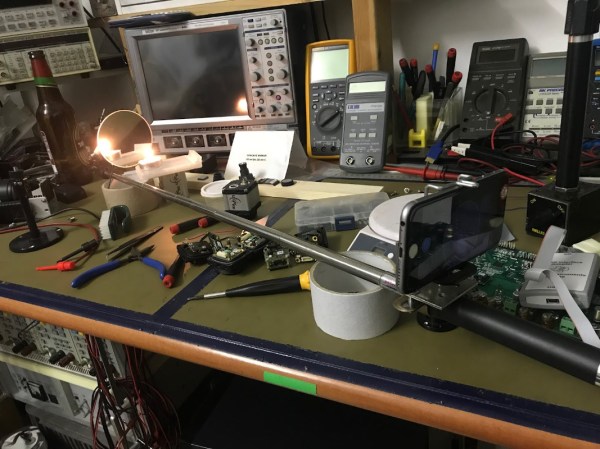
Schlieren imaging is a technique for viewing the density of transparent fluids using a camera and some clever optical setups. Density of a fluid like air might change based on the composition of the air itself with various gasses, or it may vary as a result of a sound or pressure wave. It might sound like you would need a complicated and/or expensive setup in order to view such things, but with a few common things you can have your own Schlieren setup as [elad] demonstrates.

His setup relies on a cell phone, attached to a selfie stick, with a spherical mirror at the other end. The selfie stick makes adjusting the distance from the camera to the mirror easy, as a specific distance from the camera is required as a function of focal length. For cell phone cameras, it’s best to find this distance through experimentation using a small LED as the point source. Once it’s calibrated and working, a circular field of view is displayed on the phone which allows the viewer to see any change in density in front of the mirror.

The only downside of this build that [elad] notes is that the selfie stick isn’t stiff enough to prevent the image from shaking around a little bit, but all things considered this is an excellent project that shows a neat and useful trick in the photography/instrumentation world that could be useful for a lot of other projects. We’ve only seen Schlieren imaging once before and it used a slightly different method of viewing the changing densities.
Continue reading “Schlieren On A Stick”

Arduino Rig Does Spectrophotometry

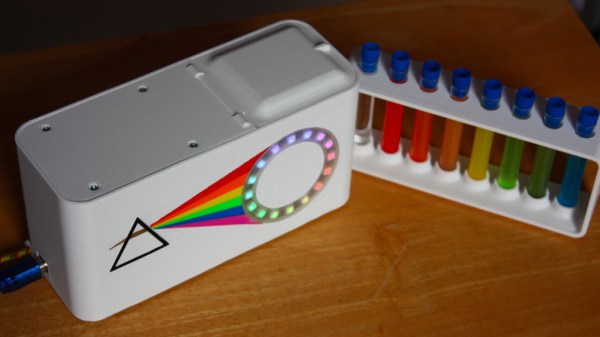
Spectrophotometry is an important scientific tool, most commonly used in biology and chemistry. It’s a method to measure the amount of light absorbed by a chemical solution at various different wavelengths. While it’s typically the preserve of expensive lab equipment, [Daniel Hingston] built a rig to do the job at home.

The heart of the rig is a normal filament-based flashlight bulb, which produces good-quality white light containing all colors. A prism is then used to split the light into its component wavelengths, so that the sample can be tested across the whole light spectrum. The prism is rotated by a servo motor, which exposes the sample to the full rainbow, while an Arduino uses a light-dependent resistor to measure how much light makes it through the sample. Thus, the amount of light absorbed by the sample can be calculated, relative to calibrations made with no sample present.

It’s a simple build that can be achieved with fairly common materials, barring the prism which may need to be specially ordered. It would be a great way to teach highschool students about advanced scientific concepts, as well as showing them behind the curtain of how lab equipment works.

We see all kinds of DIY science gear around here; this lantern-based bioreactor is a great example. Video after the break.

Continue reading “Arduino Rig Does Spectrophotometry”

A Miniature Power Supply For High Voltage Hacking

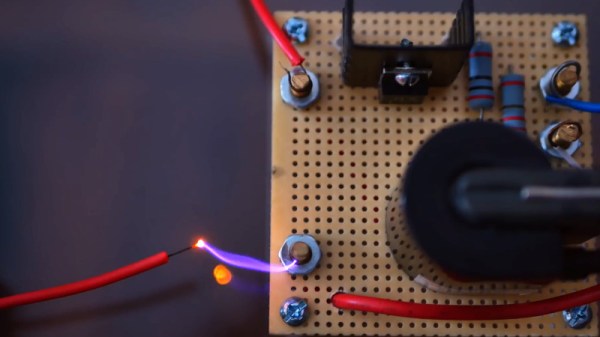
If you’re looking to experiment with plasma, you’re going to need a high voltage power supply. Usually that means something big, complex, and (naturally) expensive. But it doesn’t have to be. As [Jay Bowles] demonstrates in his latest Plasma Channel video, you can put together a low-cost power supply capable of producing up to 20,000 volts that fits in the palm of your hand. Though you should probably just put the thing down on a table when in use…

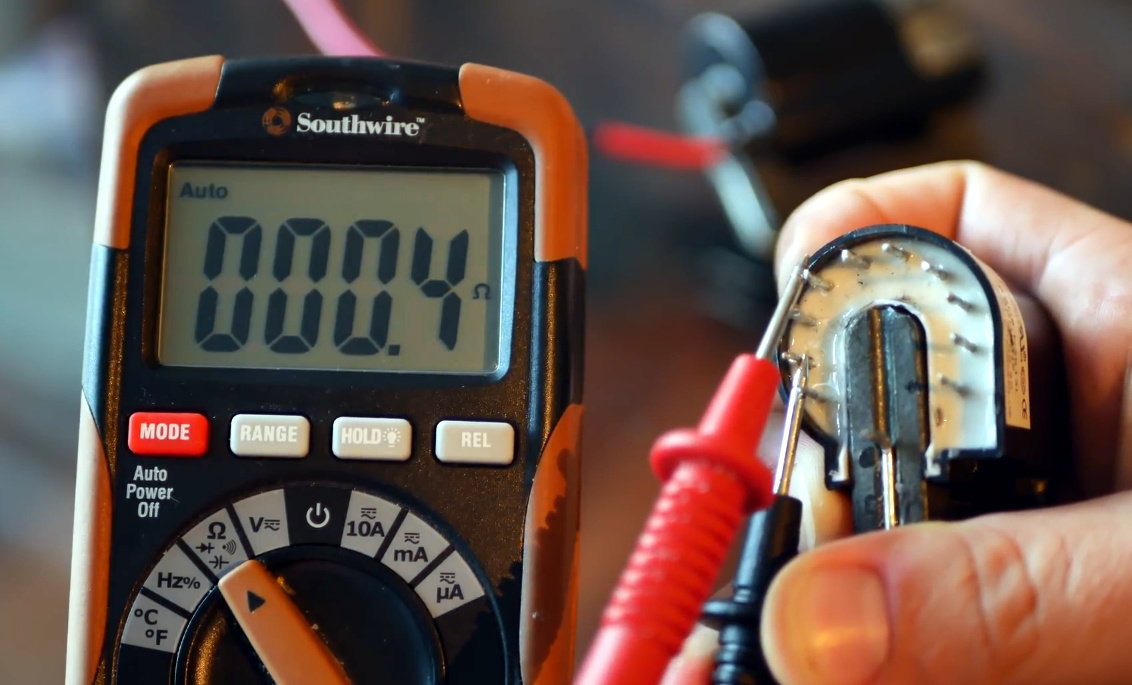
Finding the feedback coil with a multimeter.

The secret to the build is the flyback transformer. A household staple during the era of CRT televisions, these devices can still be readily found online or even salvaged from a broken TV. We’d recommend searching eBay for new old stock (NOS) transformers rather than risk getting blown through a wall while poking around in an old TV you found on the side of the road, but really it all depends on your experience level with this sort of thing.

In any event, once you have the flyback transformer in hand, the rest of the build is very simple. [Jay] demonstrates how you can determine the pinout for your transformer even if you can’t find a datasheet for it, and then proceeds to assemble the handful of ancillary parts necessary to drive it. Housed on a scrap of perfboard and mounted to a piece of plastic to keep stray objects away from the sparky bits underneath, this little power supply would be a reliable workhorse for anyone looking to start experimenting with high voltage. Perhaps an ionic lifter is in your future?

Readers with a photographic memory may recall that [Jay] used this same diminutive power supply in his recently completed water-based Marx generator.

Continue reading “A Miniature Power Supply For High Voltage Hacking”

Cool Off With A Piezo And A Glass Of Water

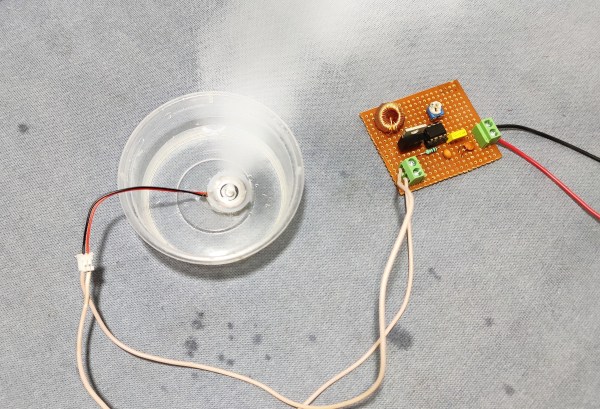
Some cool-mist humidifiers work by flinging water at a vaporizer, but our favorite kind uses a piezoelectric transducer. These work by using high-frequency sound waves to pound the surface of the water with mechanical energy. That energy introduces standing waves that force the water to break apart into a fine mist on the surface of the piezo disk.

The driving circuit for this DIY mist maker uses a 555 to generate 113 KHz, a trimmer potentiometer to fine-tune it, and a MOSFET to amplify the signal. You don’t need much more than that and a handful of passives to recreate this cool junk box experiment, but the spec of the piezo disk is quite important. The circuit is designed for atomizing transducers, which have a resonant frequency of 113 KHz — much higher than your average junk box piezo. Check out the demo and build video after the break.

Atomizing transducers can do way more than than moisten the air for our comfort. They’re not picky about where the water comes from, so if you have enough of them, you can dry a load of laundry in a few minutes.

Continue reading “Cool Off With A Piezo And A Glass Of Water”

Your Phone Is Now Helping To Detect Earthquakes

Most people’s personal experience with seismographs begins and ends with simple childhood science experiments. Watching a pendulum make erratic marks on a piece of paper while your classmates banged on the table gave you an idea on how the device worked, and there’s an excellent chance that’s the last time you gave the concept much thought. Even among hackers, whose gear in general tends to be more technologically equipped than the norm, you’re unlikely to find a dedicated seismograph up and running.

But that’s not because the core technology is hard to come by or particularly expensive. In fact, one could say with almost absolute certainty that if you aren’t actively reading these words on a device with a sensitive accelerometer onboard, you have one (or perhaps several) within arm’s reach. Modern smartphones, tablets, and even some laptops, now pack in sensors that could easily be pushed into service as broad strokes seismometers; they just need the software to collect and analyze the data.

Or at least, they did. By the time you read this article, Google will have already started rolling out an update to Android devices which will allow them to use their onboard sensors to detect possible earthquakes. With literally billions of compatible devices in operation all over the planet, this will easily become the largest distributed sensor network of its type ever put into operation. But that doesn’t mean you’re going to be getting a notification on your phone to duck and cover anytime soon.

Continue reading “Your Phone Is Now Helping To Detect Earthquakes”

Analyzing Water Quality With A Pair Of Robots

To adequately study a body of water such as a lake, readings and samples need to be taken from an array of depths and locations. Traditionally this is done by a few researchers on a small boat with an assortment of tools that can be lowered to the desired depth, which is naturally a very slow and expensive process. As the demand for ever more granular water quality analysis has grown, various robotic approaches have been suggested to help automate the process.

A group of students from Northeastern University in Boston have been working on Project Albatross, a unique combination of semi-autonomous vehicles that work together to provide nearly instantaneous data from above and below the water’s surface. By utilizing open source software and off-the-shelf components, their system promises to be affordable enough even for citizen scientists conducting their own environmental research.

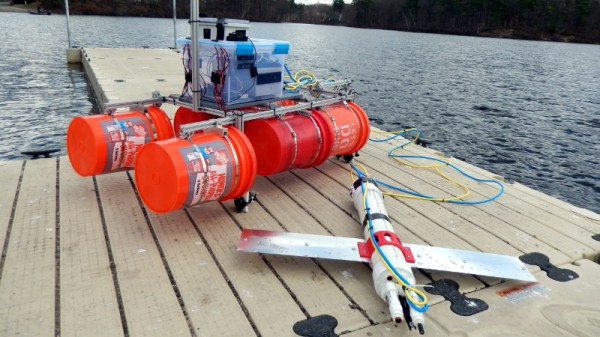
The surface vehicle, assembled from five gallon buckets and aluminum extrusion, uses a Pixhawk autopilot module to control a set of modified bilge pumps acting as thrusters. With ArduPilot, the team is able to command the vehicle to follow pre-planned routes or hold itself in one position as needed. Towed behind this craft is a sensor laden submersible inspired by the Open-Source Underwater Glider (OSUG) that won the 2017 Hackaday Prize.

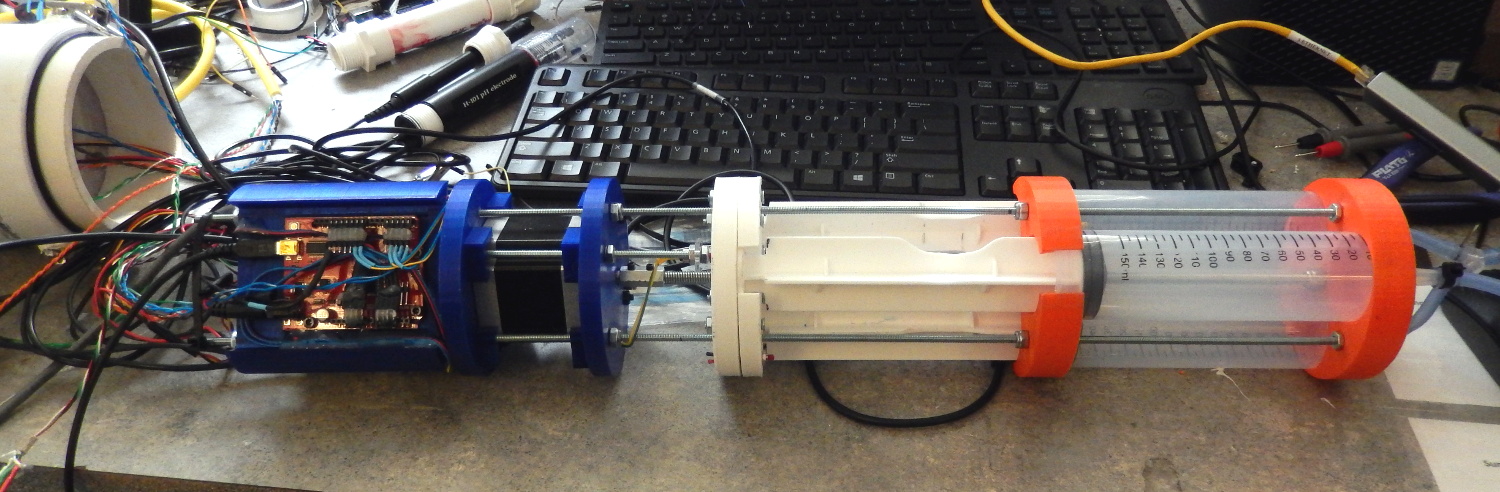
Using an array of syringes operated by a NEMA 23 stepper motor, the glider is able to control its depth in the water by adjusting its buoyancy. The aluminum “wings” on the side of the PVC pipe body prevent the vehicle from rolling will moving through the water. As with the surface vehicle, many of the glider components were sourced from the hardware store to reduce its overall cost to build and maintain.

The tether from the surface vehicle provides power for the submersible, greatly increasing the amount of time it can spend underwater compared to internal batteries. It also allows readings from sensors in the tail of the glider to be transmitted to researchers in real-time rather than having to wait for it to surface. While the team says there’s still work to be done on the PID tuning which will give the glider more finely-grained control over its depth, the results from a recent test run already look very promising.

A Tetraquark For Muster Mark!

The holy grail of every particle physics experiment is the discovery of a new particle. Finding a new constituent of matter may earn you eternal glory within the history of physics. Unfortunately, since the last missing piece of the Standard Model, the Higgs boson, was discovered in 2012, and with still no clue about the nature of dark matter and dark energy, there is not much hope to stumble upon a new fundamental building block of matter any time soon.

Luckily, this is not true for composite particles, especially the strange world of quark matter still yields some potential for new discoveries. The latest of such was the observation of a new tetraquark by the LHCb experiment. But what the hell is a quark anyway and why is it named after a German dairy product? Continue reading “A Tetraquark For Muster Mark!”