DIY Scintillation Detector Is Mighty Sensitive

Geiger counters are a popular hacker project, and may yet prove useful if and when the nuclear apocalypse comes to pass. They’re not the only technology out there for detecting radiation however. Scintillation detectors are an alternative method of getting the job done, and [Alex Lungu] has built one of his own.

Scintillation detectors have several benefits over the more common Geiger-Muller counter. They work by employing crystals which emit light, or scintillate, in the presence of ionizing radiation. This light is then passed to a photomultiplier tube, which emits a cascade of electrons in response. This signal represents the level of radioactivity detected. They can be much more sensitive to small amounts of radiation, and are more sensitive to gamma radiation than Geiger-Muller tubes. However, they’re typically considered harder to use and more expensive to build.

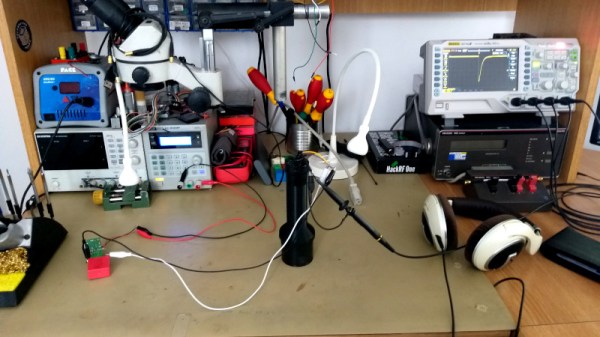
[Alex]’s build uses a 2-inch sodium iodide scintillator, in combination with a cheap photomultiplier tube he scored at a flea market for a song. [Jim Williams]’s High Voltage, Low Noise power supply is used to run the tube, and it’s all wrapped up in a tidy 3D printed enclosure. Output is via BNC connectors on the rear of the device.

Testing shows that the design works, and is significantly more sensitive than [Alex]’s Geiger-Muller counter, as expected. If you’re interested in measuring small amounts of radiation accurately, this could be the build for you. We’ve seen this technology used to do gamma ray spectroscopy too.


Say It With Me: Bandwidth

Bandwidth is one of those technical terms that has been overloaded in popular speech: as an example, an editor might ask if you have the bandwidth to write a Hackaday piece about bandwidth. Besides this colloquial usage, there are several very specific meanings in an engineering context. We might speak about the bandwidth of a signal like the human voice, or of a system like a filter or an oscilloscope — or, we might consider the bandwidth of our internet connection. But, while the latter example might seem fundamentally different from the others, there’s actually a very deep and interesting connection that we’ll uncover before we’re done.

Let’s have a look at what we mean by the term bandwidth in various contexts.

Continue reading “Say It With Me: Bandwidth”

A Stacked Peltier Cloud Chamber Build

Subatomic particles are remarkably difficult to see, but they can be made visible with the right techniques. Building a cloud chamber with dry ice is a common way to achieve this, but coming by the material can be difficult. [The Thought Emporium] wanted a more accessible build, and went for a Peltier-based design instead (Youtube link, embedded below).

By stacking several Peltier coolers in a cascade, it’s possible to increase the temperature differential generated. In this design, the copper plate of the chamber is cooled down to -33 degrees Fahrenheit (-36.11 Celcius), more than cold enough for the experiment to work. Alcohol is added to the glass chamber, and when it reaches the cold plate, it creates a super-saturated vapor. When disturbed by charged particles zipping out of a radioactive source, the vapor condenses, leaving a visible trail.

Cloud chambers are a popular experiment to try at home. It’s a great science fair project, and one that can be easily constructed with old computer parts and a couple of cheap modules from eBay. Just be careful when experimenting with radioactive sources. Video after the break.

Continue reading “A Stacked Peltier Cloud Chamber Build”

A Solar-Powered Box Of Sensors To Last 100 Years

It’s a simple goal: build a waterproof box full of environmental sensors that can run continuously for the next century. OK, so maybe it’s not exactly “simple”. But whatever you want to call this epic quest to study and record the planet we call home, [sciencedude1990] has decided to make his mission part of the 2019 Hackaday Prize.

The end goal might be pretty lofty, but we think you’ll agree that the implementation keeps the complexity down to a minimum. Which is important if these solar-powered sensor nodes are to have any chance of going the distance. A number of design decisions have been made with longevity in mind, such as replacing lithium ion batteries that are only good for a few hundred recharge cycles with supercapacitors which should add a handful of zeros to that number.

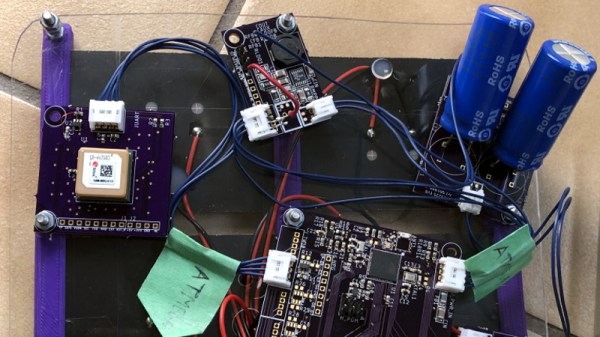
At the most basic level, each node in the system consists of photovoltaic panels, the supercapacitors, and a “motherboard” based on the ATmega256RFR2. This single-chip solution provides not only an AVR microcontroller with ample processing power for the task at hand, but an integrated 2.4 GHz radio for uploading data to a local base station. [sciencedude1990] has added a LSM303 accelerometer and magnetometer to the board, but the real functionality comes from external “accessory” boards.

Along the side of the main board there’s a row of ports for external sensors, each connected to the ATmega through a UART multiplexer. To help control energy consumption, each external sensor has its own dedicated load switch; the firmware doesn’t power up the external sensors until they’re needed, and even then, only if there’s enough power in the supercapacitors to do so safely. Right now [sciencedude1990] only has a GPS module designed to plug into the main board, but we’re very interested in seeing what else he (and perhaps even the community) comes up with.

You Wouldn’t Download A Nuclear Reactor, But Could You?

By pretty much any metric you care to use, the last couple of decades has been very good for the open source movement. There was plenty of pushback in the early days, back when the only people passionate about the idea were the Graybeards in the IT department. But as time went on, more and more developers and eventually companies saw the benefit of sharing what they were working on. Today, open source is effectively the law of the land in many fields, and you don’t have to look far to find the community openly denouncing groups who are keeping their source under lock and key.

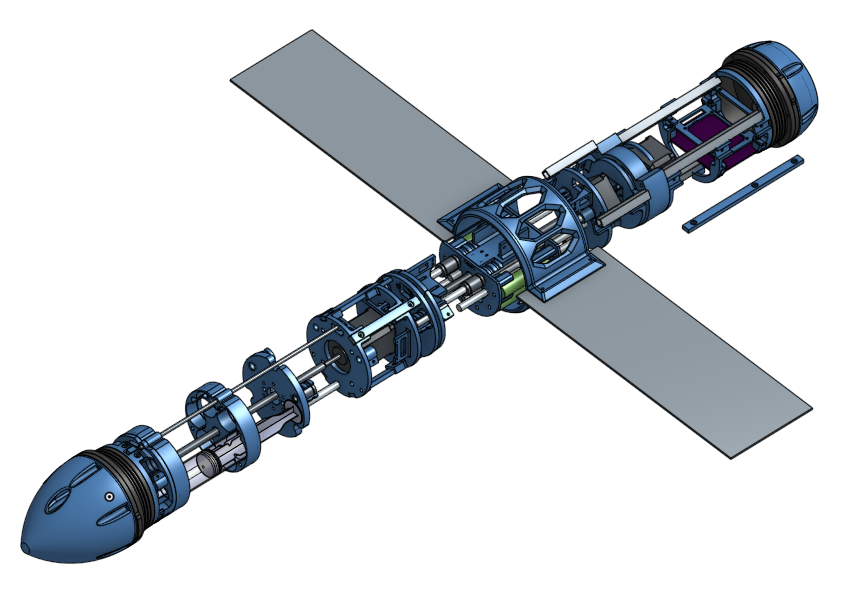
The open source submarine that won 2017 Hackaday Prize.

In the last few years, we’ve even seen the idea gain traction in the hardware field. While it’s not nearly as prevalent as opening up the software side of things, today it’s not uncommon to see hardware schematics and PCB design files included in project documentation. So not only can you download an open source operating system, web browser, and office suite, but you can also pull down all the information you need to build everything from a handheld game system to an autonomous submarine.

With so many projects pulling back the curtain, it’s not unreasonable to wonder where the limits are. There’s understandably some concerns about the emerging field of biohacking, and anyone with a decent 3D printer can download the files necessary to produce a rudimentary firearm. Now that the open source genie is out of the bottle, it seems there’s precious little that you can’t download from your favorite repository.

Scratching an exceptionally surprising entry off that list is Transatomic, who late last year uploaded the design for their TAP-520 nuclear reactor to GitHub. That’s right, now anyone with git, some uranium, and a few billion dollars of seed money can have their very own Molten Salt Reactor (MSR). Well, that was the idea at least.

So six months after Transatomic dumped a little under 100 MB worth of reactor documentation on GitHub, is the world any closer to forkable nuclear power? Let’s find out.

Continue reading “You Wouldn’t Download A Nuclear Reactor, But Could You?”

BioSentinel Mission Aims To Put Yeast Into Deep Space

It’s a truly exciting time for space enthusiasts. Humanity is finally shaking itself out of the half-century-long doldrums of deep space exploration and planning a return to the Moon and a push to Mars. Yes, exciting things have happened since the glory days of Apollo. We’ve reached out into the outer planets, drilled holes in asteroids, and made tracks across the face of Mars in an improbably durable rover. We’ve built magnificent space telescopes, created a permanent space station to replace a couple of temporary ones, and put an intricate constellation of satellites into service.

Those are all laudable achievements, but not a single living creature has intentionally achieved approached Earth escape velocity since three astronauts and five mice did it aboard Apollo 17 at 3:46 AM on December 7, 1972. Since then, we’ve all been stuck down here at the bottom of Earth’s gravity well, with only a lucky few of us getting a tease of what space travel is really like with low Earth orbit (LEO) missions.

But if NASA has its way, and certain difficulties with launch vehicles can be ironed out, in 2020 Earthlings will once again slip the surly bonds and make a trip to deep space. Of course those Earthlings will just be cultures of yeast carried into orbit around the Sun on a cubesat, but it’s a start, and it’s a good bet that more complex organisms won’t be far behind.

Continue reading “BioSentinel Mission Aims To Put Yeast Into Deep Space”

Schrodinger’s Cat Lives

If quantum physics always sounded a little squirrelly to you, take heart. Yale researchers have announced that they can do what quantum physics claimed to be impossible: they can determine the state a quantum system will collapse to before it happens. This contradicts Schrodinger’s famous hypothetical cat that is superimposed as 50% alive and 50% dead at the same time. The research appears in Nature.

Schrodinger argued that until you open the box, the cat is half alive and half dead in the same way that a qubit can be in 50% of one state or another. When you observe it, you force the system to one state. Researchers at Yale, however, have found a way to use microwaves to indirectly monitor qubits to determine their state prior to the system making a jump. Unlike a normal observation which occurs too late, the Yale technique allows researchers to change the future state to their choice.

Continue reading “Schrodinger’s Cat Lives”