This week Jonathan chats with Michael Meeks about Collabora! What’s the origin story in this consulting company, why do they have an outstanding office suite, and where is the world headed to accomplish digital sovereignty? Watch to find out!
Car enthusiasts want to know how quickly they can make a quarter mile. Weightlifters are forever trying to add one more plate to the bar. Internet denizens have their own favorite number to brag about: the result from a speed test.
The ritual is familiar. Close a few browser tabs, click the big “Go” button, and watch the needle climb. Perhaps you pay for gigabit service and see 940 megabits per second, which produces a satisfied nod. Perhaps you see 299 megabits and begin obsessing over network hardware. But before you get too excited either way, try another test. There is a fair chance it will give you a different answer.
That does not necessarily mean one test is lying. “Internet speed” is not a single physical quantity waiting to be measured. A speed test measures the performance of a particular device, over a particular local connection, through a particular ISP route, to a particular server, at a particular time using a particular test method. Change any of those things and the answer can change too. Continue reading “The Need For Speed: Internet Speed Measurement (or DIY?)”→
Have you ever found out that something you remember from your youth is now gone, and you didn’t even notice? If you are a certain age, you might feel that way when I deliver the news: You haven’t been able to buy International Reply Coupons (IRCs) at a US Post Office since early 2013. By the end of 2026, you won’t be able to buy them anywhere. The age of the IRC is over.
What’s an IRC?
An IRC from 1978 (public domain).
If that didn’t mean anything to you, you might be too young to remember, or maybe you just weren’t into shortwave listening or ham radio. Although there were other reasons to get IRCs, a radio hobby is the most likely reason a Hackday reader would have bought an IRC.
For radio purposes, here’s the problem. You’ve worked on your station for months, and one winter night, you finally pull in that rare station from Luxembourg. They’ll send you a QSL card to verify that you heard them. You only have to send them a letter telling them what time you heard them, what frequency, and some details about the program you heard. But they probably don’t want to pay the postage required to send hundreds or thousands of cards overseas.
While this is a radio-specific problem, you might find the same issue with pen pals or when trying to buy things from an overseas company.
SASE
If everyone were in the same country, the solution would be easy. Take a stamp, put it on an envelope that has your address on it, and stuff it in with the letter. Or, you could just drop a stamp or two in the letter you sent.
The problem is, US postage won’t help Radio Luxembourg. On the other hand, the effort required for you to buy postage that works in Luxembourg would have been a nightmare.
Enter the UPU
The Universal Postal Union is a UN agency that is effectively an association of post offices in 192 countries. Their charter is to facilitate mailing things worldwide.
The IRCs date back to 1906. The idea is you buy an IRC at your post office. You send it to Radio Luxembourg, or wherever. There, the mail person at the radio station could go to their post office and trade the coupon for enough local postage to send a surface letter worldwide.
Since the first V2 rocket sailed above the Kármán line back in 1944 and right up until the modern era, the trajectory of most space-bound rockets was more or less the same: after expending their propellants they would either crash into some desolate steppe or plunge into the ocean. In either event, the rocket was disposable. The important bit up top might go on to explore the stars or send a human crew off on their mission, but the booster rocket that lifted the spacecraft out of the atmosphere was always going to be sacrificed for the cause.
But in the 1970s NASA had a wild idea: what if we didn’t smash a brand-new rocket valued at millions of dollars into the ocean every time we wanted to put something in orbit? Instead, they would build a hybrid space vehicle that blended the vertical takeoff and raw power of a rocket with the capabilities of an airplane, allowing it and whatever it was carrying to make a gentle runway landing at the end of its mission. As such, the Space Shuttle was born.
With the benefit of hindsight, we now know the Shuttle wasn’t quite the spaceflight revolution that NASA had hoped for. The age of reusable rockets didn’t truly begin until 2015, when SpaceX landed the first stage of their Falcon 9. To date they’ve repeated the feat nearly 600 times, all the while increasing the reliability and speed of their operations. Today the Falcon 9 is the most prolific launch vehicle in history, and nearly every other rocket in active development is being designed to include some element of reusability.
Most recently, China demonstrated that they could recover their Long March 10B rocket by gently bringing it down into what amounts to a giant butterfly net. While it might seem a bit quaint compared to rockets that land on their tails like something out of a 1950s sci-fi movie, the idea offers considerable promise.
Having Linux on so many devices is both a blessing and a curse. Sure, it is great that you can hack on things and modify them or even totally repurpose them. But it also means you have a fleet of Linux devices you have to manage and keep track of.
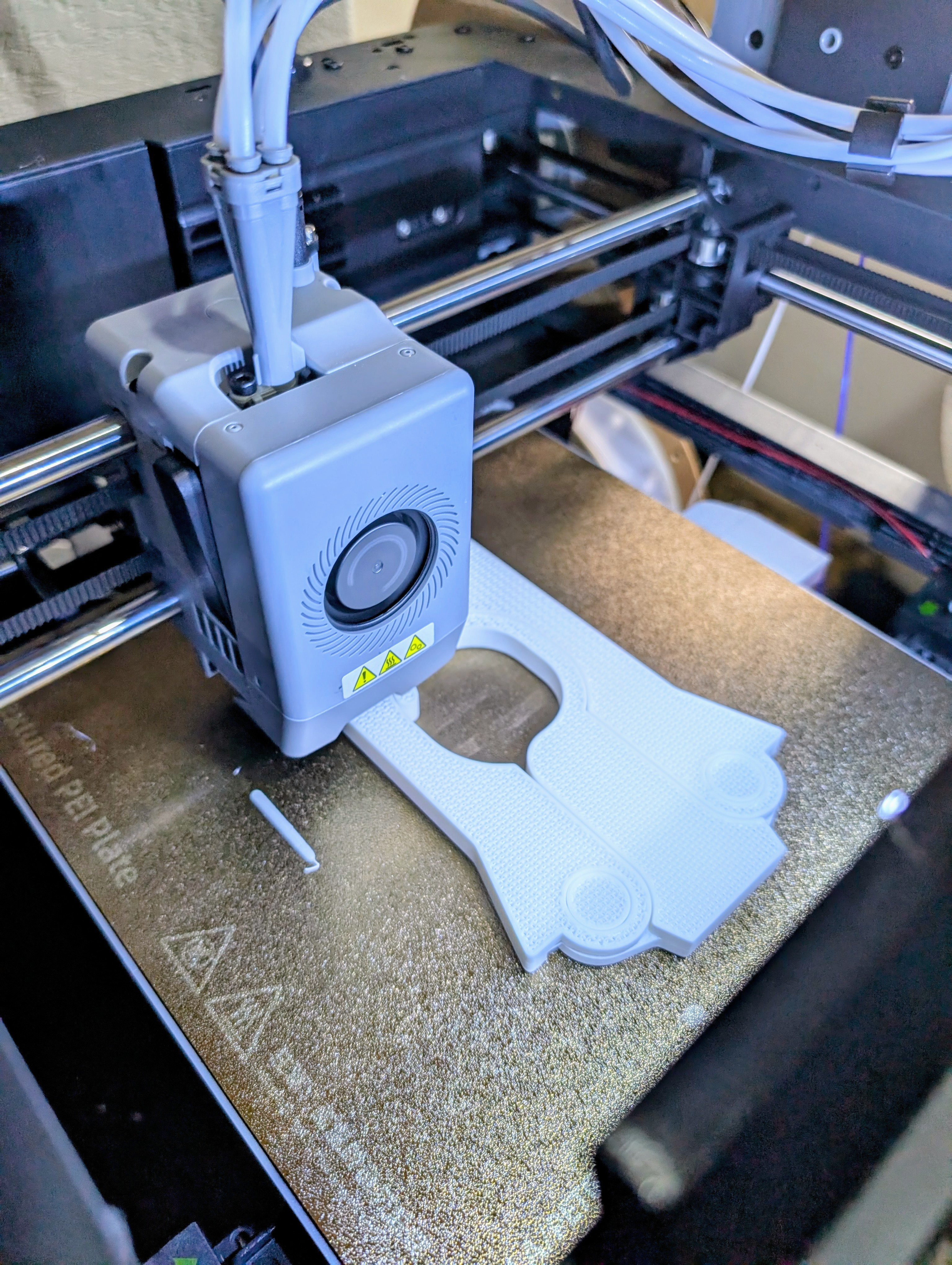
My current “main” 3D printer is a Flashforge AD5X: a nice, cheap machine that does four colors with the purge/exchange method. It sort of runs Klipper. I say sort of because Flashforge has Klipper running on a Linux host in the box, but it is massively crippled and modified. I’m sure it works for most folks. I’m also sure that if you know nothing about Linux, Klipper, or 3D printing, the experience is probably better thanks to all the cloud point-and-click interfaces. But, of course, I check none of those boxes.
I’ve had the printer for probably a year or more. Almost immediately, I put a “mod” on the printer to give it a more true Klipper interface and gave me things like shell access. There are several that I think will do this, but I used Zmod, which doesn’t totally replace the printer’s firmware; it just sort of patches it and extends it. You can easily bypass or even remove it and go back to the stock printer, although I would not want to.
In my case, the issue was a printer, but the same idea might apply to any embedded Linux system, from a router to a thermostat. Sure, it runs Linux, but is it Linux you can change?
The Problem
The AD5X runs Linux… sort of.
The Flashforge firmware and Zmod both will run on the AD5X’s little sister, the AD5M. However, the AD5M has a significantly less capable processor board than the AD5X. That means that Linux on the boxes is very stripped down. From Flashforge’s point of view, no one should be in the Linux OS anyway, and the author of Zmod probably figures every byte used is a byte taken away from the user or other advanced Zmod features.
It may seem like a first-world problem, but there were two things that irked me about the printer’s Linux. There was no less or more command for poking around files. There was also only vi as an editor. I did a few hacks to make myself happy. I wrote a pager in shell script, for example. I would try to remember to use my desktop emacs and tramp to edit files on the box. But it was a shame that there were some very basic tools lacking. Besides that, even the tools that were there like ls lacked help commands in case you want some strange option you can’t remember.
No Install
To save space, the printer doesn’t really have programs like ls, cat, and grep. Instead, it has a single busybox executable. This is common on small systems. You get one copy of the libraries and a single executable that will do all the work you need. You can invoke, for example, grep by running “busybox grep” or, if you make a symlink to busybox named grep, the user may never realize that you don’t really have grep installed.
However, busybox has to be built. You can’t easily install packages to it. So I couldn’t just run some package manager and install less or anything else. My plan was to produce a new busybox package myself to supply at least the missing commands and maybe some of the more basic ones, too. How hard could it be?
We are absolutely stoked to announce that the Hackaday Superconference is taking place this year November 6th through 8th in glorious Pasadena California, and we want to see you there!
If you’ve been to any of the previous nine Supercons, you know that it’s a fantastic gathering of the most motivated and interesting hackers around — but it’s also been a relatively small gathering. And while we love the very high signal-to-noise ratio of folks who show up, we’re always a little bit sad when the tickets sell out because it represents hackers who couldn’t be there.
So this year, we’re celebrating Supercon Ten by expanding out of our traditional location at the Design Lab so that we can accommodate 20% more hackers, while still keeping the cozy nature of the event intact. So if you’ve been wanting to come to Supercon, but procrastinated the ticket sales every year, this year is looking 20% better.
Along with the many displays of outrage, gnashing of teeth and other displays of profound grief at the recent news that Sony will no longer manufacture physical game discs come 2028, we have also heard some voices pipe up with a variety of statements, such as that this decision makes game archiving basically impossible. Of course, the truth of the matter is that software archiving in general has become much harder already over the past decades, while game consoles are just late to the archiving-hostile party.
As an example, one merely has to contrast Sony’s PlayStation with e.g. the Valve Steam store and software by juggernauts like Adobe and Autodesk. Here the former moved after the Creative Suite (CS6) series of Photoshop and other tools fully over to the Creative Cloud (CC) subscription model, where DRM and constant rental software renewals are in order. Unlike that disc copy of CS6 Master Collection that will stay good practically forever, there’s nothing really to archive with Adobe’s CC software.
Similarly, with digital game downloads and their constant patches now put inside a heavily encrypted environment that relies on a special launcher, preserving video games has been turned into into a virtual nightmare for many years now.