Home automation is huge right now in consumer electronics, but despite the wide availability of products on the market, hackers and makers are still spinning up their own solutions. It could be because their situations are unique enough that commercial offerings wouldn’t cut it, or perhaps they know how cheaply many automation tasks can be implemented with today’s microcontrollers. Still others go the DIY route because they’re worried about the privacy implications of pushing such a system into the cloud.
Seeing how many of you were out there brewing bespoke automation setups gave us the idea for this year’s Home Sweet Home Automation contest, which just wrapped up last week. We received more than 80 entries for this one, and the competition was fierce. Judging these contests is always exceptionally difficult, as nearly every entry is a standout accomplishment in its own way.
But the judges forged ahead valiantly, and we now have the top three projects which will be receiving $150 in store credit from the folks at DigiKey.
One of the most basic tools for tinkering with electronics is a multimeter. Today, even a cheap meter has capabilities that would have been either very expensive or unobtainable back in the 1970s. Still, even then, a meter was the most affordable way to do various tasks around the shop. Is this cable open? Are these two wires shorted? What’s the value of this resistor? Is the circuit getting power? Is the line voltage dropping? You can answer all those questions — and many more — with a basic meter. But there’s one thing that hasn’t changed much over the years: probes. That’s a shame because there are a lot of useful options.
The probes that came with your meter probably have much in common with the probes a 1970-era meter had. Yeah, the banana plugs probably have a little plastic cover, and the plastic itself might be a little different. Parts are small these days, so the tips might be a little finer than older probes. But if you sent your probes back in time, few people would notice them.
The Blinders Syndrome
One problem is that those probes are usually good enough. We’ve all clipped an alligator clip to a test probe. I’ve even fashioned super pointy probes out of syringes. Years ago, I bought an expensive kit with many attachments I rarely use, like little hooks and spade lugs. Then, I happened to go down the wrong aisle at Harbor Freight.
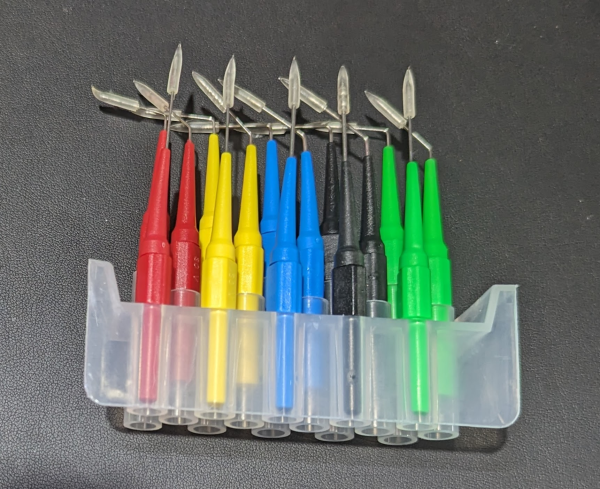
Back probes ready for action.
In the automotive section, I noticed a tidy plastic box labeled “22 pc. back probe kit.” I’d never heard the term “back probe,” but it was clearly some sort of wire. It turns out the kit has a bunch of very fine needles on banana jacks and some patch cables to connect them to your meter.
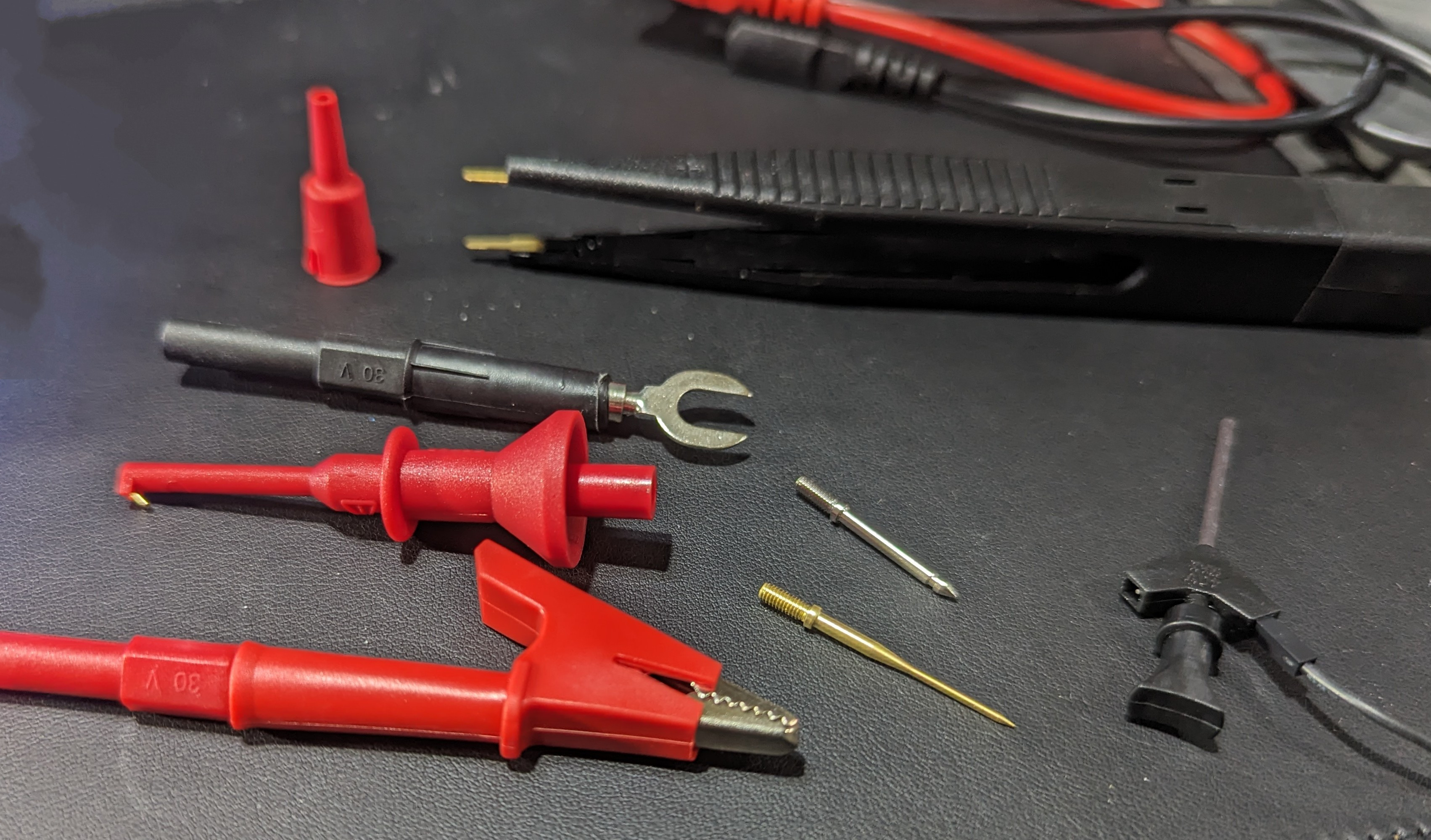
They are “back probes” because you can jam them in the back of connectors next to the wire. There are five colors of needles, and each color set has three items: a straight needle, a bent needle, and a 90-degree bend needle.
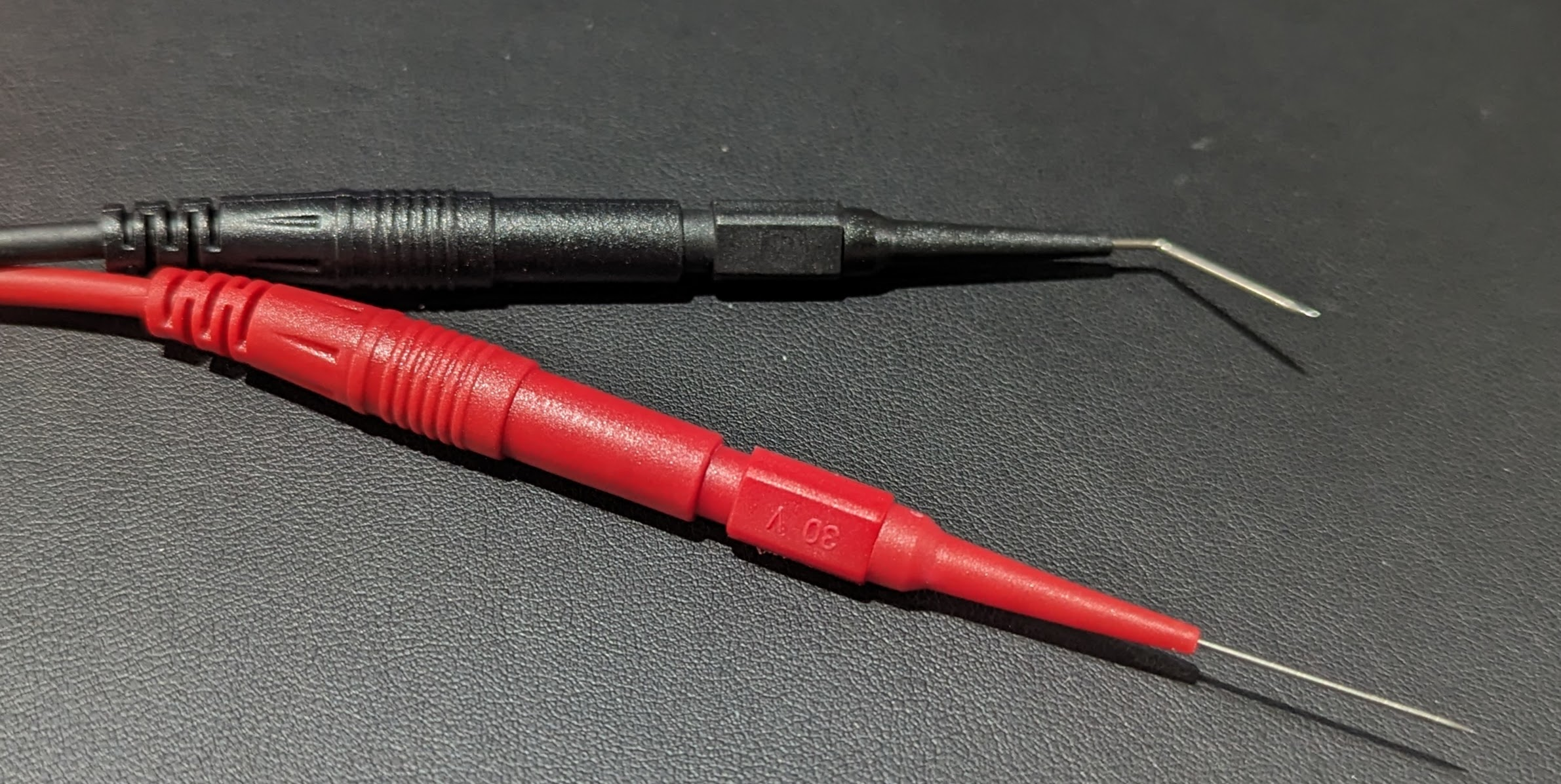
I’d never heard of this, and that started me down the rabbit hole of looking at what other exotic probes were out there. If you search the usual sources for “back probe,” you’ll see plenty of variations. There are also tons of inexpensive probe kits with many useful tips for different situations. Like everything, the price was much lower than I had paid for the rarely used kit I bought years ago. The only thing I really use out of that kit are the test hook clips and you can buy those now for a few bucks that just push over your probes.
Choices
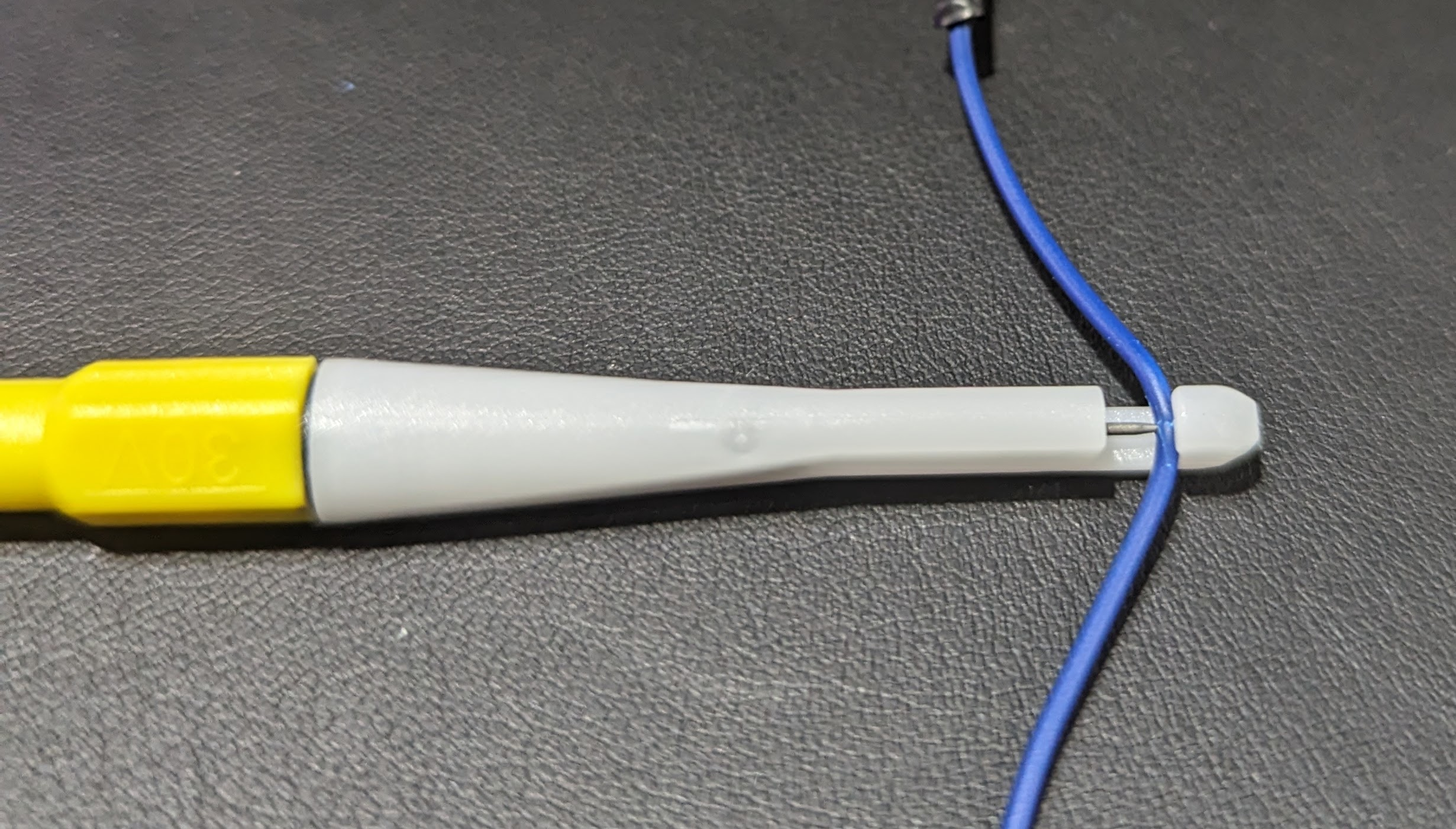
Wire-piercing probe works best for larger wires.
You could probably use the needles to stick through insulation, too. But if that’s your goal, they make piercing clip test probes specifically for that purpose. A little plastic holder has a hook for your wire and a needle that threads in to penetrate the wire.
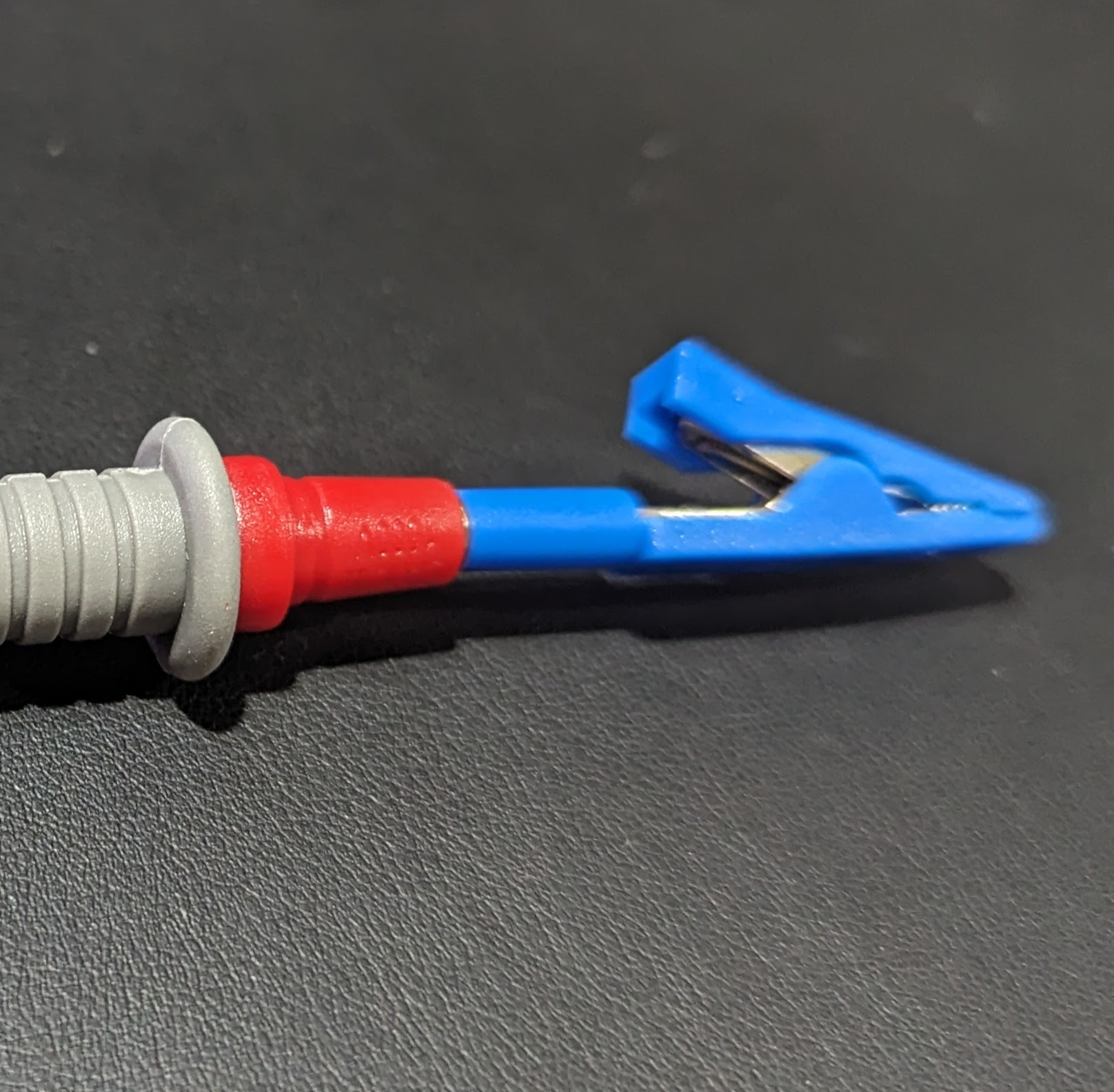
These alligator clips fit over most probes.
I also picked up some little alligator clips that slide over standard 2mm probe tips. These are very handy and prevent you from having to clip a lead to your probe so you can clip the other end to the circuit. However, if you look for a “test lead kit,” you’ll find many options for about $20. One kit had interchangeable probe tips, alligator clips, spades, SMD tweezers, and tiny hooks for IC legs. The alligator clips on the one I bought are the newer style that has a solid insulating body — not the cheap rubbery covers. They feel better and are easier to handle, too.
Breadboarding
Some of the accessories in the test probe kit.
Of course, you can make your own solderless breadboard jumpers, and you’ve probably seen that you can buy jumpers of various kinds. But if you search, you can even find test probes with breadboard wire ends. The other end will terminate in a test hook or alligator clips. You can also get them with banana plugs on the end to plug right into your meter. You can usually find versions with the male pin for a breadboard or a female receptacle for connecting to pins.
Another week in football, another VAR controversy to fill the column inches and rile up the fans. If you missed it, Coventry scored a last-minute winner in extra time in a crucial match—an FA Cup semi-final. Only, oh wait—computer says no. VAR ruled Haji Wright was offside, and the goal was disallowed. Coventry fans screamed that the system got it wrong, but no matter. Man United went on to win and dreams were forever dashed.
Systems like the Video Assistant Referee were brought in to make sport fairer, with the aim that they would improve the product and leave fans and competitors better off. And yet, years later, with all this technology, we find ourselves up in arms more than ever.
Well, it’s official — AI is ruining everything. That’s not exactly news, but learning that LLMs are apparently being used to write scientific papers is a bit alarming, and Andrew Gray, a librarian at University College London, has the receipts. He looked at a cross-section of scholarly papers from 2023 in search of certain words known to show up more often in LLM-generated text, like “commendable”, “intricate”, or “meticulous”. Most of the words seem to have a generally positive tone and feel a little fancier than everyday speech; one rarely uses “lucidly” or “noteworthy” unless you’re trying to sound smart, after all. He found increases in the frequency of appearance of these and other keywords in 2023 compared to 2022, when ChatGPT wasn’t widely available.
In what is probably the longest-distance tech support operation in history, the Voyager mission team succeeded in hacking their way around some defective memory and convincing their space probe to send sensor data back to earth again. And for the record, Voyager is a 46-year old system at a distance of now 24 billion kilometers, 22.5 light-hours, from the earth.
While the time delay that distance implies must have made for quite a tense couple days of waiting between sending the patch and finding out if it worked, the age of the computers onboard probably actually helped, in a strange way. Because the code is old-school machine language, one absolutely has to know all the memory addresses where each subroutine starts and ends. You don’t call a function like do_something(); but rather by loading an address in memory and jumping to it.
This means that the ground crew, in principle, knows where every instruction lives. If they also knew where all of the busted memory cells were, it would be a “simple” programming exercise to jump around the bad bits, and re-write all of the subroutine calls accordingly if larger chunks had to be moved. By “simple”, I of course mean “incredibly high stakes, and you’d better make sure you’ve got it right the first time.”
In a way, it’s a fantastic testament to simpler systems that they were able to patch their code around the memory holes. Think about trying to do this with a modern operating system that uses address space layout randomization, for instance. Of course, the purpose there is to make hacking directly on the memory harder, and that’s the opposite of what you’d want in a space probe.
Nonetheless, it’s a testament to careful work and clever software hacking that they managed to get Voyager back online. May she send for another 46 years!
This article is part of the Hackaday.com newsletter, delivered every seven days for each of the last 200+ weeks. It also includes our favorite articles from the last seven days that you can see on the web version of the newsletter.
Want this type of article to hit your inbox every Friday morning? You should sign up!
This particular attack has a couple of components, and abuses a couple of vulnerabilities, though the odd thing about this one is that the initial access is still unknown. The first part of the infection is Line Dancer, a memory-only element that disables the system log, leaks the system config, captures packets and more. A couple of the more devious steps are taken, like replacing the crash dump process with a reboot, to keep the in-memory malware secret. And finally, the resident installs a backdoor in the VPN service.
There is a second element, Line Runner, that uses a vulnerability to arbitrary code from disk on startup, and then installs itself onto the device. That one is a long term command and control element, and seems to only get installed on targeted devices. The Talos blog makes a rather vague mention of a 32-byte token that gets pattern-matched, to determine an extra infection step. It may be that Line Runner only gets permanently installed on certain units, or some other particularly fun action is taken.
Fixes for the vulnerabilities that allowed for persistence are available, but again, the initial vector is still unknown. There’s a vulnerability that just got fixed, that could have been such a vulnerability. CVE-2024-20295 allows an authenticated user with read-only privileges perform a command injection as root. Proof of Concept code is out in the wild for this one, but so far there’s no evidence it was used in any attacks, including the one above. Continue reading “This Week In Security: Cisco, Mitel, And AI False Flags”→
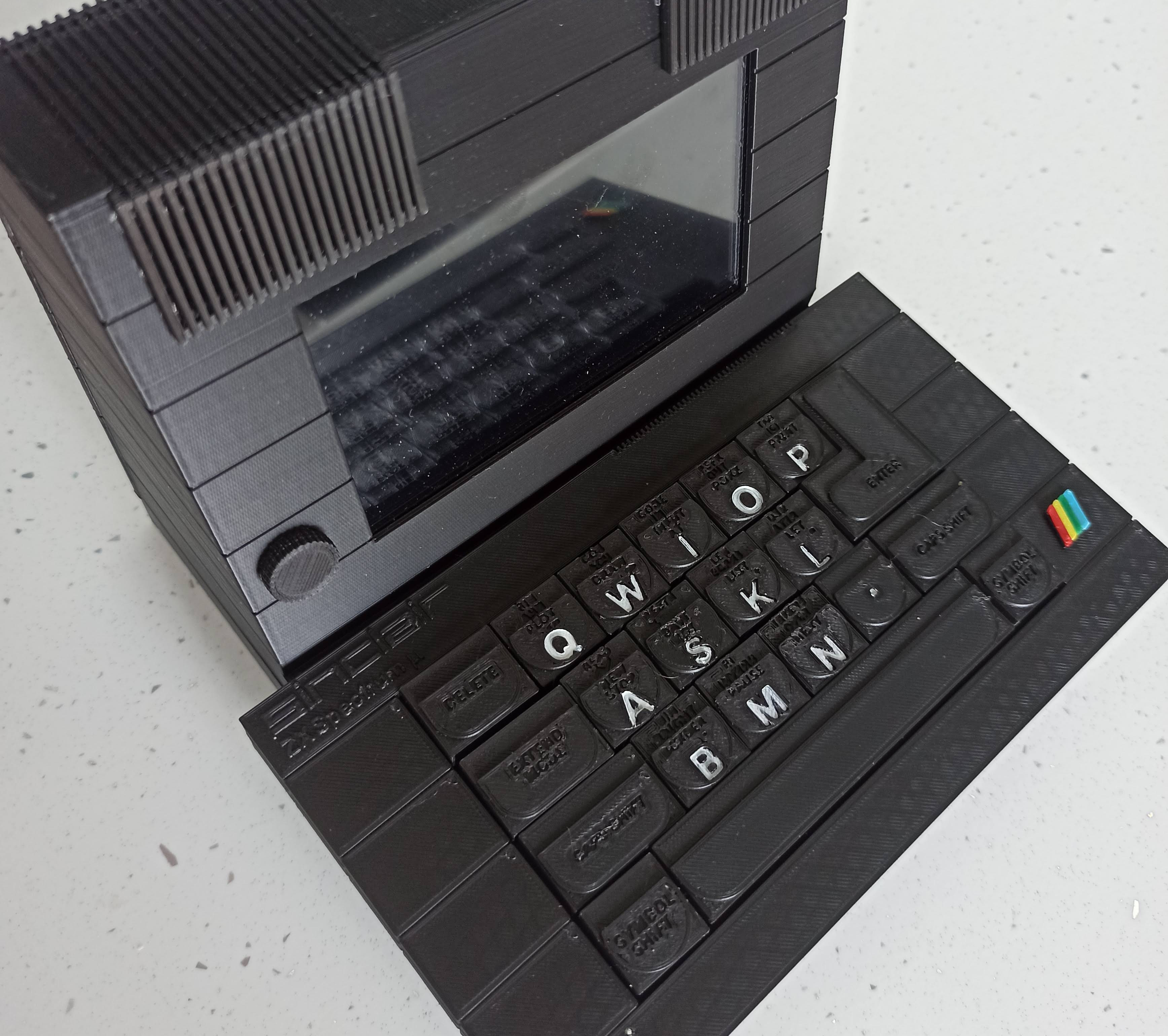
[SrBlonde]’s wonderful micro Spectrum project has only the essential inputs, which makes for an interesting-looking keyboard for sure. Inside you’ll find an Orange Pi Zero 2 board loaded with Batocera so [SrBlonde] can play all their favorite childhood games on the 5″ IPS display.
Something else that’s interesting is that the switches are a mix of blues and blacks — clickies and linears. I can’t figure out how they’re distributed based on the numbers in the components list, but I could see using clickies on the alphas and linears everywhere else (or vice versa). At any rate, it’s a great project, and you can grab the STL files from Thingiverse if you’re so inclined.