Wizards Slay The Dragon That Lays The Golden Egg

Hail, and well met adventurers! There’s rumors of dark dealings, and mysterious machinations from that group of Western mystics, Wizards of the Coast (WotC). If this pernicious plot is allowed to succeed, a wave of darkness will spread over this land of Open Source gaming, the vile legal fog sticking to and tainting everything it touches. Our quest today is to determine the truth of these words, and determine a defense for the world of open gaming, and indeed perhaps the entire free world! Beware, the following adventure will delve into the bleak magic of licensing, contract law, and litigation.

Ah, Dungeons and Dragons. The original creation of Gary Gygax, refined by countless others, this table-top role-playing game has brought entertainment and much more to millions of players for years. In 2000, WotC made a decision that opened the mechanics of that universe to everyone. The 3rd Edition of Dungeons and Dragons was released under the Open Gaming License, a very intentional port of Open Source licensing to table-top gaming — obviously inspired by the GNU Public License. Ryan Dancey was one of the drivers behind the new approach, and made this statement about it:

I think there’s a very, very strong business case that can be made for the idea of embracing the ideas at the heart of the Open Source movement and finding a place for them in gaming. […] One of my fundamental arguments is that by pursuing the Open Gaming concept, Wizards can establish a clear policy on what it will, and will not allow people to do with its copyrighted materials. Just that alone should spur a huge surge in independent content creation that will feed into the D&D network.

Continue reading “Wizards Slay The Dragon That Lays The Golden Egg”

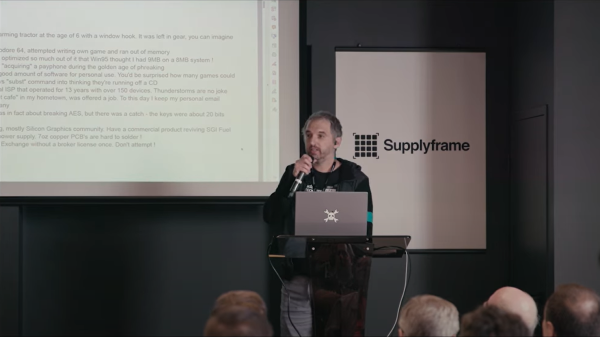
Supercon 2022: Samy Kamkar’s Glowing Breath

Sometimes the journey itself is the destination. This one started when [Samy] was 10 and his mom bought a computer. He logged on to IRC to talk with people about the X-Files and was WinNuked. Because of that experience, modulo a life of hacking and poking and playing, the talk ends with a wearable flex-PCB Tesla coil driving essentially a neon sign made from an ampule of [Samy]’s own breath around his neck. Got that? Buckle up, it’s a rollercoaster.

Continue reading “Supercon 2022: Samy Kamkar’s Glowing Breath”

All About USB-C: Power Delivery

USB-C eliminates proprietary barrel plug chargers that we’ve been using for laptops and myriads of other devices. It fights proprietary phone charger standards by explicitly making them non-compliant, bullying companies into making their devices work with widely available chargers. As a hobbyist, you no longer need to push 3 A through tiny MicroUSB connectors and underspecced cables to power a current-hungry Pi 4. Today, all you need is a USB-C socket with two resistors – or a somewhat special chip in case the resistors don’t quite get you where you want to be.

You get way more bang for your buck with USB-C. This applies to power too; after all, not all devices will subsist on 15 W – some will want more. If 15 W isn’t enough for your device, let’s see how we can get you beyond.

Reaching Higher

USB-C power supplies always support 5 V and some are limited to that, but support for higher voltages is where it’s at. The usual voltage steps of USB-C are 5 V, 9 V, 15 V and 20 V ; 12V support is optional and is more of a convention. These steps are referred to as SPR, and EPR adds 28 V, 36 V and 48 V steps into the mix – for up to 240 W; necessitating new cables, but being fully backwards and forwards compatible, and fully safe to use due to cable and device checks that USB-C lets you perform.

A charger has to support all steps below its highest step, which means that 20 V-capable chargers also have to support 5 V, 9 V, and 15 V as well – in practice, most of them indeed do, and only some might skip a step or two. You can also get voltages in-between, down to 3.3 V, even, using a PD standard called PPS (or the AVS standard for EPR-range chargers) – it’s not a requirement, but you’ll find that quite a few USB-C PSUs will oblige, and PPS support is usually written on the label. Continue reading “All About USB-C: Power Delivery”

Ask Hackaday: What’s Your Worst Repair Win?

Like many of you, I’ve become the designated “fix-it” person for my family and friends. While it can be a lot of work — I just finished an oil change that required me to lay in a cold, wet driveway and I can’t mention in polite company the substances I was bathed in while fixing a clogged pipe last week  — I generally relish my role. I enjoy solving problems, I love working with my hands and my head, and who doesn’t like saving money and time?

But for me, the best part of being the fix-it guy is the satisfaction that comes from doing something others can’t do. I find this especially true with automotive repairs, which conventional wisdom says is strictly the province of factory-trained experts. A little bit of a hero complex, perhaps? Absolutely! After all, I don’t get paid for my repairs, so I’ve got to get a little something for the effort.

This is why a recent pair of unrelated fixes left me feeling thoroughly unsatisfied. Neither of these jobs was a clear win, at least in terms of getting the rush of being able to do something that nobody else could. At best, these were qualified wins, which both still left me feeling a little defeated. And that got me thinking that I’m probably not the only one who has had marginal repair wins like these.

Continue reading “Ask Hackaday: What’s Your Worst Repair Win?”

Hackaday Links Column Banner

Hackaday Links: January 8, 2023

Something odd is afoot in the mountains around Salt Lake City, Utah, at least according to local media reports of remote radio installations that have been popping up for at least the past year. The installations consist of a large-ish solar panel, a weatherproof box full of batteries — and presumably other electronics, including radios — and a mast bearing at least one antenna. Local officials aren’t quite sure who these remote setups belong to or what they’re intended to do, but the installations obviously represent a huge investment in resources.

The one featured in the story was located near the summit of Twin Peaks, which is about 11,000 feet (3,300 meters) in elevation, which with that much gear was probably a hell of a hike. Plus, the owner took great pains to make sure the site would withstand the weather, with antenna mast guy wires that must have required lugging a pretty big drill up with them. There aren’t any photos of the radios in the enclosure, but one photo shows a 900-MHz LORA antenna, while another shows what appears to be a panel antenna, perhaps pointing toward another site. So maybe a LORA mesh network? Some comments in the Twitter thread show most people are convinced this is a Helium crypto mining rig, but the Helium Explorer doesn’t show any hotspots listed in that area. Either way, the owners are out of luck, since their gear is being removed if it’s on public land.

Continue reading “Hackaday Links: January 8, 2023”

The Surprisingly Simple Way To Steal Cryptocurrency

In the news a few days ago, the revelation that Luke Dashjr, a core Bitcoin developer, had his wallet compromised, and lost 200 BTC. A small fortune, and something of a shock. I’m guessing that someone with that expertise would not have left his private key lying around, so as a cryptocurrency non-enthusiast I’m left curious as to how the attackers might have done it. So I phoned a few friends who do walk those paths for an explanation, and the result was a fascinating conversation or two. The most probable answer is still that someone broke into his computer and copied the keys — straight-up computer theft. But there’s another possible avenue that doesn’t involve stealing anything, and is surprisingly simple. Continue reading “The Surprisingly Simple Way To Steal Cryptocurrency”

The Problem With Passwords

By now it’s probable that most readers will have heard about LastPass’s “Security Incident“, in which users’ password vaults were lifted from their servers. We’re told that the vaults are encrypted such that they’re of little use to anyone without futuristic computing power and a lot of time, but the damage is still done and I for one am glad that I wasn’t a subscriber to their service. But perhaps the debacle serves a very good purpose for all of us, in that it affords a much-needed opportunity for a look at the way we do passwords. Continue reading “The Problem With Passwords”