Don’t Believe Everything You Read: The Great Electric Toaster Hoax

We’ve all looked up things on Wikipedia and, generally, it is usually correct information. However, the fact that anyone can edit it leads to abuse and makes it somewhat unreliable. Case in point? The BBC’s [Marco Silva] has the story of the great online toaster hoax which erroneously identified the inventor of the toaster with great impact.

You should read the original story, but in case you want a synopsis, here goes: Until recently, the Wikipedia entry for toasters stated that a Scottish man named Alan MacMasters invented the electric toaster in the 1800s. Sounds plausible. Even more so because several books had picked it up along with the Scottish government’s Brand Scottland website. At least one school had a day memorializing the inventor and a TV show also honored him with a special dessert named for Alan MacMasters, the supposed inventor. Continue reading “Don’t Believe Everything You Read: The Great Electric Toaster Hoax”

A Hacker Walks Into A Trade Show: Electronica 2022

Last week, the world’s largest electronics trade fair took place in Munich, so I had to attend. Electronica is so big that it happens only once every two years and fills up 14 airplane hangars. As the fairly generic name suggests, it covers anything and everything having to do with electronics. From the producers of your favorite MLCC capacitors to the firms that deliver them to your doorstep, from suppliers of ASIC test equipment to the little shop that’ll custom wind toroids for you, that’s a pretty wide scope. Walking around, I saw tomorrow’s technology today from the big players, but I also picked up some ideas that would be useful for the home gamer.

When I first walked in, for instance, I ran into the Elantas booth. They’re a company that makes flexible insulation and specialty industrial coatings. But what caught my eye was a thermoformed plastic sheet with circuit traces on it. To manufacture them, they cut out copper foil, glue it to a flat plastic sheet with a glue that has a little give, and then put it all together into a vacuum former. The result is a 3D circuit and organically formed substrate in one shot. Very cool, and none of the tech for doing that is outside of the reach of the determined hacker.

The Cool Stuff

All of the stands, big or small, try to lure you in with some gimmick. The big fish, firms with deep pockets, put up huge signs and open bars, and are staffed by no shortage of salespeople in suits. The little fish, on the other hand, have to resort to showing you the cool stuff that they do, and it’s more often the application engineers sitting there, ready to talk tech. You can guess which I found more interesting.

For instance when I walked up to an obviously DIY popcorn popper that was also showing 5000 FPS footage of kernels in mid-pop, I had to ask. The company in question was a small UK outfit that made custom programmable power supplies and digital acquisition gear that interfaced with it. You could plug in their box to some temperature probes, fire off the high-speed video camera, and control the heating and cooling profile without writing any code. Very sweet. Continue reading “A Hacker Walks Into A Trade Show: Electronica 2022”

Start Your Engines: The FPV Contest Begins Now!

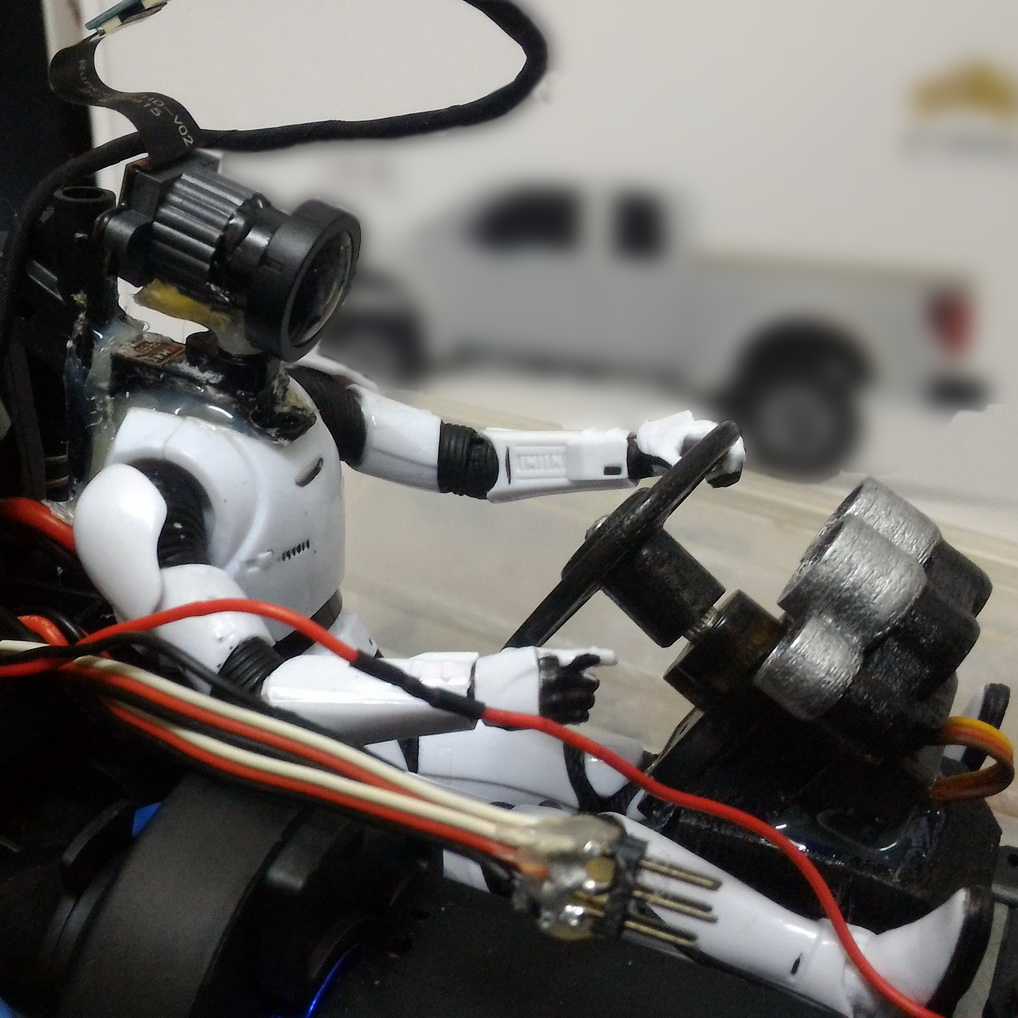
There are places that you can go in person, but for everything else, there’s FPV. Whether you’re flying race quads, diving the depths in a yellow submarine, or simply roving the surface of the land, we want to see your builds. If it’s remote controlled, and you feel like you’re in the pilot’s seat, it’s FPV.

That’s you in the car.

When you say “first person view” many of you will instinctively follow up with “flight” or “drone”. But given the ease of adding a camera and remote control to almost any vehicle, there’s no reason to only fly the FPV skies. (Of course, we want to see your crazy quadcopter builds too.)

We went looking for a few less-traditional examples to whet your appetite, and we found a lot. There are super-cute FPV bots for indoors and more robust tanks for cruising around the neighborhood. In the summer, you’ll probably need an FPV lawnmower, and for the winter, naturally, an FPV snowblower or a budget-friendly FPV snow-boat. Or skip the outdoors entirely and terrorize the pool with an FPV sub.

This contest isn’t exclusively about the vehicles either. If you’re working on the tech that makes FPV possible, we want you to enter. For instance, this simple quad/drone tracker will help keep your video feed running and your mind on flying. This cockpit will make the immersion more complete. And nobody likes the jello-cam effect that excess vibration can cause, so we’d like to see camera hacks as well.

And of course, your quads. Is your FPV quad too fast, too light, or does it fly too far? Show us. The contest starts now and runs until Jan 3, 2023, and there are three $150 shopping sprees courtesy of Digi-Key on the line. Get hacking!

Spoofing LIDAR Could Blind Autonomous Vehicles To Obstacles

Humans manage to drive in an acceptable fashion using just two eyes and two ears to sense the world around them. Autonomous vehicles are kitted out with sensor packages altogether more complex. They typically rely on radar, lidar, ultrasonic sensors, or cameras all working in concert to detect the road conditions ahead.

While humans are pretty wily and difficult to fool, our robot driving friends are less robust. Some researchers are concerned that LiDAR sensors could be spoofed, hiding obstacles and tricking driverless cars into crashes, or worse.

Continue reading “Spoofing LIDAR Could Blind Autonomous Vehicles To Obstacles”

How To Repair? The Death Of Schematics

There was a time when, if you were handy with a soldering iron, you could pretty easily open up a radio or TV repair business. You might not get rich, but you could make a good living. And if you had enough business savvy to do sales too, you could do well. These days there aren’t many repair shops and it isn’t any wonder. The price of labor is up and the price of things like TVs drops every day. What’s worse is today’s TV is not only cheaper than last year’s model, but probably also better. Besides that, TVs are full of custom parts you can’t get and jam-packed into smaller and smaller cases.

Case in point, I saw a “black Friday” ad for a 40-inch 1080p flatscreen with a streaming controller for $98. Granted, that’s not huge by today’s standards and I’m sure it isn’t a perfect picture. But for $98? Even a giant high-quality TV these days might cost a bit more than $1,000 and you can get something pretty great for well under $500.

Looking back, a Sears ad showed a great deal on a 19″ color TV in 1980. The price? $399. That doesn’t sound too bad until you realize that today that would be about $1,400. So with a ratio of about 3.5 to 1, a $30/hour service call would be, today, $105. So for an hour’s service call with no parts, I could just buy that 40″ TV. Add even one simple part or another hour and I’m getting close to the big league TVs.

Did you ever wonder how TV repair technicians knew what to do? Well, for one thing, most of the time you didn’t have to. A surprising number of calls would be something simple like a frayed line cord or a dirty tuner. Antenna wires destroyed by critters was common enough. In the tube days, you could pretty easily swap tubes to fix the bulk of actual problems.

Continue reading “How To Repair? The Death Of Schematics”

FDA’s Approval Of Cell Culture Chicken: The Rise Of Fresh Meat Without The Animal?

On November 14th of this year, the FDA cleared the path for Upside Foods to sell its cell-culture-based chicken products within the US. This is the first product of its kind to be cleared for commercial sale within the Americas, with only Singapore having previously cleared a similar product for sale, back in December of 2020. This latter product comes courtesy of another California start-up called Eat Just.

Since that initial approval in Singapore, Eat Just has begun to set up a 2,800 square meter (~30,000 square feet) production facility in Singapore that is scheduled to begin producing thousands of kilograms of slaughter-free meat starting in the first quarter of 2023. This would make it the top-runner in the cultured meat industry, which to this point has seen dozens of start-ups, but precious few actual products for sale.

With CEO Josh Tetrick of Eat Just projecting price equality between their cultured meat and meat from animals by 2030, could the FDA’s approval herald the dawn of slaughter-free meat? There are obviously still hurdles, but as we’ll see, the idea is not nearly as far-fetched as one might think.

Continue reading “FDA’s Approval Of Cell Culture Chicken: The Rise Of Fresh Meat Without The Animal?”

Hackaday Podcast 193: Found Computers, Internet Over WhatsApp, Two-Factor C64, Shifting Cars, And Self-Shooting Fighter Planes

This week, Editor-in-Chief Elliot Williams and Staff Writer Dan Maloney review the literature on a hack-packed week of action. We’ll find a Linux machine inside just about anything, including curb-side TVs and surprisingly secure EV chargers. No Internet? No problem — just tunnel IP through WhatsApp! We’ll see that 3D printers can be repurposed for lab automation of the cheap, build the worst — but coolest — 2FA dongle of all time, and see how a teetering tower of cards can make your old motherboard think any ISA card is plugged into it. Worried that driving an EV is going to be a boring experience? Don’t be — maybe you’ll still get to jam through the gears. But if you do, rest assured there’ll be plenty of careful engineering done to see if it’s safe. Err, at least we hope so…

Download the podcast for safe keeping.

Check out the links below if you want to follow along, and as always, tell us what you think about this episode in the comments!

Continue reading “Hackaday Podcast 193: Found Computers, Internet Over WhatsApp, Two-Factor C64, Shifting Cars, And Self-Shooting Fighter Planes”