Testing any kind of project in the real world is expensive. You have to haul people and equipment around, which costs money, and if you break anything, you have to pay for that too! Simulation tends to come first. Making mistakes in a simulation is much cheaper, and the lessons learned can later be verified in the real world. If you want to learn to fly a quadcopter, the best thing to do is get some time behind the sticks of a simulator before you even purchase anything with physical whirly blades.
Oddly enough, the same goes for AI. Microsoft built a simulation product to aid the development of artificial intelligence systems for drones by the name of Project AirSim. It aims to provide a comprehensive environment for the testing of drone AI systems, making development faster, cheaper, and more practical.
Long-time readers of Hackaday will know that we attend quite a few events, including summer hacker camps. Here in Europe this year there are two large events, the British Electromagnetic Field, and the Dutch MCH, or May Contain Hackers. These events are put together by volunteers from within the community, and as part of the MCH setup I noticed they needed drivers for their off-site logistics. I have a licence to drive medium-sized trucks in Europe so it seemed like a perfect fit. I traveled early on the first set-up day to the Dutch city of Utrecht, and found myself behind the wheel of a large Volkswagen box van. My brief career as a trucker had begun!
An Empty Field Of Dreams
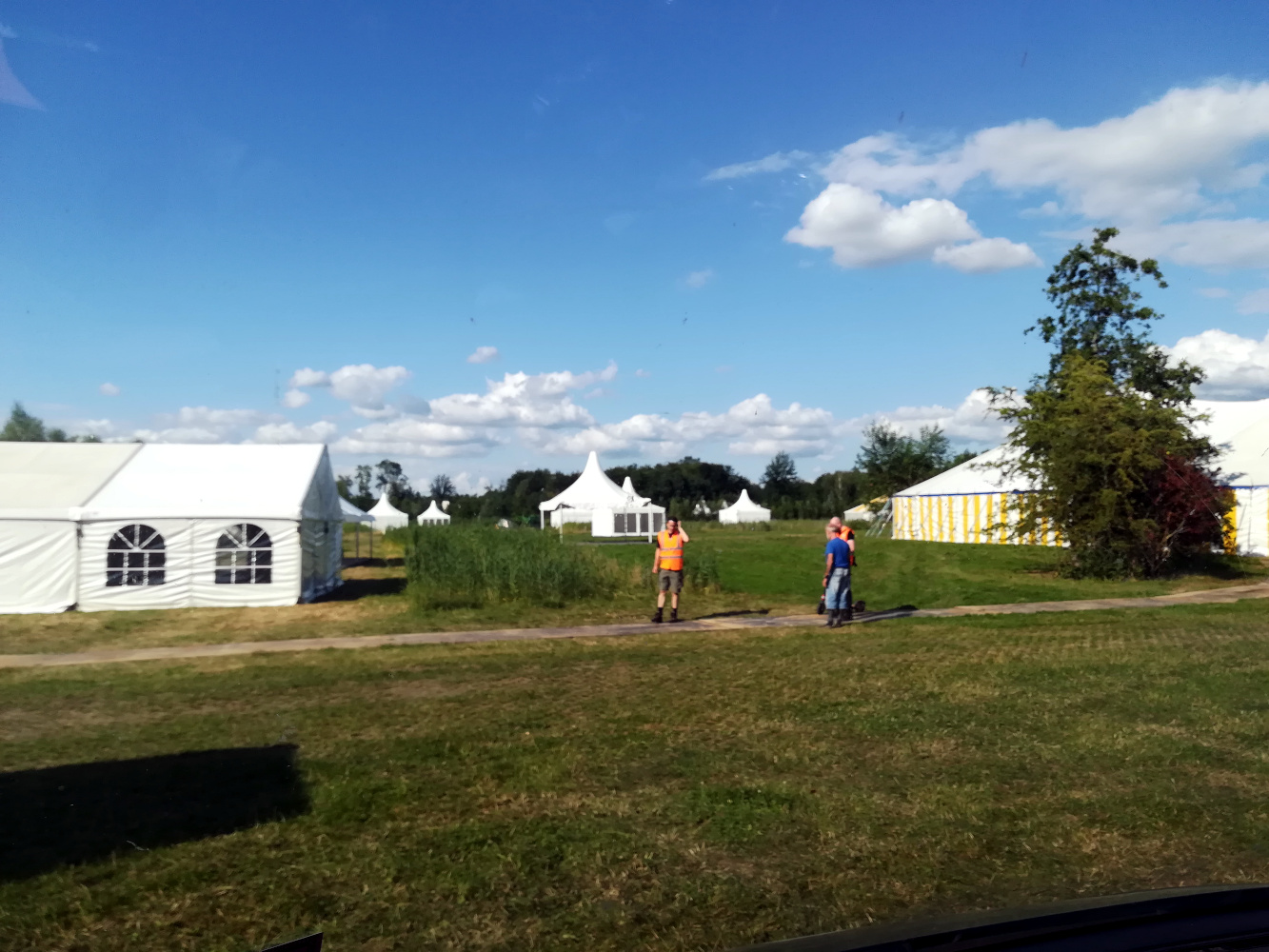
The tents stand in isolation at the end of day one.
The Netherlands is a relatively small country and the MCH site at Zeewolde is roughly in its centre, so while the traffic could be heavy the distances weren’t large by American or even British standards. There were however a wide variety of loads waiting for me and my fellow driver, and a few obstacles such as the hottest days of the year and angry Dutch farmers blockading the roads. If you’re interested in the logistics behind a large hacker camp then our journeys provided an insight that maybe wandering around the field doesn’t quite deliver.
Arriving on site on the first day gives a perspective on how much of the infrastructure comes from specialist contractors and thus isn’t delivered by the hackers. Articulated trucks from the marquee company were disgorging the main tents, with their crews expertly assembling them in record time. The toilets and showers were arriving as self-contained hook lift container units, and yet more contractors were delivering fencing or tables and chairs. I can add the power infrastructure to this list, but due I’m told to delays at another event this wasn’t on site on the first day. Continue reading “What Goes Into A Hacker Camp”→
You’ve probably heard about Google Chromebooks. Like Android, Chrome OS is based on some variant of Linux, but it is targeted at the “cloud first” strategy so Chromebooks typically don’t have a huge amount of storage or compute power. If you have a real Chromebook, you can also use it to run certain other kinds of programs via virtualization. However, Google has recently pushed out Chrome OS Flex which is meant to install on a spare laptop you might happen to have hanging around. Seems attractive to take that only Windows 7 laptop and repurpose it to run Chrome OS, especially if you can run Linux apps on it. Unfortunately, Chrome OS Flex has a very different use case and I would only recommend installing it if you meet the exact use case it addresses.
The other option, of course, is to just install Linux on that old hardware. There are several distributions that are made for that purpose and, honestly, even most of the major distributions will work fine on older hardware with a little tweaking to turn off some of the more resource-costly features. That assumes you know how to install, tweak, and maintain Linux.
Wow! We knew that the Hack it Back Challenge round of the Hackaday Prize would bring out the clever repairers among you, but we’re still impressed to see the results! This was a tough round for the judges, but they came up with a short list of ten finalists, and we’re pleased to bring them to you here.
The Hack it Back Challenge aimed to keep old gear from being thrown away by performing a heroic repair, giving it a new purpose in life, or otherwise bringing it back to a useful state. Of course, once you’ve got the box open, you start thinking of how to improve whatever the gadget is, and some of our finalists took that in unexpected directions. Continue reading “2022 Hackaday Prize: Congratulations To The Winners Of The Hack It Back Challenge”→
We’ve been interested in looking at how AI can process things other than silly images. That’s why the “Free AI Bot that Generates the Excel Formula for Any Problem” caught our eye. Based on GPT-3, it supposedly transforms your problem description into a formula suitable for Excel or Google Sheets.
Our first prompt didn’t work out very well. But that was sort of our fault. When they say “Excel formula” they mean that quite literally. So trying to describe the actual result you want in terms of columns or rows seems to be beyond it. Not realizing that, we asked:
If the sum of column H is greater than 50, multiply column A by 0.33
And got:
=IF(SUM(H:H)>50,A*0.33,0)
A Better Try
Which is close, but not really how anyone even mildly proficient with Excel would interpret that request. But that’s not fair. It really needs to be a y=f(x) sort of problem, we suppose.
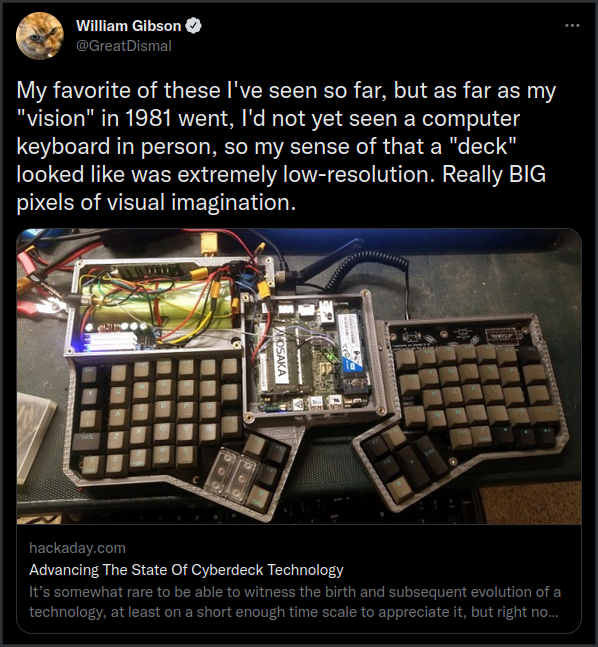
When William Gibson first described the “cyberspace deck” used by the protagonists in Burning Chrome and Neuromancer, he offered only a few concrete details: they allow the user to explore cyberspace, are generally portable, and more adept owners often modify them to fit their particular needs. Anything else was left to the individual’s imagination, due in no small part to the fact that he author himself didn’t exactly know what the things would look like at the time. Still, not bad for a guy who was hammering it all out on a typewriter at the time.
Build your deck like Gibson is watching, because he is.
Now 40 years later, fact has caught up with fiction. The hacker and maker community have embraced the cyberdeck idea in a big way, and we’ve been blown away by the incredible creativity that goes into these bespoke computing devices.
Which is why we’re happy to announce the first, but very likely not the last, 2022 Cyberdeck Contest. Impress the judges with your Sprawl-ready rig, and you could claim one of three $150 USD Digi-Key shopping sprees to help fund your next cyberpunk masterpiece. You’ve got until Sept. 30, 2022.
So what is a cyberdeck, exactly? That’s a surprisingly difficult question to answer, but since we’re running a contest here, we’ll have to give it a shot…
It needs to be a computer of some sort, certainly. It should also serve a practical purpose; as impressive as your cosplay prop might be, we’re really looking for functional devices here. Nominally that means it will have a keyboard and some kind of display, but figuring out how it all connects and what form the components will take is where things get interesting.
Above all, it needs to be personal. What would your dream computer look like? What features would it have? There’s no right or wrong answer here — a good cyberdeck should be a reflection of the person who built it, and no two should ever be quite the same.
If there’s one thing for sure about Hackaday, it’s that we keep a finger on the pulse of the hardware hacking community. Trends come and go, but they rarely slip by us, thanks to the constant supply of tips to hot projects that our loyal readers send in. It’s great to get a first look at these projects and see what kind of trends they represent, and to see how the community reacts to them. Some trends fade quickly, some catch on for a bit, and some really catch fire.
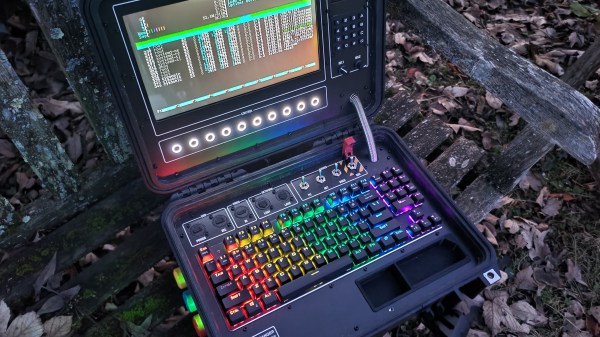
One trend that’s gotten pretty hot lately is the cyberdeck. Finding ways to squeeze a computer into a compact, field-ready package and make it useable is a challenge right off the bat. Adding the suite of sensors and peripherals that have become de rigueur for cyberdecks adds another level of complexity, and taking the build across the finish line with the proper cyberdeck aesthetic makes these gadgets super-fun to build and (hopefully) to use.
If cyberdecks sound like fun, you’re right! And to help us all get onboard the cyberdeck train, we’re going to mix things up with this Hack Chat. Rather than putting one person in the hot seat for our usual AMA-style discussion, we thought it would be fun to get everyone into a chat and brainstorm some cyberdeck designs. And to help seed the discussion, we’ve invited a bunch of hackers whose cyberdeck builds we’ve featured before:
We’re not sure everyone will be able to make it, but we are sure that the more cyberdeck-adjacent people we have in the chat, the better. Whether you’re a veteran builder or just starting your first build, you’re going to want to stop by this Hack Chat and get in on the discussion. Particularly because we’re just kicking off our new Cyberdeck Design Contest in about an hour (spoiler!), and this’ll be a great way to get going!