Ask Hackaday: How Is The Chip Shortage Affecting You?

Some friends of mine are designing a new board around the STM32F103 microcontroller, the commodity ARM chip that you’ll find in numerous projects and on plenty of development boards. When the time came to order the parts for the prototype, they were surprised to find that the usual stockholders don’t have any of these chips in stock, and more surprisingly, even the Chinese pin-compatible clones couldn’t be found. The astute among you may by now have guessed that the culprit behind such a commodity part’s curious lack of availability lies in the global semiconductor shortage.

A perfect storm of political unintended consequences, climate-related crises throttling Taiwanese chip foundries and shutting down those in the USA, and faulty pandemic recovery planning, has left the chipmakers unable to keep up with the demand from industries on the rebound from their COVID-induced slump. Particularly mentioned in this context is the automotive industry, which has seen plants closing for lack of chips and even models ditching digital dashboards for their analogue predecessors.

Chips on order everywhere on the Mouser website.

The fall-out from all this drama in the world’s car factories has filtered down through all levels that depend upon semiconductors; as the carmakers bag every scrap of chip fab capacity that they can, so in turn have other chip customers scrambled to keep their own supply lines in place. A quick scan for microcontrollers through distributors like Mouser or Digi-Key finds pages and pages of lines on back-order or out of stock, with those lines still available being largely either for niche applications, unusual package options, or from extremely outdated product lines. The chances of scoring your chosen chip seem remote and most designers would probably baulk at trying to redesign around an ancient 8-bit part from the 1990s, so what’s to be done?

Such things typically involve commercially sensitive information so we understand not all readers will be able to respond, but we’d like to ask the question: how has the semiconductor shortage affected you? We’ve heard tales of unusual choices being made to ship a product with any microcontroller that works, of hugely overpowered chips replacing commodity devices, and even of specialist systems-on-chip being drafted in to fill the gap. In a few years maybe we’ll feature a teardown whose author wonders why a Bluetooth SoC is present without using the radio functions and with a 50R resistor replacing the antenna, and we’ll recognise it as a desperate measure from an engineer caught up in 2021’s chip shortage.

So tell us your tales from the coalface in the comments below. Are you that desperate engineer scouring the distributors’ stock lists for any microcontroller you can find, or has your chosen device remained in production? Whatever your experience we’d like to know what the real state of the semiconductor market is, so over to you!


IRC Will Never Die

The big kerfuffle in the open source world this week surrounds the biggest IRC server operator, Freenode. Wherever the dust settles, myriad important open source projects use Freenode’s IRC servers for their main channel of user feedback, and a number of vibrant communities call or called Freenode home. What you would call a 3D printer, and most of the software that drives it, for instance, was brainstormed up in Freenode’s #reprap. If you want help with a Linux distribution, you’ll be set straight within a few minutes in the relevant channel, because the people who wrote, packaged, or maintain it are probably on Freenode waiting to chat.

But suppose Freenode burns to the ground tomorrow, as some are suggesting. So what? My take is that is doesn’t matter. Freenode doesn’t own IRC, setting up an IRC server is essentially trivial, and what’s really important is the online community — they can just pick up and move somewhere else with very little hassle.

This is not to say that we don’t all benefit from the diligence that Freenode’s volunteer administrators and operators have donated to the cause over the years. IRC servers don’t run themselves, and Freenode’s admins fought and won an epic battle with spammers a couple years back. Keeping IRC running at scale is a different thing than setting up something for your friends, and so the Freenode folks definitely deserve our thanks.

But look, IRC is an old protocol and it’s a simple protocol. It’s so simple, in fact, that writing an IRC bot is just a few dozen lines in Python, using no external libraries. All you need to do is send plain text over a socket. You can do this — it makes a great networking hello world.

IRC is fun for hackers, but if you want a user-friendly GUI client, you ridiculously many to choose from. There are even no-install web clients if you just want to dip your toes in. Heck, you could install your own server in an hour or so.

So saying that the demise of Freenode is the end of IRC is a lot like saying that the end of Hotmail was the end of e-mail. In the grand scheme of things, almost nobody actually uses IRC — Freenode has 78,000 users while Slack has 10 million — and IRC users are very savvy, if not full-on geeky. These are the sort of people who can probably find the server field in a menu and change it from irc.freenode.net to irc.whatever.org.

In addition to our traditional #hackaday channel on irc.freenode.net, there’s also a channel set up on irc.libera.chat as well. There isn’t much action in either — IRC tends to be a slow conversation, so don’t freak out if someone responds to you an hour later — but if you want to swing by, we’re there. IRC will never die!

2021 Hackaday Prize Begins!

If you missed our announcement, this year’s Hackaday Prize is on! We’ve all had a rough year and a half, and it’s lead a lot of us to think seriously about our world. How would you want to change it going forward? Fifty entrants will rethink, refresh, and rebuild their way into $500, and the Grand Prize is $25,000. Get hacking!

New Part Day: ESP32-WROOM-DA

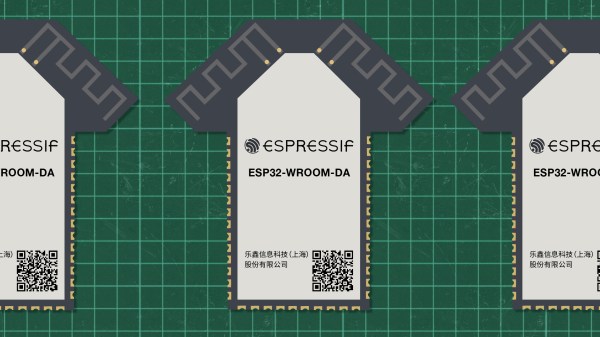
We’re always interested in the latest from the world’s semiconductor industry here at Hackaday, but you might be forgiven for noticing something a little familiar about today’s offering from Espressif. The ESP32-WROOM-DA has more than a passing resemblance to the ESP32-WROOM dual-core-microcontroller-with-WiFi  module that we’ve seen on so many projects over the last few years because it’s a WROOM, but this one comes with a nifty trick to deliver better WiFi connectivity.

The clever WiFi trick comes in the form of a pair of antennas at 90 degrees to each other. It’s a miniaturised version of the arrangement with which you might be familiar from home routers, allowing the device to select whichever antenna gives the best signal at any one time.

We can see that the larger antenna footprint will require some thought in PCB design, but otherwise the module has the same pinout as the existing WROVER. It’s not much of a stretch to imagine it nestled in the corner of a board at 45 degrees, and we’re sure that we’ll see it appearing in projects directly. Anything that enhances the connectivity of what has become the go-to wireless microcontroller on these pages can only be a good thing.

Hackaday Podcast 119: Random Robot Writing, Slithering Snake Shenanigans, And Phased Array Phenomena

Hackaday editors Mike Szczys and Elliot Williams pick up on the neatest hacks you may have missed. We start off with another “What’s that Sound?” so put your geeky-ears to the test and win a Hackaday Podcast T-shirt. Here are a couple of classic hacks to bring you joy: music based on Markov chains, and a squiggly take on the classic Nokia game of snake. For the more hardcore science geeks we dive into the B Meson news coming out of CERN’s physics experiments. And after taking a detour in bristle-bot-based pen plotting, we unpack the hidden system of pipes that carry oil, gas, diesel, and more from the refinery to your region.

Take a look at the links below if you want to follow along, and as always, tell us what you think about this episode in the comments!

Direct download (The best 57 MB you’ll download all day!)

Places to follow Hackaday podcasts:

Continue reading “Hackaday Podcast 119: Random Robot Writing, Slithering Snake Shenanigans, And Phased Array Phenomena”

This Week In Security: Watering Hole Attackception, Ransomware Trick, And More Pipeline News

In what may be a first for watering hole attacks, we’ve now seen an attack that targeted watering holes, or at least water utilities. The way this was discovered is a bit bizarre — it was found by Dragos during an investigation into the February incident at Oldsmar, Florida. A Florida contractor that specializes in water treatment runs a WordPress site that hosted a data-gathering script. The very day that the Oldsmar facility was breached, someone from that location visited the compromised website.

You probably immediately think, as the investigators did, that the visit to the website must be related to the compromise of the Oldsmar treatment plant. The timing is too suspect for it to be a coincidence, right? That’s the thing, the compromised site was only gathering browser fingerprints, seemingly later used to disguise a botnet. The attack itself was likely carried out over Teamviewer. I will note that the primary sources on this story have named Teamviewer, but call it unconfirmed. Assuming that the breach did indeed occur over that platform, then it’s very unlikely that the website visit was a factor, which is what Dragos concluded. On the other hand, it’s easy enough to imagine a scenario where the recorded IP address from the visit led to a port scan and the discovery of a VNC or remote desktop port left open. Continue reading “This Week In Security: Watering Hole Attackception, Ransomware Trick, And More Pipeline News”

Practical Sensors: The Hall Effect

Measuring a magnetic field can be very easy with some pretty low tech, or it can be very high tech. It just depends on what kind of measurement you need and how much effort you want to expend. The very simplest magnetic sensors are reed switches. These are basically relays with no coil. Instead of a coil, an external magnet gets close enough to make or break the contacts in the reed. You see these a lot in, for example, door alarm sensors.

Then again, there’s no real finesse to a reed. It changes state when it sees enough of a magnetic field and that’s about all. You could use a compass with some sort of detection on the needle to get some more information about the field, but not much more. That was, however, how early magnetometers worked. Today, you have lots of options, including the nearly ubiquitous Hall effect sensor.

You might use a Hall effect to measure the magnetic button on a keyboard key coming down when you press it or the open and closed state of a valve. A lot of Hall effects see service as current monitors. Since a coil generates a magnetic field proportional to the current through it, a magnetic sensor can estimate the current in a coil of wire without any physical contact. Hall effects can also watch a magnet go by in a linear motion system or a rotating system to get an idea of position or speed. For example, check out this brushless motor controller that uses three sensors to understand the motor’s position.

History

Edwin Hall identified the effect in 1879. The basic idea is simple: an electrical conductor carrying current will exhibit changes due to an external magnetic field nearby. These changes show up as voltage you measure across the conductor. Normally, the voltage across a conductor will be nearly zero, but with a magnetic field, you’ll get a non-zero reading in proportion to the magnetic field strength in a particular plane, as we’ll see shortly.

Hall effect sensors are just one type of modern magnetometer. There are many different kinds including those that use inductive pickup coils that may or may not rotate or a fluxgate, which is a special type of coil. Some use a scale or a spring to measure force against another magnet — sometimes microscopically. You can even detect a magnetic field using optical properties like the Kerr effect or Faraday rotation.

Continue reading “Practical Sensors: The Hall Effect”

Freenode Debacle Prompts Staff Exodus, New Network

It’s no secret that Internet Relay Chat (IRC) has lost some of its appeal in recent years. These days there’s plenty of free chat platforms boasting slick web interfaces and smartphone push notifications, to say nothing of social networks like Facebook and Twitter. The ability to communicate with like minded individuals from all over the planet in real-time is now something we take for granted, so it’s little surprise that newer and flashier protocols and services have steadily eroded the IRC user base.

But there’s often a hidden cost to using these more modern communication protocols. A lack of operational transparency naturally leads to concerns over monitoring and censorship, which makes such services a poor match for the free and open source community. As such, many open projects have eschewed these newer and more popular services for IRC networks that were developed and maintained by the community itself. Among these, the best-known and most respected is Freenode. Originally started as a Linux support channel in 1995, Freenode grew to become the defacto communication and support tool for free and open source projects of all shapes and sizes, and by 2013 had officially become the largest and most active IRC network in the world.

Unfortunately, the incredible legacy of Freenode is now being jeopardized by what former staff members are describing as nothing short of a hostile takeover. Through a complex series of events which actually started several years ago, control of Freenode has been taken from the community and put into the hands of an enigmatic and wealthy entrepreneur who claims his ultimate goal is to revolutionize IRC and return it to the forefront of online communication. Here’s where it gets weird.

Continue reading “Freenode Debacle Prompts Staff Exodus, New Network”