Blurring is a commonly used visual effect when digitally editing photos and videos. One of the most common blurs used in these fields is the Gaussian blur. You may have used this tool thousands of times without ever giving it greater thought. After all, it does a nice job and does indeed make things blurrier.
Do you ever wonder how much of what we do you could figure out from scratch? Tying your shoe might seem simple now, but kids have trouble mastering the skill, and dreaming it up for the first time is even harder. The same holds true for a lot of technology we use every day. Would you think up the computer mouse or even the computer if they didn’t already exist? Surely, though, one of the simplest and most useful math equations that is fundamental to electronics — Ohm’s law — would be easy to figure out, right? It is often the first thing you learn about electronics, but figuring it out that first time turned out to be quite difficult.
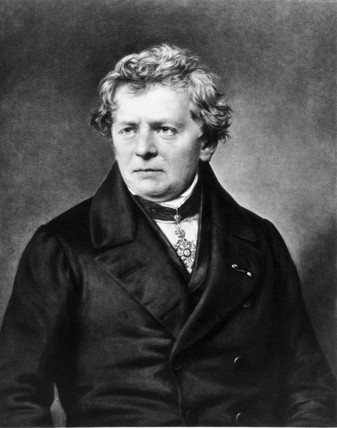
The fellow who discovered the relationship was Georg Ohm, a high school math and physics teacher from Köln. What you might not know is that the first time he published it, he got it wrong. But, lucky for us, he figured out his mistake and was able to correct it.
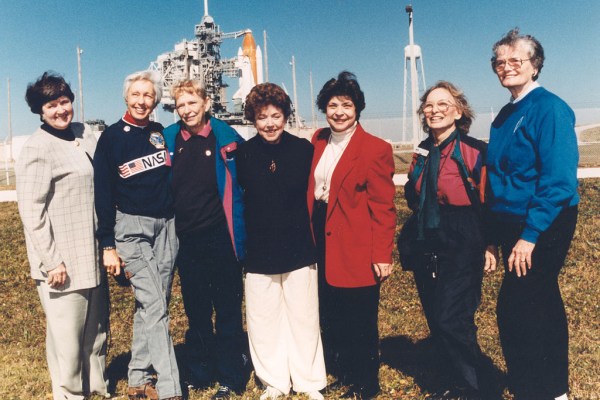
When Mary Wallace “Wally” Funk reached the boundary of space aboard the first crewed flight of Blue Origin’s New Shepard capsule earlier today, it marked the end of a journey she started 60 years ago. In 1961 she became the youngest member of what would later become known as the “Mercury 13”, a group of accomplished female aviators that volunteered to be put through the same physical and mental qualification tests that NASA’s Mercury astronauts went through. But the promising experiment was cut short by the space agency’s rigid requirements for potential astronauts, and what John Glenn referred to in his testimony to the Committee on Science and Astronautics as the “social order” of America at the time.
Beginning right now, the 2021 Hackaday Prize challenges you to Reimagine Supportive Tech. Quite frankly, this is all about shortcuts to success. Can we make it easier for people to learn about science and technology? Can we break down some barriers that keep people from taking up DIY as a hobby (or way of life)? What can we do to build on the experience and skill of one another?
For instance, to get into building your own electronics, you need a huge dedicated electronics lab, right? Of course that’s nonsense, but we only know that because we’ve already been elbow-deep into soldering stations and vacuum tweezers. To the outsider, this looks like an unclimbable mountain. What if I told you that you could build electrics at any desk, and make it easy to store everything away in between hacking sessions? That sounds like a job for [M.Hehr’s] portable workbench & mini lab project. Here’s a blueprint that can take a beginner from zero to solder smoke while having fun along the way.
What about breaking down complex topics into something us newbies can swallow? Radio signals are all around us, but again the barriers to getting into SDR are many and varied. A great bit of supportive tech would be a project that shows simple hardware and shares a virtual machine with the open source software toolchain already set to go. A beginner could pick something like this up and be listening for transponders from airplanes passing by in a matter of hours.
If you’re reading this, chances are you’ve spent countless joyful hours learning how to do some difficult and fascinating stuff. Share the wealth! Take an existing hardware concept and make it modular and easy to use. Refine an existing design to make it more approachable for users with any range of mobility challenges. Or pull together a beginner-friendly project to move STEM education forward.
Ten finalists from this round will win $500 and be shuttled onto the final round judging in October for a chance at the $25,000 Hackaday Prize and four other top prizes. Start your project page on Hackaday.io and use the dropdown in the left sidebar to enter it into the 2021 Hackaday Prize.
When writing code for a new hardware platform, the last thing you want to do is bother with the minutiae of I/O routines, string handling and other similarly tedious details that have nothing to do with the actual project. On bigger systems, this is where the C standard library would traditionally come into play.
For small embedded platforms like microcontrollers, resources are often tight enough that a full-blown stdlib won’t fit, which is why Newlib exists: to bring the portability benefits of a standard library to microcontrollers.
Whether you use C, C++ or MicroPython to program an MCU, Newlib is likely there under the hood. Yet how exactly does it integrate with the hardware, and how are system calls (syscalls) for e.g. file and input/output handling implemented? Continue reading “The Newlib Embedded C Standard Library And How To Use It”→
Just a few weeks before Atlantis embarked on the final flight of the Space Shuttle program in 2011, a small Mexican company by the name of Squad quietly released Kerbal Space Program (KSP) onto an unsuspecting world. Until that point the company had only developed websites and multi-media installations. Kerbal wasn’t even an official company initiative, it started as a side project by one of their employees, Felipe Falanghe. The sandbox game allowed players to cobble together rockets from an inventory of modular components and attempt to put them into orbit around the planet Kerbin. It was immediately addictive.
There was no story to follow, or enemies to battle. The closest thing to a score counter was the altimeter that showed how far your craft was above the planet’s surface, and the only way to “win” was to put its little green occupant, the titular Kerbal, back on the ground in one piece. The game’s challenge came not from puzzles or scripted events, but from the game’s accurate (if slightly simplified) application of orbital mechanics and Newtonian dynamics. Building a rocket and getting it into orbit in KSP isn’t difficult because the developers baked some arbitrary limitations into their virtual world; the game is hard for the same reasons putting a rocket into orbit around the Earth is hard.
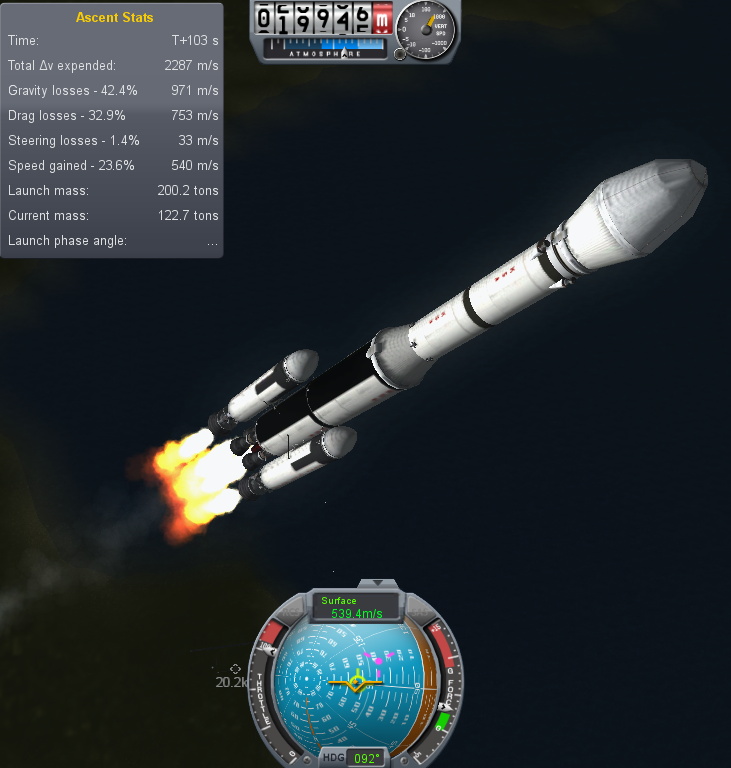
One of my early rockets, circa 2013.
Over the years official updates added new components for players to build with and planets to explore, and an incredible array of community developed add-ons and modifications expanded the scope of the game even further. KSP would go on to be played by millions, and seeing a valuable opportunity to connect with future engineers, both NASA and the ESA helped develop expansions for the game that allowed players to recreate their real-world vehicles and missions.
But now after a decade of continuous development, with ports to multiple operating systems and game consoles, Squad is bringing this chapter of the KSP adventure to a close. To celebrate the game’s 10th anniversary on June 24th, they released “On Final Approach”, the game’s last official update. Attention will now be focused on the game’s ambitious sequel, which will expand the basic formula with the addition of interstellar travel and planetary colonies, currently slated for release in 2022.
Of course, this isn’t the end. Millions of “classic” KSP players will still be slinging their Kerbals into Hohmann transfer orbits for years to come, and the talented community of mod developers will undoubtedly help keep the game fresh with unofficial updates. But the end of official support is a major turning point, and it seems a perfect time to reminisce on the impact this revolutionary game has had on the engineering and space communities.
Hackaday editors Mike Szczys and Elliot Williams help you get caught up on a week of wonder hacks. We don’t remember seeing a floppy drive headline the demoscene, but sure enough, there’s a C64 demo that performs after the computer is disconnected. What causes bench tools to have unreliable measurements? Sometimes a poor crystal choice lets AC ruin the party. We dive into the ongoing saga of the Audacity open source project’s change of ownership, and talk about generator exciter circuits — specifically their role in starting grid-scale generators from shutdown.
Take a look at the links below if you want to follow along, and as always, tell us what you think about this episode in the comments!