Hackaday editors Mike Szczys and Elliot Williams recap a week of great hacks. You won’t want to miss the dynamometer Leo Fernekes built to measure the power output of his Sterling engine, which is also DIY. In this age of lithium-powered multirotors, it’s nice to step back and appreciate a hand-built rubberband-powered ornithopter.
We have a surprising amount to say about Python’s addition of the match statement (not be be confused with switch statements). And when it comes to electromechanical synth gear, it’s hard to beat a spinning tape-head sequencer.
Take a look at the links below if you want to follow along, and as always, tell us what you think about this episode in the comments!
Twitch Plays Pokemon burst onto the then nascent livestreaming scene back in 2014, letting Twitch viewers take command of a Game Boy emulator running Pokemon Red via simple chat commands. Since then, the same concept has been applied to everything under the sun. Other video games, installing Linux, and even trading on the New York Stock Exchange have all been gameified through Twitch chat.
TwitchPlaysPokemon started a craze in crowdsourced control of video games, robots, and just about everything else.
You, thirsty reader, are wondering how you can get a slice of this delicious action. Fear not, for with a bit of ramshackle code, you can let Twitch chat take over pretty much anything in, on, or around your computer.
It’s Just IRC
The great thing about Twitch chat is that it runs on vanilla IRC (Internet Relay Chat). The protocol has been around forever, and libraries exist to make interfacing easy. Just like the original streamer behind Twitch Plays Pokemon, we’re going to use Python because it’s great for fun little experiments like these. With that said, any language will do fine — just apply the same techniques in the relevant syntax.
SimpleTwitchCommander, as I’ve named it on Github, assumes some familiarity with basic Python programming. The code will allow you to take commands from chat in two ways. Commands from chat can be tabulated, and only the one with the most votes executed, or every single command can be acted on directly. Actually getting this code to control your robot, video game, or pet viper is up to you. What we’re doing here is interfacing with Twitch chat and pulling out commands so you can make it do whatever you like. With that said, for this example, we’ve set up the code to parse commands for a simple wheeled robot. Let’s dive in.
A few weeks back we brought word that Reddit users [derekcz] and [Xerbot] had managed to receive the 2232.5 MHz telemetry downlink from a Falcon 9 upper stage and pull out some interesting plain-text strings. With further software fiddling, the vehicle’s video streams were decoded, resulting in some absolutely breathtaking shots of the rocket and its payload from low Earth orbit.
Since this data has apparently been broadcast out in the clear for nearly a decade before anyone on the ground noticed, it’s easy to see this as an overreaction. After all, what’s the harm in a few geeks with hacked together antennas getting a peek at a stack of Starlink satellites? [derekcz] even mused that allowing hobbyists to capture these space views might earn the company some positive buzz, something Elon Musk never seems to get enough of.
Some of the images [derekcz] was able to capture from the Falcon 9
On the other hand, we know that SpaceX is actively pursuing more lucrative national security launch contracts for both the Falcon 9 and Falcon Heavy. For these sensitive government payloads, the normal on-screen telemetry data and space views are omitted from the company’s official live streams. It seems likely the Pentagon would be very interested in finding out how civilians were able to obtain this information, and a guarantee from SpaceX that the link would be encrypted for all future flights could have helped smooth things over.
When I started writing this, there was a container ship stuck in the Suez canal that had been blocking it for days. Just like that, a vital passage became completely clogged, halting the shipping schedule of everything from oil and weapons to ESP8266 boards and high-waist jeans. The incident really highlights the fragility of the whole intermodal system and makes us wonder if anything will change.
A rainbow of dry storage containers. Image via xChange
Setting the Standard
We are all used to seeing the standard shipping container that’s either a 10′, 20′, or 40′ long box made of steel or aluminum with doors on one end. These are by far the most common type, and are probably what come to mind whenever shipping containers are mentioned.
These are called dry storage containers, and per ISO container standards, they are all 8′ wide and 8′ 6″ tall. There are also ‘high cube’ containers that are a foot taller, but otherwise share the same dimensions. Many of these containers end up as some type of housing, either as stylish studios, post-disaster survivalist shelters, or construction site offices. As the pandemic wears on, they have become so much in demand that prices have surged in the last few months.
Although Malcom McLean did not invent container shipping, the strict containerization standards that followed in his wake prevent issues during stacking, shipping, and storing, and allow any container to be handled safely at any port in the world, or load onto any rail car with ease. Every bit of the container is standardized, from the dimensions to the way the container’s information is displayed on the end. At most, the difference between any two otherwise identical containers is the number, the paint job, and maybe a few millimeters in one dimension.
Standard as they may be, these containers don’t work for every type of cargo. There are quite a few more types of shipping containers out there that serve different needs. Let’s take a look at some of them, shall we?
One of the joys of an itinerant existence comes in periodically being reunited with the fruits of various orders that were sent to hackerspaces or friends somewhere along the way. These anonymous parcels from afar hold an assortment of wonders, with the added element of anticipation that comes from forgetting exactly what had been ordered.
So it is with today’s subject, a Mustool MT525 electromagnetic radiation tester. At a cost not far above £10 ($13.70), this was an impulse purchase driven by curiosity; these devices claim to measure both magnetic and electric fields, but what do they really measure? My interest in these matters lies in the direction of radio, but I have never examined such an instrument. Time to subject it to the Hackaday treatment.
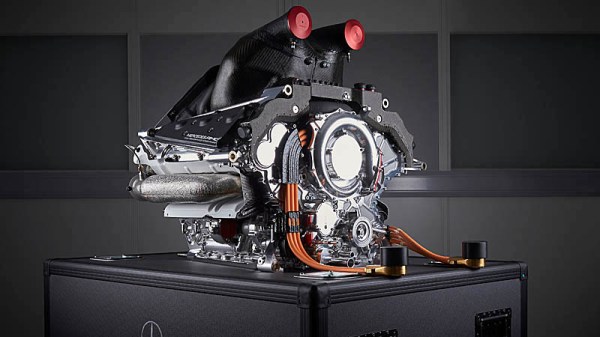
In 2014, Formula 1 switched away from V8 engines, electing instead to mandate all teams race with turbocharged V6 engines of 1.6 litres displacement, fitted with advanced energy recovery systems. The aim was to return Formula 1 to having some vague notion of relevance to modern road car technologies, with a strong focus on efficiency. This was achieved by mandating maximum fuel consumption for races, as well as placing a heavy emphasis on hybrid technology.
The Mercedes W05 Hybrid was the first of 7 championship-winning F1 cars from the British-based, German-funded team. It quickly showed the value of the team’s split-turbo technology.
Since then, Mercedes have dominated the field in what is now known as the turbo-hybrid era. The German team has taken home every drivers and constructors championship since, often taking home the crown well before the season is over. Much has been made of the team’s engine as a key part of this dominance, widely considered to be more powerful and efficient than the competition at all but a few select races in the last seven years, and much of the credit goes to the company’s innovative split-turbo system. Today, we’ll explore why the innovation was such a game changer in Formula 1.
IBM has come up with an automatic debating system called Project Debater that researches a topic, presents an argument, listens to a human rebuttal and formulates its own rebuttal. But does it pass the Turing test? Or does the Turing test matter anymore?
The Turing test was first introduced in 1950, often cited as year-one for AI research. It asks, “Can machines think?”. Today we’re more interested in machines that can intelligently make restaurant recommendations, drive our car along the tedious highway to and from work, or identify the surprising looking flower we just stumbled upon. These all fit the definition of AI as a machine that can perform a task normally requiring the intelligence of a human. Though as you’ll see below, Turing’s test wasn’t even for intelligence or even for thinking, but rather to determine a test subject’s sex.