Linux Fu: VPN For Free With SSH

If you see a lot of banner ads on certain websites, you know that without a Virtual Private Network (VPN), hackers will quickly ravage your computer and burn down your house. Well, that seems to be what they imply. In reality, though, there are two main reasons you might want a VPN connection. You can pay for a service, of course, but if you have ssh access to a computer somewhere on the public Internet, you can set up your own VPN service for no additional cost.

The basic idea is that you connect to a remote computer on another network and it makes it look like all your network traffic is local to that network. The first case for this is to sidestep or enhance security. For example, you might want to print to a network printer without exposing that printer to the public Internet. While you are at the coffee shop you can VPN to your network and print just like you were a meter away from the printer at your desk. Your traffic on the shop’s WiFi will also be encrypted.

The second reason is to hide your location from snooping. For example, if you like watching the BBC videos but you live in Ecuador, you might want to VPN to a network in the UK so the videos are not blocked. If your local authorities monitor and censor your Internet, you might also want your traffic coming from somewhere else.

Continue reading “Linux Fu: VPN For Free With SSH”

The Cost Of Moving Atoms In Space; Unpacking The Dubious Claims Of A $10 Quintillion Space Asteroid

The rest of the media were reporting on an asteroid named 16 Psyche last month worth $10 quintillion. Oddly enough they reported in July 2019 and again in February 2018 that the same asteroid was worth $700 quintillion, so it seems the space rock market is similar to cryptocurrency in its wild speculation. Those numbers are ridiculous, but it had us thinking about the economies of space transportation, and what atoms are worth based on where they are. Let’s break down how gravity wells, distance, and arbitrage work to figure out how much of this $10-$700 quintillion we can leverage for ourselves.

The value assigned to everything has to do with where a thing is, AND how much someone needs that thing to be somewhere else. If they need it in a different place, someone must pay for the transportation of it.

In international (and interplanetary) trade, this is where Incoterms come in. These are the terms used to describe who pays for and has responsibility for the goods between where they are and where they need to be. In this case, all those materials are sitting on an asteroid, and someone has to pay for all the transport and insurance and duties. Note that on the asteroid these materials need to be mined and refined as well; they’re not just sitting in a box on some space dock. On the other end of the spectrum, order something from Amazon and it’s Amazon that takes care of everything until it’s dropped on your doorstep. The buyer is paying for shipping either way; it’s just a matter of whether that cost is built into the price or handled separately. Another important term is arbitrage, which is the practice of taking a thing from one market and selling it in a different market at a higher price. In this case the two markets are Earth and space.

Continue reading “The Cost Of Moving Atoms In Space; Unpacking The Dubious Claims Of A $10 Quintillion Space Asteroid”

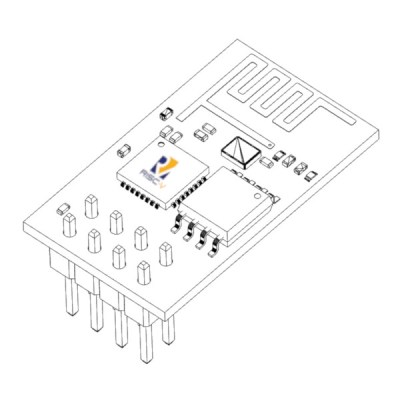
Espressif Leaks ESP32-C3: A WiFi SoC That’s RISC-V And Is ESP8266 Pin-Compatible

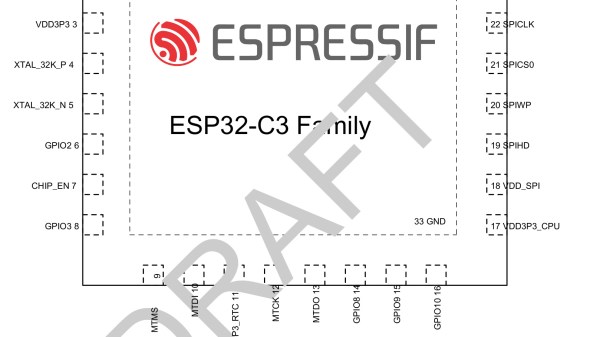
Six years on from the emergence of the Espressif ESP8266 we might believe that the focus had shifted to the newer dual-core ESP32. But here comes a twist in the form of the newly-revealed ESP32-C3. It’s a WiFi SoC that despite its ESP32 name contains a RISC-V core in place of the Tensilica core in the ESP32s we know, and uses the ESP8266 pin-out rather than that of its newer sibling. There’s relatively little information about it at the time of writing, but CNX Software have gathered together what there is including a draft datasheet whose English translation is available as a Mega download. As with other ESP32 family members, this one delivers b/g/n WiFi and Bluetooth Low-Energy (BLE) 5, where it differs is the RISC-V 32 Single-core processor with a clock speed of up to 160 MHz. There is 400 kB of SRAM and 384 kB ROM storage space built in.

While there is no official announcement yet, Espressif has been dropping hints. There’s been an OpenOCD configuration file for it in the Espressif repositories since the end of last month. And on Friday, Espressif Software Engineering Manager [Sprite_tm] answered a reddit comment, confirming the RISC-V core.

ESP-01: Kjerish, CC BY-SA 4.0, RISC-V logo: RISC-V foundation, Public domain.

Why they are releasing the part as an ESP32 rather than giving it a series number of its own remains a mystery, but it’s not hard to see why it makes commercial sense to create it in an ESP8266-compatible footprint. The arrival of competing parts in the cheap wireless SoC space such as the Bouffalo Labs BL602 we mentioned recently is likely to be eating into sales of the six-year-old chip, so an upgrade path to a more capable part with minimal new hardware design requirements could be a powerful incentive for large customers to stay with Espressif.

We’re left to guess on how exactly the rollout will proceed. We expect to see similar developer support to that they now provide for their other chips, and then ESP32-C3 powered versions of existing ESP8266 boards in short order. It’s also to be hoped that a standard RISC-V toolchain could be used instead of the device-specific ones for current Espressif offerings. What we should not expect are open-source replacements for the blobs that drive the on-board peripherals, as the new chip will share the same closed-source IP as its predecessors for them. Perhaps if the PINE64 initiative to reverse engineer blobs for the BL602 bears fruit, we might see a similar effort for this chip.

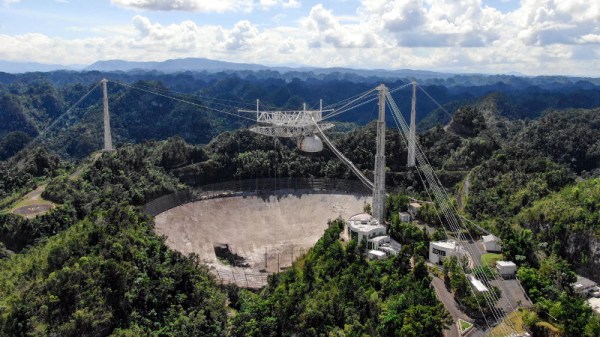
The Battle For Arecibo Has Been Lost

It is with a heavy heart that we must report the National Science Foundation (NSF) has decided to dismantle the Arecibo Observatory. Following the failure of two support cables, engineers have determined the structure is on the verge of collapse and that the necessary repairs would be too expensive and dangerous to conduct. At the same time, allowing the structure to collapse on its own would endanger nearby facilities and surely destroy the valuable research equipment suspended high above the 300 meter dish. Through controlled demolition, the NSF hopes to preserve as much of the facility and its hardware as possible.

Section of the Arecibo Message

When the first support cable broke free back in August, we worried about what it meant for the future of this unique astronomical observatory. Brought online in 1963 as part of a Cold War project to study how ICBMs behaved in Earth’s upper atmosphere, the massive radio telescope is unique in that it has the ability to transmit as well as receive. This capability has been used to produce radar maps of distant celestial objects and detect potentially hazardous near-Earth asteroids.

In 1974, it was even used to broadcast the goodwill of humankind to any intelligent lifeforms that might be listening. Known as the “Arecibo Message”, the transmission can be decoded to reveal an assortment of pictograms that convey everything from the atomic numbers of common elements to the shape of the human body. The final icon in the series was a simple diagram of Arecibo itself, so that anyone who intercepted the message would have an idea of how such a relatively primitive species had managed to reach out and touch the stars.

There is no replacement for the Arecibo Observatory, nor is there likely to be one in the near future. The Five hundred meter Aperture Spherical Telescope (FAST) in China is larger than Arecibo, but doesn’t have the crucial transmission capability. The Goldstone Deep Space Communications Complex in California can transmit, but as it’s primarily concerned with communicating with distant spacecraft, there’s little free time to engage in scientific observations. Even when it’s available for research, the largest dish in the Goldstone array is only 1/4 the diameter of the reflector at Arecibo.

Just last week we wondered aloud whether a nearly 60 year old radio telescope was still worth saving given the incredible advancements in technology that have been made in the intervening years. Now, unfortunately, we have our answer.

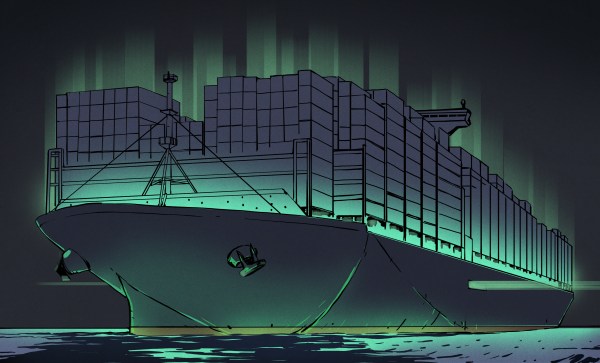
The Shipping Industry’s Transition To Atomic Power And Faster Deliveries

The transport of goods with cargo ships and especially container ships is the backbone of today’s economies, with about 90% of non-bulk cargo transported with them. This is in addition to the large number of oil tankers and LNG carriers. Unfortunately, due to their use of diesel engines they are also responsible for about 3.5% of the world’s CO2 emissions, in addition to 18 – 30% of nitrogen oxide and 9% of sulfur oxides.

Although the switch to low-sulfur diesel (ULSD) and the use of speed limits has reduced some of these pollutants, the shipping industry sees itself faced with the necessity to decarbonize in order to meet the obligations of the Paris Agreement. This essentially means finding a way to switch from diesel engines to an alternative which has comparable or better fuel costs, produces no or almost no pollutants and will not negatively affect logistics.

As a highly competitive, cut-throat industry, this does seem to leave shipping companies backed up againstĀ  a wall. Yet an existing, proven technology just so happens to exist already which can be retrofitted into existing cargo ships. Continue reading “The Shipping Industry’s Transition To Atomic Power And Faster Deliveries”

Larry Berg And The Purple Open Passion Project

It all started with an 88-ton Arburg RP300 injection molding machine in the basement, and a bit of inattention. Larry Berg wanted a couple custom plastic plugs for his Garmin GPS, so he milled out a mold and ran a few. But he got distracted, and came back an hour later to find that his machine had made 400. Instead of throwing them away, he mailed them away for free, but then he found that people started throwing money at him to make more. People all over the world.

This is how the Purple Open Project turned into an global network of GPS geeks, selling molded alternatives to the oddball Garmin plugs for pledges to pay an unspecified amount, and ended up producing over 350,000 plugs over 16 years before he passed away in 2012. This is the story of a hacker’s hacker, who wanted to be able to connect his GPS to his computer and use it the way he wanted, and accidentally created an international business.

Continue reading “Larry Berg And The Purple Open Passion Project”

How To Get Into Cars: Offroading Mods

While plenty of automotive enthusiasts are all about carving corners at the local track days, it’s a special breed that leaves tarmac behind for the dusty trail ahead. If your chosen ride is of the four-wheelin’ variety, here’s how you can modify it to dominate the dirt and mud.

Handling The Terrain

Building a good offroad rig requires a very different focus than building a car for street performance. A screaming high-performance engine is of no use when your tires are spinning in the air because you’re stuck in deep sand or on top of a pointy rock. Instead, four wheelers are concerned with a whole different set of parameters. Ground clearance is key to getting over obstacles without getting stuck, and good articulation is key to keeping your wheels on the ground and pushing you forward in deep ruts and on crazy angles. You’ll also want plenty of low-down torque, and tyres that can grip up in all conditions without snagging a puncture. It’s a whole different ballgame, so read on!

Continue reading “How To Get Into Cars: Offroading Mods”