Hands-On: The Pandemic DEF CON Badge Is An Audio Cassette

My DEF CON Safe Mode badge just arrived in the mail this afternoon. The Vegas-based conference which normally hosts around 30,000 attendees every year has moved online in response to the global pandemic, and the virtual event spins up August 6-9. Known for creative badges, North America’s most well-known infosec con has a tick-tock cycle that alternates electronic and non-electronic badges from year to year. During this off-year, the badge is an obscure deprecated media: the audio cassette.

This choice harkens back to the DEF CON 23 badge which was an vinyl record — I have the same problem I did back in 2015… I lack access to playback this archaic medium. Luckily [Grifter] pointed everyone to a dump of the audio contents over at Internet Archive, although knowing how competitive the badge hacking for DEF CON is, I’m skeptical about the reliability of these files. Your best bet is to pull the dust cover off your ’88 Camry and let your own cassette roll in the tape deck. I also wonder if there are different versions of the tape.

But enough speculation, let’s look at what physically comes with the DEF CON 28 badge.

Continue reading “Hands-On: The Pandemic DEF CON Badge Is An Audio Cassette”

Liquid Air Energy Storage: A Power Grid Battery Using Regular Old Ambient Air

When you think of renewable energy, what comes to mind? We’d venture to guess that wind and solar are probably near the top of the list. And yes, wind and solar are great as long as the winds are favorable and the sun is shining. But what about all those short and bleak winter days? Rainy days? Night time?

Render of a Highview LAES plant. The air is cleaned, liquefied in the tower, and stored in the white tanks. The blue tanks hold waste cold which is reused in the liquefaction process. Image via Highview Power

Unfavorable conditions mean that storage is an important part of any viable solution that uses renewable energy. Either the energy itself has to be stored, or else the means to produce the energy on demand must be stored.

One possible answer has been right under our noses all along — air. Regular old ambient air can be cooled and compressed into a liquid, stored in tanks, and then reheated to its gaseous state to do work.

This technology is called Cryogenic Energy Storage (CES) or Liquid Air Energy storage (LAES). It’s a fairly new energy scheme that was first developed a decade ago by UK inventor Peter Dearman as a car engine. More recently, the technology has been re-imagined as power grid storage.

UK utility Highview Power have adopted the technology and are putting it to the test all over the world. They have just begun construction on the world’s largest liquid air battery plant, which will use off-peak energy to charge an ambient air liquifier, and then store the liquid air, re-gasifying it as needed to generate power via a turbine. The turbine will only be used to generate electricity during peak usage. By itself, the LAES process is not terribly efficient, but the system offsets this by capturing waste heat and cold from the process and reusing it. The biggest upside is that the only exhaust is plain, breathable air.

Continue reading “Liquid Air Energy Storage: A Power Grid Battery Using Regular Old Ambient Air”

This Week In Security: Iran’s ITG18, ProcMon For Linux, And Garbage Collection Fail

Even top-tier security professionals make catastrophic mistakes, and this time it was the operators at Iran’s ITG18. We’re once again talking about the strange shadowy world of state sponsored hacking. This story comes from the IBM X-Force Incident Response Intelligence Services (IRIS). I suspect a Deadpool fan must work at IBM, but that’s beside the point.

A server suspected to be used by ITG18 was incorrectly configured, and when data and training videos were stored there, that data was publicly accessible. Among the captured data was records of compromised accounts belonging to US and Greek military personnel.

The training videos also contained a few interesting tidbits. If a targeted account used two factor authentication, the attacker was to make a note and give up on gaining access to that account. If a Google account was breached, the practice was to start with Google Takeout, the service from Google that allows downloading all the data Google has collected related to that account. Yoiks. Continue reading “This Week In Security: Iran’s ITG18, ProcMon For Linux, And Garbage Collection Fail”

Jan Czochralski And The Silicon Revolution

If you were to travel back in time to the turn of the previous century and try to convince the average person that the grains of sand on just about any beach would be the basis of an industry worth hundreds of billions of dollars within 100 years, they’d probably have thought you were crazy. Aside from being coarse, rough, and irritating, sand is everywhere, and convincing anyone of its value would be a hard sell, unless your interlocutor was a real estate visionary with an appreciation of the future value of seaside property and a lot of patience.

Fast forward to our time, and we all know the value of the material that comes from common quartz sand: silicon, specifically the ultra-purified crystals of silicon that end up as the wafers we depend on to build the circuitry of life. The trip from beach to chip foundry is a long and non-obvious one which would not have been possible without the insights of an undistinguished Polish student and one-time druggist who discovered the process that made the Information Age possible: Jan Czochralski.

Continue reading “Jan Czochralski And The Silicon Revolution”

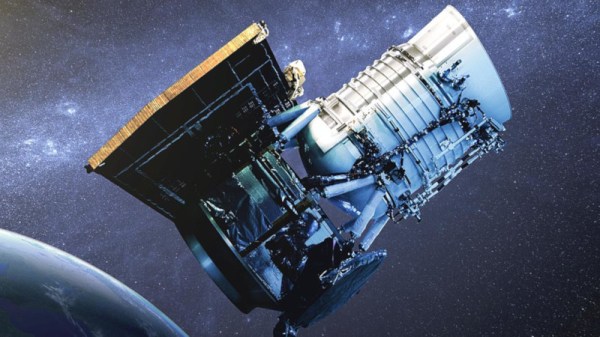
The WISE In NEOWISE: How A Hibernating Satellite Awoke To Discover The Comet

Over the last few weeks the media has been full of talk about NEOWISE, one of the brightest and most spectacular comets to ever pass through our solar system that you can still see if you hurry. While the excitement over this interstellar traveler is more than justified, it’s also an excellent opportunity to celebrate the Wide-field Infrared Survey Explorer (WISE) space telescope it was named after. The discovery of this particular comet is just the latest triumph in the orbiting observatory’s incredible mission of discovery that’s spanned over a decade, with no signs of slowing down anytime soon.

In fact, WISE has been operational for so long now that its mission has evolved beyond its original scope. When it was launched in December 2009 from California’s Vandenberg Air Force Base, its primary mission was scheduled to be completed in less than a year. But like many NASA spacecraft that came before it, WISE achieved its original design goals and found itself ready for a new challenge. Though not before it spent almost three years in hibernation mode as the agency decided what to do with it.

Continue reading “The WISE In NEOWISE: How A Hibernating Satellite Awoke To Discover The Comet”

Beyond Printf(): Better Logging Practices For Faster Debugging

All of us who do some programming know that logging is a time-tested way to output messages about the internal state of our code. With varying degrees of adjustable granularity, these messages allow us to keep track of not only the state of the application, but also its overall health. When things do end up going FUBAR, these log messages are usually the first thing we look at as a software equivalent of a Flight Data Recorder in an airplane.

Spending some time and care in not only designing the logging system, but also in deciding what should be logged and at what level, can make our future self appreciate life a lot more. We’re all familiar with the practice of ‘printf-debugging’, where logging is added as part of the usual post-crash autopsy as one tries to figure out what exactly went wrong. It’s one way of doing it, and eventually it works, but we can do much better.

People are lazy, and you’re only going to stick to good logging practices if they are at least as easy if not easier than sprinkling printf() statement throughout the code. Yet at the same time we want to be able to handle things like log levels and newlines without too much extra typing. The most successful logging libraries are built with this

Continue reading “Beyond Printf(): Better Logging Practices For Faster Debugging”

Window In The Skies: Why Everyone Is Going To Mars This Month

Mars may not be the kind of place to raise your kids, but chances are that one day [Elton John]’s famous lyrics will be wrong about there being no one there to raise them. For now, however, we have probes, orbiters, and landers. Mars missions are going strong this year, with three nations about to launch their rockets towards the Red Planet: the United States sending their Perseverance rover, China’s Tianwen-1 mission, and the United Arab Emirates sending their Hope orbiter.

As all of this is planned to happen still within the month of July, it almost gives the impression of a new era of wild space races where everyone tries to be first. Sure, some egos will certainly be boosted here, but the reason for this increased run within such a short time frame has a simple explanation: Mars will be right around the corner later this year — relatively speaking — providing an ideal opportunity to travel there right now.

In fact, this year is as good as it gets for quite a while. The next time the circumstances will be (almost) as favorable as this year is going to be in 2033, so it’s understandable that space agencies are eager to not miss out on this chance. Not that Mars missions couldn’t be accomplished in the next 13 years — after all, several endeavors are already in the wings for 2022, including the delayed Rosalind Franklin rover launch. It’s just that the circumstances won’t be as ideal.

But what exactly does that mean, and why is that? What makes July 2020 so special? And what’s everyone doing up there anyway? Well, let’s find out!

Continue reading “Window In The Skies: Why Everyone Is Going To Mars This Month”